
Am I Spoiled Quiz
How the Scales are Structured
Who Usually Takes This Test?
See How You Compare
Below is a preview of how scores are typically distributed across each scale.
Example Questions From the Test
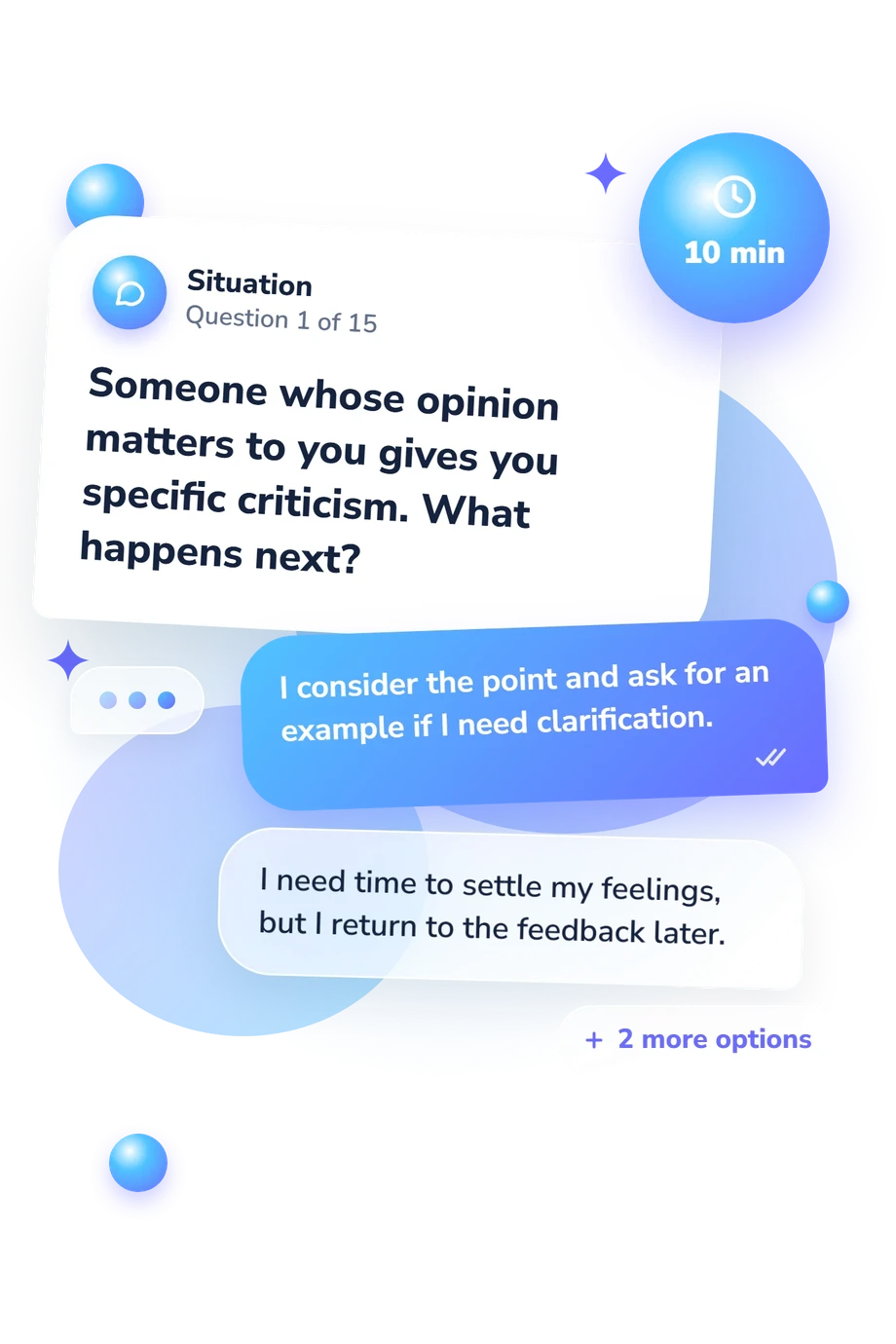
- I consider the point and ask for an example if I need clarification.
- I need time to settle my feelings, but I return to the feedback later.
- I defend myself at first, though I may reflect on it once the conversation is over.
- I dismiss the criticism as jealousy, bias, or unfairness without examining it.
- I should meet the same core requirements as everyone else.
- Using a connection for advice or an introduction is reasonable, but I should still qualify.
- A connection should be able to secure some exceptions to the requirements.
- My background or connections should give me access even if other applicants are stronger.
- Replace it or add it to the shared list without waiting for someone else to notice.
- Mention it and agree with the others on who will replace it.
- Wait until someone asks me to handle it.
- Leave it for whoever cares most about keeping it stocked.
Am I Spoiled Quiz - Description and methodology of the test
People who want to examine their own reactions in difficult social situations can use the Am I Spoiled Quiz as a structured self-reflection exercise. It may help distinguish occasional frustration from recurring expectations that others should accommodate them. Readers wondering whether their reactions suggest spoiled or entitled habits can use it as an are-you-spoiled quiz to identify patterns they may want to change.
What This Assessment Explores
A parent may use the result as a discussion prompt, but the respondent evaluates their own conduct rather than treating it as a quiz asking whether my child is spoiled. The prompts focus on criticism, limits, disappointment, shared duties, gratitude, and expectations of priority. The profile identifies situations in which particular reactions may recur, helping the respondent notice habits they may wish to examine.
The three result dimensions are:
- Adaptability and Accountability (0-15) shows how you respond to criticism, limits, and mistakes: Steady adjustment (0-5), Situational reactivity (6-10), or Frequent resistance (11-15).
- Expectations of Special Treatment (0-15) reflects whether priority, exceptions, or elevated standards feel deserved: Grounded expectations (0-5), Selective privilege (6-10), or Strong special-treatment expectations (11-15).
- Reciprocity and Appreciation (0-15) indicates how consistently you recognize and return effort: Mutual regard (0-5), Inconsistent reciprocity (6-10), or One-sided habits (11-15).
Methodology and Evidence Base
Each item presents an everyday situation with four ordered response options. Choices move from flexible, accountable reactions toward defensiveness, demands for exception, or disregard for mutual obligations. Answers feed the three dimensions, but the questionnaire does not state how many points each option contributes; use the displayed ranges and bands rather than an invented formula.
A quiz asking whether I am a spoiled brat may feel blunt, yet the prompts examine conduct rather than assign a permanent label. Conceptually, the themes are closest to McIntosh (1989) and also align with Campbell et al. (2004) on psychological entitlement and Lange et al. (2019) on status-seeking entitlement. These works provide comparison and theory; this questionnaire is not presented as an adaptation or standardized administration of their instruments.
A parent may use its themes as a prompt for discussion with a child, but the result is more than a spoiled child quiz: the score still belongs to the respondent. Because responses are self-reported, current mood, self-awareness, and context may influence the profile; the displayed bands are reflective summaries rather than clinical classifications.
- McIntosh, B. J. (1989). Spoiled Child Syndrome. Pediatrics, 83(1), 108-115. 10.1542/peds.83.1.108
- Campbell, W. K., Bonacci, A. M., Shelton, J., Exline, J. J., & Bushman, B. J. (2004). Psychological Entitlement: Interpersonal Consequences and Validation of a Self-Report Measure. Journal of Personality Assessment, 83(1), 29-45. 10.1207/s15327752jpa8301_04
- Lange, J., Redford, L., & Crusius, J. (2019). A Status-Seeking Account of Psychological Entitlement. Personality and Social Psychology Bulletin, 45(7), 1113-1128. 10.1177/0146167218808501
Updated: