
Motorcycle Quiz
How the Scales are Structured
Who Usually Takes This Test?
See How You Compare
Below is a preview of how scores are typically distributed across each scale.
Example Questions From the Test
- The lever by the left handgrip
- The lever by the right handgrip
- The pedal by the left foot
- The gearshift lever
- The pedal near the right foot
- The left-hand lever
- The pedal near the left foot
- The engine stop switch
- Keep both arms rigid and steer only by shifting your hips
- Press forward gently on the left handgrip
- Turn the handlebars sharply left and hold them there
- Press forward gently on the right handgrip
Motorcycle Quiz - Description and methodology of the test
Riders who want to check whether their everyday knowledge supports safer decisions can use this motorcycle quiz as a focused review. It is a compact check of motorcycle safety knowledge for beginners, returning riders, and motorcyclists preparing for further instruction. The result indicates an overall level of motorcycle knowledge, while the topics can help you choose whether to review control knowledge, hazard decisions, equipment awareness, or maintenance knowledge.
What This Assessment Explores
Questions cover basic riding decisions, not personality, preference, or motorcycle shopping. As a motorcycle knowledge test, the questionnaire identifies study priorities across controls, hazards, equipment, passengers, impairment, and mechanical concerns.
The items fall into three practical areas:
- Controls and handling show whether the rider recognizes safe braking, steering, cornering, and load effects.
- Hazard strategy reflects choices around blind areas, swerving, rail crossings, loose surfaces, and following distance.
- Equipment, condition, and maintenance cover helmet fit, impairment, weather, tire pressure, chain care, leaks, ABS, and controls.
Motorcycle Knowledge runs from 0-16. Foundations to build is 0-6, Developing knowledge is 7-12, and Strong basics knowledge is 13-16. The bands describe tested knowledge, not physical skill or guaranteed safety.
Methodology and Evidence Base
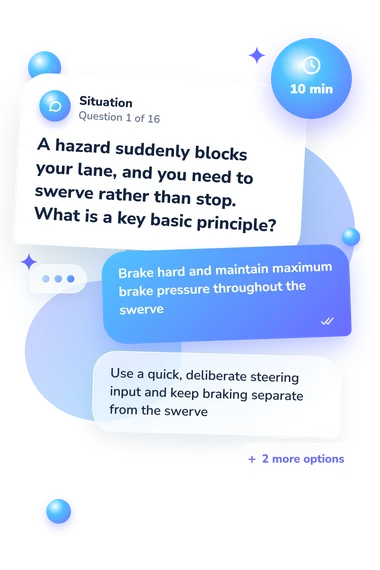
Each item uses a short factual or situational prompt with four answer choices. The respondent selects the best option, so the format tests recognition and decision knowledge rather than a personal narrative. Topics include tire pressure, swerving, curves, passenger loading, controls, blind zones, ABS, rail crossings, alcohol, helmets, loose surfaces, leaks, steering, and wet-weather spacing.
The questionnaire does not state a separate weighting formula, so the displayed result summarizes performance across the tested items rather than riding skill or crash probability.
The content is conceptually consistent with Dewar et al. (2013), MSF's Basic RiderCourse handbook, and NHTSA's model entry-level standards. The sources emphasize pre-ride checks, control operation, hazard management, protective equipment, passenger considerations, and factors that impair performance. Vlahos et al. (2021) supplies relevant research context for motorcycle rider training and crashes, while this questionnaire has no stated standardization study or norm set.
Current attention, outside help, local rules, and familiarity with motorcycle terminology can affect performance. Use the outcome to choose study or supervised-practice topics; a strong band does not establish road competence.
- Dewar, Alexis R., Michael A. Rupp, Marc D. Gentzler, and Mustapha Mouloua. "Improving Motorcycle Training Programs: Suggestions and Recommendations." Proceedings of the Human Factors and Ergonomics Society Annual Meeting, 57(1), 1485-1489, 2013. 10.1177/1541931213571331
- Motorcycle Safety Foundation. "MSF Basic RiderCourse Rider Handbook." Edition 1.0, Fifth Printing (Rev.), January 2020. Irvine, CA: Motorcycle Safety Foundation, 2020.
- Windwalker Corporation and Highway Safety Services, LLC. "Model National Standards for Entry-Level Motorcycle Rider Training." Report No. DOT HS 811 503. Washington, DC: National Highway Traffic Safety Administration, 2011.
- Vlahos, Nicholas J., Lorrie Laing, Danena Gaines, Tim Kerns, Cynthia Burch, and Cemal Ayvalik. "Exploring the Relationship Between Entry-Level Motorcycle Rider Training and Motorcycle Crashes." Report No. DOT HS 813 189. Washington, DC: National Highway Traffic Safety Administration, 2021. 10.21949/1526029
Updated: