
Nutrition Quiz
How the Scales are Structured
Who Usually Takes This Test?
See How You Compare
Below is a preview of how scores are typically distributed across each scale.
Example Questions From the Test
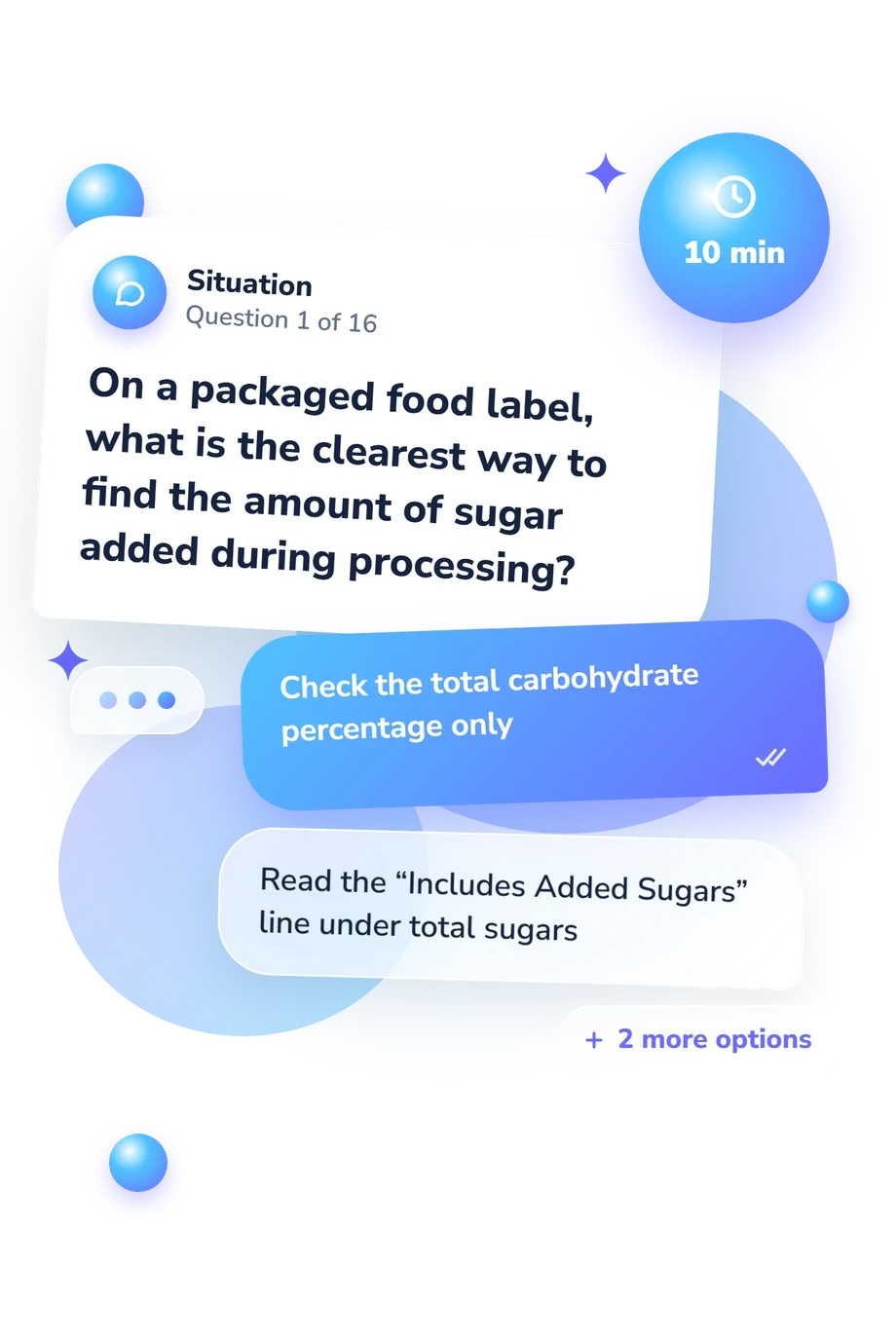
- Check the total carbohydrate percentage only
- Read the “Includes Added Sugars” line under total sugars
- Subtract the protein grams from the total sugar grams
- Count how many sweeteners appear in the ingredient list
- Unfortified sea salt
- Raw leafy greens alone
- B12-fortified foods or an appropriate B12 supplement
- Unfortified fermented vegetables alone
- Replace the butter with coconut oil
- Replace the butter with shortening high in saturated fat
- Replace the butter with additional cream
- Replace the butter with olive oil
Nutrition Quiz - Description and methodology of the test
People who want to check practical food knowledge can use this nutrition quiz to examine everyday decisions about nutrients, labels, portions, and food choices. It is suitable for learners and curious adults who want a clear snapshot before reviewing a topic. A nutrition test with answers can make strengths and gaps easier to notice, turning the result into a focused starting point for study.
What This Assessment Explores
This assessment measures practical nutrition knowledge rather than eating habits or personal health. Its items cover nutrient functions, food choices, labels, portions, preparation, and storage. The nutrition test questions use familiar situations, so the result points toward concrete areas for review.
The result is organized into four learning areas:
- Nutrient roles and sources show whether you connect vitamins, minerals, fats, protein, and B12 with functions or foods.
- Food choice and meal composition indicate recognition of fiber, protein, energy density, unsaturated fat, and balance.
- Labels and portions test interpretation of added sugars, servings, calories, sodium, and whole-grain wording.
- Food safety and preparation cover rinsing beans, improving iron absorption, and refrigerating leftovers.
Nutrition Knowledge is scored from 0-16: Foundations to build (0-6), Developing knowledge (7-12), or Strong knowledge (13-16). This educational result describes the covered topics, not diet quality or medical need.
Methodology and Scientific Basis
As a self-report learning tool, the questionnaire presents selected-response nutrition questions and answers, with one best option for each situation. The displayed total summarizes performance across the items and gives score bands, but it does not specify how many points each answer contributes, so no more detailed scoring rule should be inferred.
The closest conceptual reference is the General Nutrition Knowledge Questionnaire-Revised (GNKQ-R; Kliemann et al., 2016). This online questionnaire is conceptually consistent with that instrument, but it is not presented as an adaptation of it. Earlier work by Parmenter and Wardle (1999) and validation work by Jones et al. (2015) support organizing nutrition knowledge into practical domains and using structured questions. Those studies do not establish reliability, validity, norms, or cutoffs for this version.
Interpret the result as an educational snapshot of the topics sampled. A higher band suggests stronger command of covered concepts, while a lower band identifies subjects to revisit. In practice, this basic nutrition knowledge test is affected by attention, prior education, memory, and the honesty of self-report; it cannot establish a person's diet, health, or medical needs.
- Kliemann N, Wardle J, Johnson F, Croker H. Reliability and validity of a revised version of the General Nutrition Knowledge Questionnaire. European Journal of Clinical Nutrition. 2016;70(10):1174-1180. 10.1038/ejcn.2016.87
- Parmenter K, Wardle J. Development of a general nutrition knowledge questionnaire for adults. European Journal of Clinical Nutrition. 1999;53(4):298-308. 10.1038/sj.ejcn.1600726
- Jones AM, Lamp C, Neelon M, Nicholson Y, Schneider C, Wooten Swanson P, Zidenberg-Cherr S. Reliability and validity of nutrition knowledge questionnaire for adults. Journal of Nutrition Education and Behavior. 2015;47(1):69-74. 10.1016/j.jneb.2014.08.003
Updated: