
Easy Quiz
How the Scales are Structured
Who Usually Takes This Test?
See How You Compare
Below is a preview of how scores are typically distributed across each scale.
Example Questions From the Test
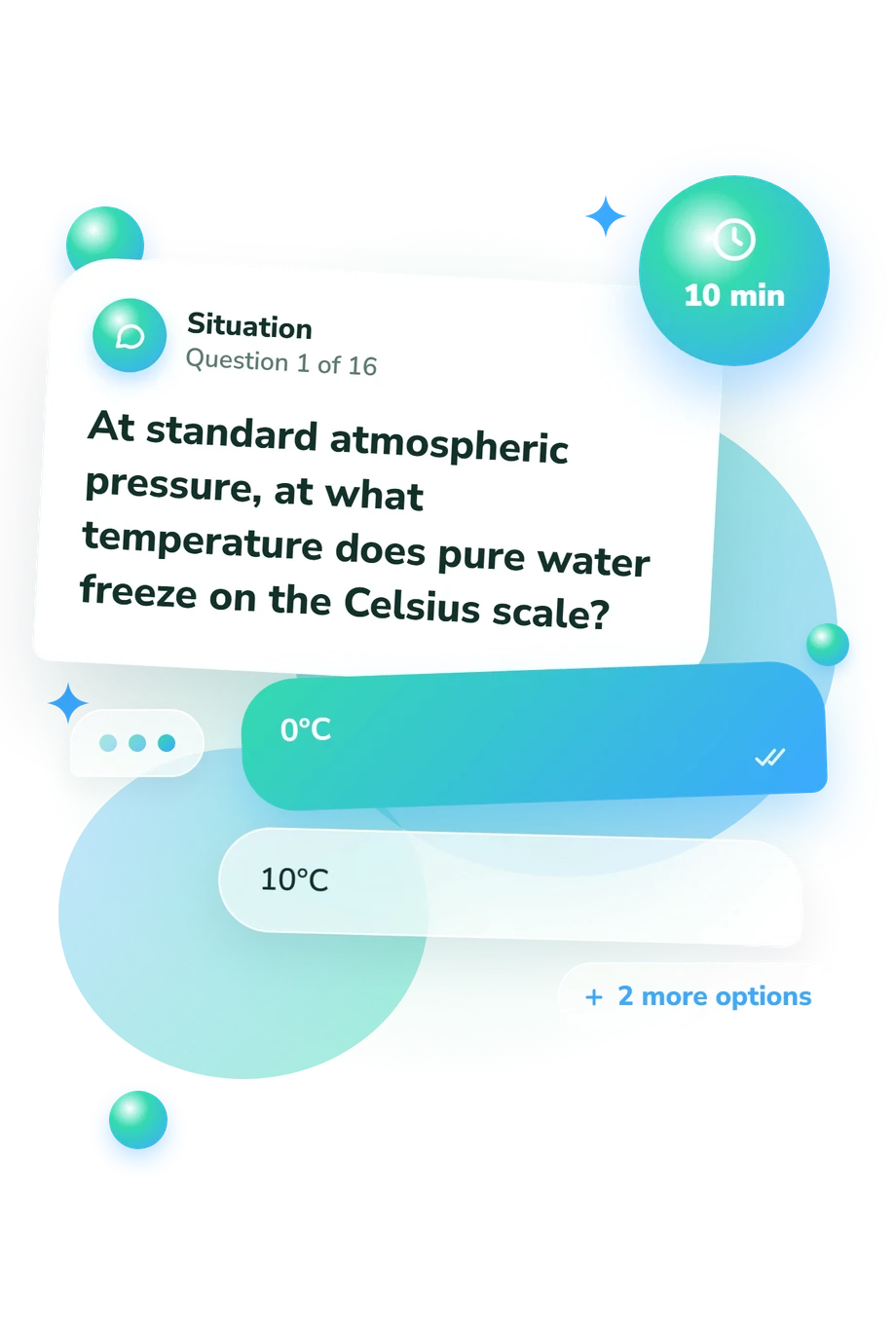
- 0°C
- 10°C
- 32°C
- 100°C
- $30
- $5
- $20
- $10
- Pacific Ocean
- Atlantic Ocean
- Indian Ocean
- Arctic Ocean
Easy Quiz - Description and methodology of the test
People who want a low-pressure check of everyday knowledge can use this easy quiz to gauge their current beginner-level knowledge. It suits learners, families, and anyone returning to general knowledge practice. As a beginner quiz, it offers a compact snapshot for self-reflection rather than detailed subject-by-subject guidance or separate scores.
What This Assessment Measures
These questions sample general knowledge rather than one school subject. Together, they make this an easy trivia quiz across everyday facts, simple calculations, science, geography, directions, vocabulary, time, and culture. It suits anyone seeking foundational recall in ordinary situations.
The thematic groups identify subject areas covered by the questions, not separate scores:
- Everyday numeracy covers simple sums, fractions, prices, and quantities within the overall knowledge result.
- Time and measurement cover schedules, units, and calendar facts within the same overall result.
- Science and nature cover basic processes and living things within the overall result.
- Geography, language, and culture cover places, meanings, literature, and familiar references.
The questionnaire reports one Easy Trivia Knowledge result (0-16). Starting Point (0-6) reflects a beginning foundation; Developing Knowledge (7-12) reflects solid but uneven familiarity; Strong Foundation (13-16) reflects consistently strong beginner-level knowledge across the covered subjects.
Methodology and Evidence Base
Each item offers one question and four fixed answer choices. Respondents select an answer rather than write an extended explanation, and the questionnaire presents one overall result with descriptive bands. As a basic knowledge quiz, it asks for recognition of the correct alternative, while attention to wording still matters.
The General Knowledge Norms study is the closest evidence reference, updating earlier work by Nelson and Narens on general-information recall. Ackerman's theory adds a developmental perspective in which knowledge reflects experience, interests, personality, and accumulated learning, not abstract reasoning alone. This questionnaire is conceptually consistent with those works, not an adaptation of their published instruments.
The cited published studies do not supply norms or validation for this questionnaire. Performance can vary with answer accuracy, language familiarity, educational and cultural exposure, memory, attention, concentration, and familiarity with a topic. The overall result describes broad performance without showing which subject caused a missed answer.
- Tauber, Sarah K., John Dunlosky, Katherine A. Rawson, Matthew G. Rhodes, and Danielle M. Sitzman. (2013). General knowledge norms: Updated and expanded from the Nelson and Narens (1980) norms. Behavior Research Methods, 45(4), 1115-1143. 10.3758/s13428-012-0307-9
- Nelson, Thomas O., and Louis Narens. (1980). Norms of 300 general-information questions: Accuracy of recall, latency of recall, and feeling-of-knowing ratings. Journal of Verbal Learning and Verbal Behavior, 19(3), 338-368. 10.1016/S0022-5371(80)90266-2
- Ackerman, Phillip L. (1996). A theory of adult intellectual development: Process, personality, interests, and knowledge. Intelligence, 22(2), 227-257. 10.1016/S0160-2896(96)90016-1
Updated: