
Duck Identification Quiz
How the Scales are Structured
Who Usually Takes This Test?
See How You Compare
Below is a preview of how scores are typically distributed across each scale.
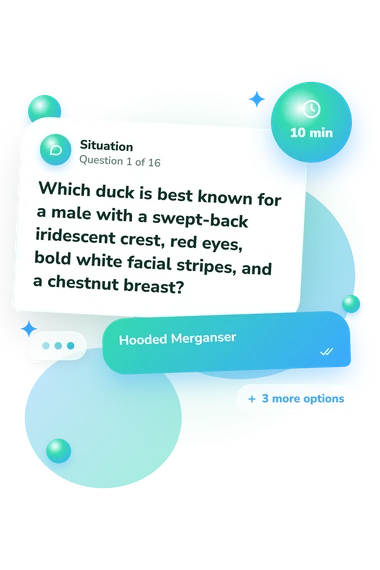
Example Questions From the Test
- Hooded Merganser
- Wood Duck
- Common Goldeneye
- Green-winged Teal
- Eurasian Wigeon
- Green-winged Teal
- American Wigeon
- Gadwall
- Wood Duck
- Bufflehead
- Hooded Merganser
- Common Merganser
Duck Identification Quiz - Description and methodology of the test
People who want to improve field identification can use this duck identification quiz to check how confidently they connect written field-mark descriptions with likely species. Beginners, returning birders, and anyone practicing recognition of North American ducks can use this duck quiz to work through species comparisons. The result gives an overall identification-knowledge band as an educational knowledge summary.
What This Assessment Explores
These questions ask you to match written field-mark descriptions to North American duck species, not complete a field survey. They suit beginners and returning birders practicing comparison. This duck id quiz connects bill, plumage, posture, and pattern clues with likely species.
The result appears as Duck Identification Knowledge: 0-16. Foundations (0-6) reflects prominent clues; Developing Identifier (7-12) shows use of several field marks; Strong Identifier (13-16) indicates consistent links between detailed observations and likely species. The result is an educational knowledge summary, not a birding certification.
The item themes ask you to use these kinds of evidence:
- Bill shape and markings separate species with similar body colors.
- Head pattern and eye details distinguish facial designs and crowns.
- Body profile and posture reveal size, shape, and tail carriage.
- Wing patches and plumage contrast distinguish ducks described in flight or at rest.
Methodology and Evidence Base
Each item presents a vignette with four species choices. Clues cover crest, eye patch, bill edge, neck ring, wing patch, body shape, and tail profile. Choose the species that best matches the written clues. This comparison makes the waterfowl id quiz an exercise in linking described marks rather than relying on one word.
The questionnaire displays an overall score and a corresponding band, not separate subscores for field-mark types. This waterfowl quiz can guide review of missed distinctions and suggest field-guide topics for further study. Because the questionnaire is unstandardized, its result is an educational, non-norm-referenced summary.
Comparison is conceptually consistent with Crossley’s waterfowl guide, Hines’s identification key, and Johnsgard’s field guide, which emphasize observable marks. The questionnaire is not an adaptation of those works. Husby and colleagues’ study of active testing offers external evidence about bird-identification learning; it does not standardize this questionnaire.
Scores can vary with prior exposure, attention, regional experience, and interpretation of written clues. They cannot capture habitat, behavior, distance, lighting, seasonal variation, or uncertainty during a live encounter. Use the result for self-reflection alongside broader field practice.
- Crossley, Richard, Paul Baicich, and Jessie Barry. 2017. The Crossley ID Guide: Waterfowl. West Cape May, NJ: Crossley Books. 512 pp. ISBN 978-0-692-90035-2.
- Hines, Bob. 1976. Ducks at a Distance: A Waterfowl Identification Guide. Ottawa: Canadian Wildlife Service, Environment Canada. 19 pp.
- Johnsgard, Paul A. 2010. “Waterfowl of North America: Identification Key to North American Waterfowl.” In Waterfowl of North America, Revised Edition. Lincoln: University of Nebraska-Lincoln Libraries.
- Husby, Magne, Tove Anita Fiskum, Boris Belchev, Taulant Bino, Iordan Hristov, Oskars Keišs, Hanna Kuzyo, Veronika Samotskaya, Marko Šćiban, and Iva Šoštarić. 2025. “Effective Learning and Testing of Bird Identification Skills.” Journal of Biological Education 59 (4): 692-711. 10.1080/00219266.2024.2386256