
Bartender Quiz
How the Scales are Structured
Who Usually Takes This Test?
See How You Compare
Below is a preview of how scores are typically distributed across each scale.
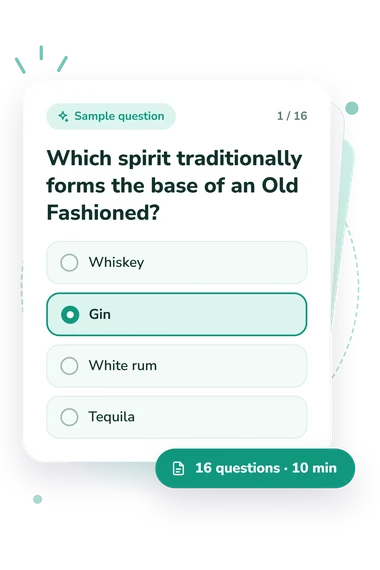
Example Questions From the Test
- Whiskey
- Gin
- White rum
- Tequila
- Serve the mixture warm in the shaker tin
- Pour the cocktail and all the shaking ice into the coupe
- Top the coupe with tonic water before pouring
- Strain the cocktail into the coupe without the shaking ice
- Soda water
- Tonic water
- Ginger beer
- Sparkling wine
Bartender Quiz - Description and methodology of the test
People who want to check their command of classic drinks can use this bartender quiz as a focused skills snapshot. It suits aspiring bartenders, hospitality learners, and curious home mixers who want to recognize ingredients, cocktail families, service choices, and basic technique. As a bartender knowledge quiz, it points to topics worth revisiting rather than treating one score as proof of professional readiness.
What This Assessment Explores
Rather than testing trivia, the assessment samples formulas, spirits, modifiers, garnishes, balance, chilling, dilution, straining, and sparkling ingredients. In practice, questions for bartenders shift between identification and decisions, so performance reflects recipe familiarity and what happens in the glass.
The result is a learning profile for people exploring or refreshing bartending knowledge. It can show whether review should focus on cocktail families, ingredients, or preparation choices.
The result uses one summary scale, Bartender Knowledge (0-16). Its bands describe the level shown:
- Foundation (0-6) indicates recognition of some bar essentials while leaving classic families, base spirits, or preparation methods to review.
- Developing (7-12) shows useful working knowledge with gaps in recipes or service decisions.
- Strong (13-16) reflects a confident grasp of classic cocktails and practical preparation principles; the score is not a professional certification.
Methodology and Evidence Base
Each item presents a prompt with four answer choices, asking the reader to identify a recipe, ingredient, base spirit, service step, or technique. Other prompts use troubleshooting scenarios, such as correcting sweet-sour balance, preserving carbonation, or choosing whether to shake, stir, or strain. The questions and answers for bartenders use one keyed option per prompt, and the displayed score summarizes performance across the set.
Conceptually, the content is consistent with the IBA Official Cocktail List and formula and technique principles discussed by Day, Fauchald, and Kaplan (2018) and Morgenthaler and Holmberg (2014). These sources support classic specifications, balance, dilution, chilling, and service; this questionnaire is not a validated adaptation of those works.
Research by Trevithick and colleagues (1999) notes that stirring and shaking can produce different physical results in martinis, but it does not establish this questionnaire’s reliability or standardization. Used as a bartending quiz online, the assessment works best as a review aid. Results can vary with training, regional conventions, terminology, guessing, and attention, so the score should be read as a snapshot of quiz performance rather than a complete measure of bartending ability.
- International Bartenders Association. IBA Official Cocktail List. International Bartenders Association, n.d.
- Day, Alex, Nick Fauchald, and David Kaplan. Cocktail Codex: Fundamentals, Formulas, Evolutions. Ten Speed Press, 2018.
- Morgenthaler, Jeffrey, and Martha Holmberg. The Bar Book: Elements of Cocktail Technique. Chronicle Books, 2014.
- Trevithick, C. C., M. M. Chartrand, J. Wahlman, F. Rahman, M. Hirst, and J. R. Trevithick. “Shaken, Not Stirred: Bioanalytical Study of the Antioxidant Activities of Martinis.” BMJ, vol. 319, no. 7225, 1999, pp. 1600-1602. 10.1136/bmj.319.7225.1600
Updated: