
What Villain Are You Quiz
How the Scales are Structured
Who Usually Takes This Test?
See How You Compare
Below is a preview of how scores are typically distributed across each scale.
Example Questions From the Test
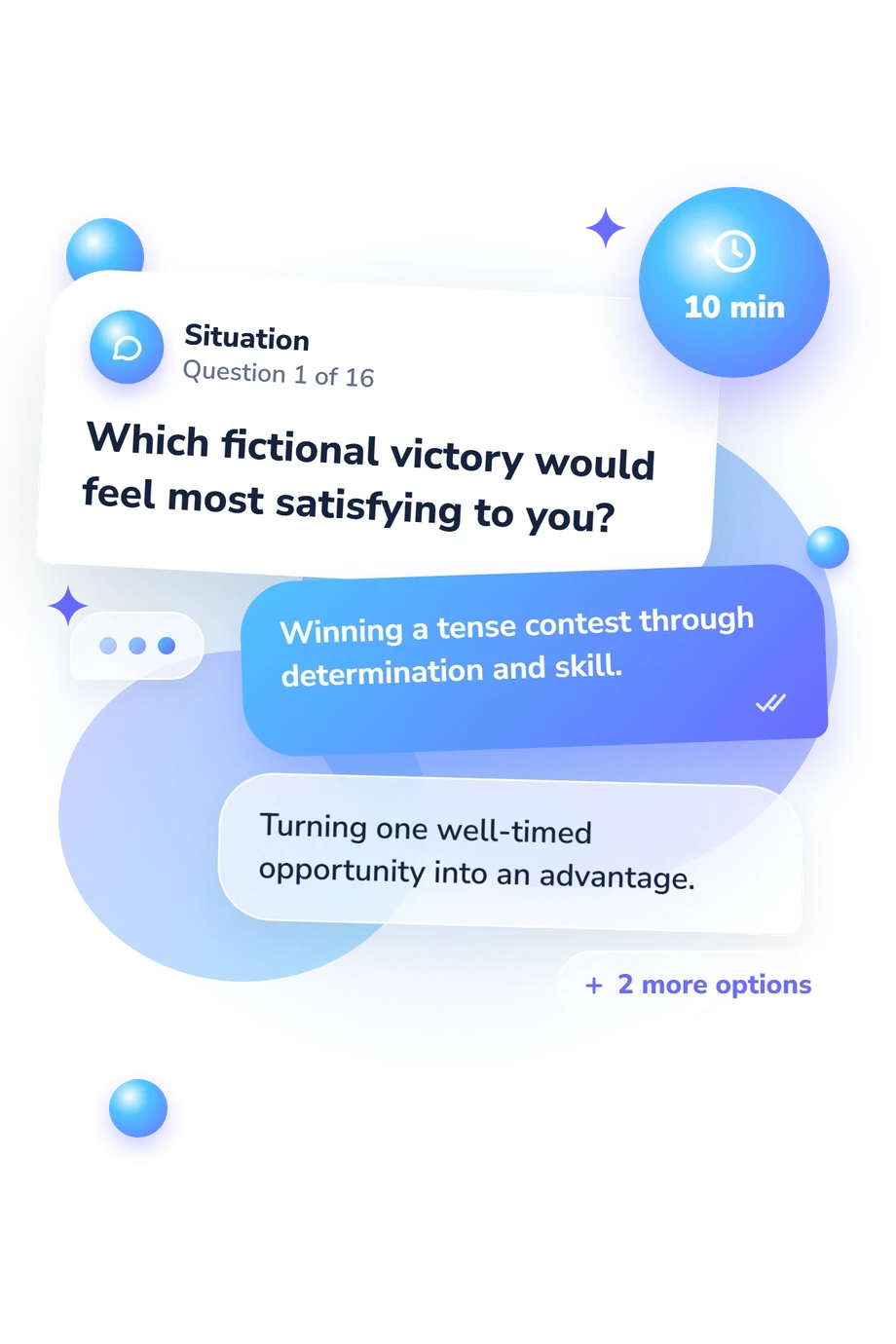
- Winning a tense contest through determination and skill.
- Turning one well-timed opportunity into an advantage.
- Watching a carefully prepared strategy succeed despite complications.
- Revealing that every apparent setback was already part of the design.
- Use the council’s own procedures to propose a careful reform.
- Make exceptions where possible while building support for change.
- Challenge the tradition openly and rally others to resist it.
- Work to remove the council’s power and replace the entire system.
- Testing my abilities and seeing how far I can go.
- Finishing high enough to earn respect from the field.
- Getting the chance to face the champion directly.
- Defeating the champion in a moment no one can dispute or forget.
What Villain Are You Quiz - Description and methodology of the test
Readers who enjoy character psychology can use the What Villain Are You Quiz to examine how they respond to strategy, authority, rivalry, and uncertainty. People taking a which villain are you quiz can use the result as a playful, organized profile rather than a moral verdict. The scenarios invite reflection on the imaginative choices behind a fictional role and on which kinds of conflict, power, and change engage them.
What This Assessment Explores
This villain quiz covers planning, resistance, competition, and disruption. Results cover authority, rivals, secrecy, and change.
Scenarios emphasize preference, not moral judgment. Results from what villain am I quiz mirror habits, not identity.
These dimensions are:
- The Mastermind (0-12) measures planning: Improvisational (0-4) favors flexibility, Tactical (5-8) adapts, and Mastermind Affinity (9-12) favors layered strategy.
- The Rebel (0-12) measures resistance: Selective Dissenter (0-4) preserves rules, Rule Challenger (5-8) questions authority, and Rebel Affinity (9-12) seeks change.
- The Rival (0-12) measures competition: Self-Directed (0-4) stays self-focused, Competitive (5-8) uses opponents as targets, and Rival Affinity (9-12) seeks decisive comparison.
- The Trickster (0-12) measures misdirection, improvisation, and playful disruption: Straightforward (0-4) prefers clarity, Playful Improviser (5-8) enjoys surprise, and Trickster Affinity (9-12) favors reversals and uncertainty.
Methodology and Scientific Basis
Each item presents a fictional scenario with four response choices. You select the reaction that best matches your preferred handling of plans, authority, rivals, secrecy, setbacks, or social change. This self-report structure turns imaginative choices into a profile rather than a category.
Each dimension receives a separate score. The highest outcome represents the strongest affinity, while outcomes within one point of it form a blended result. The displayed bands describe relative strength within this questionnaire; it is an original online self-reflection measure with no documented standardization or norms, and no point-by-point rule should be inferred.
The profile frames the result of a what kind of villain are you quiz as a preference pattern, not an identity claim. Its themes are conceptually consistent with, not an adaptation of, published research. Black and colleagues connected liking for dark fictional characters with morality, Machiavellianism, and imaginative resistance. Work by Kjeldgaard-Christiansen, Eden, and Grizzard and their coauthors adds perspectives on personality, moral perception, and character schemas.
Self-perception, current context, and response bias can shape a self-report result, so it is best used for reflection rather than diagnosis.
- Black, Jessica E., Yomna Helmy, Olivia Robson, and Jennifer L. Barnes. (2019). Who can resist a villain? Morality, Machiavellianism, imaginative resistance and liking for dark fictional characters. Poetics, 74, 101344. 10.1016/j.poetic.2018.12.005
- Kjeldgaard-Christiansen, Jens, Anne Fiskaali, Henrik Høgh-Olesen, John A. Johnson, Murray Smith, and Mathias Clasen. (2021). Do Dark Personalities Prefer Dark Characters? A Personality Psychological Approach to Positive Engagement with Fictional Villainy. Poetics, 85, 101511. 10.1016/j.poetic.2020.101511
- Eden, Allison, Mary Beth Oliver, Ron Tamborini, Anthony Limperos, and Julia Woolley. (2015). Perceptions of Moral Violations and Personality Traits Among Heroes and Villains. Mass Communication and Society, 18(2), 186-208. 10.1080/15205436.2014.923462
- Grizzard, Matthew, Jialing Huang, Kaitlin Fitzgerald, Changhyun Ahn, Haoran Chu, and colleagues. (2018). Sensing Heroes and Villains: Character-Schema and the Disposition Formation Process. Communication Research, 45(4), 479-501. 10.1177/0093650217699934
Updated: