
Wednesday Character Quiz
How the Scales are Structured
Who Usually Takes This Test?
See How You Compare
Below is a preview of how scores are typically distributed across each scale.
Example Questions From the Test
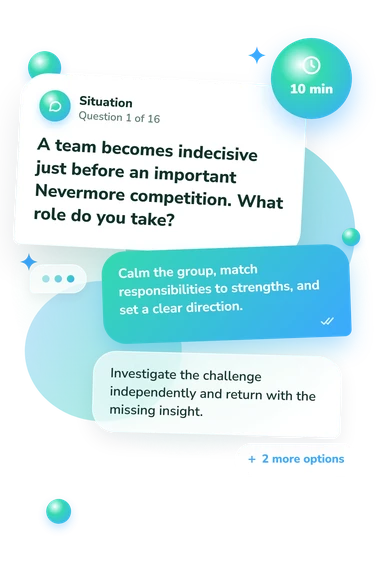
- Calm the group, match responsibilities to strengths, and set a clear direction.
- Investigate the challenge independently and return with the missing insight.
- Ease the tension so everyone can reconnect before making a decision.
- Visualize several possible approaches and show the group how each might unfold.
- Meeting them openly and proving myself through a demanding, fair contest.
- Keeping perspective and spending time with people who do not treat life as a ranking.
- Quietly studying what makes the rival difficult to beat.
- Exploring the rivalry through creative work until I understand my reaction.
- Make room for people to choose freely before I attempt to persuade them.
- Rely on preparation and demonstrated skill so my case stands on its own.
- Ask a trusted friend to present the idea while I remain in the background.
- Step away from the decision entirely and let the group find its own direction.
Wednesday Character Quiz - Description and methodology of the test
Visitors drawn to Nevermore’s contrasting personalities can use the Wednesday Character Quiz to reflect on choices and reactions they recognize in themselves. Its personality-focused format supports self-reflection and conversation about the series’ fictional characters, making this Wednesday personality quiz easy to share with friends and discuss familiar responses.
What This Assessment Explores
Scenarios cover rivalry, responsibility, friendship, uncertainty, investigation, public pressure, and creative setbacks. They show which fictional responses feel familiar in context.
Someone wondering which Wednesday character they most resemble receives a profile of fictional affinity, not a judgment of worth. The displayed fictional affinities are:
- Bianca Barclay Affinity (0-12) reflects fictional leadership alignment: Independent Style (0-4), Emerging Authority (5-8), or Poised Powerhouse (9-12).
- Enid Sinclair Affinity (0-12) reflects fictional warmth and openness: Quieter Contrast (0-4), Bright Common Ground (5-8), or Colorful Kindred Spirit (9-12).
- Wednesday Addams Affinity (0-12) reflects fictional skepticism and investigation: Different Instincts (0-4), Shared Sharpness (5-8), or Kindred Investigator (9-12).
- Xavier Thorpe Affinity (0-12) reflects fictional intuition and creativity: More Outwardly Driven (0-4), Creative Resonance (5-8), or Intuitive Artist (9-12).
Methodology and Evidence Base
Each scenario offers four choices emphasizing ways of acting, noticing, relating, or creating. Several affinities can appear together because the choices represent different responses, so you need not choose which Wednesday character you are.
The four scores are read separately, so a respondent may show strong alignment with one fictional style and quieter resonance with another. The three bands summarize increasing alignment, not rank among characters. Because item-level point weights are not stated, each band is best read as a broad profile rather than an account of answer contributions.
Methodologically, research on character similarity and media identification offers conceptual context only. Hoffner and Buchanan (2005) link identification with perceived similarity and character attributes, while Cohen (2001) describes psychological engagement with a media character. Neither study validates this questionnaire or makes it an adaptation of either measure.
The online assessment has no stated standardization sample, norms, or clinical cutoffs. Choices may shift with current mood, self-awareness, and a character’s appeal, so the profile captures a moment of affinity rather than stable personal measurement.
- Hoffner, Cynthia, and Martha Buchanan. (2005). “Young Adults’ Wishful Identification With Television Characters: The Role of Perceived Similarity and Character Attributes.” Media Psychology, 7(4), 325-351. 10.1207/S1532785XMEP0704_2
- Cohen, Jonathan. (2001). “Defining Identification: A Theoretical Look at the Identification of Audiences With Media Characters.” Mass Communication and Society, 4(3), 245-264. 10.1207/S15327825MCS0403_01