
Marketing Quiz
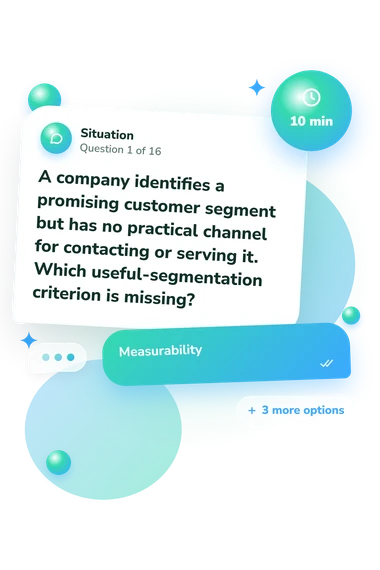
How the Scales are Structured
Who Usually Takes This Test?
See How You Compare
Below is a preview of how scores are typically distributed across each scale.
Example Questions From the Test
- $130
- $50
- $80
- $30
- 25%
- 0%
- 5%
- 0%
- How often have you used this product in the past month?
- How much did you enjoy our convenient and innovative new service?
- Which feature, if any, influenced your purchase most?
- How satisfied or dissatisfied are you with the service?
Marketing Quiz - Description and methodology of the test
People who want to check practical marketing knowledge can use this marketing quiz to examine how they handle common decisions in strategy, pricing, communication, research, and measurement. It is suitable for learners, applicants, and professionals refreshing foundational material. A quiz on marketing for students can turn broad study into a focused review of concepts that need more practice.
What This Assessment Explores
This assessment samples the knowledge needed to interpret markets and select appropriate marketing actions. Its scenarios connect concepts with decisions about customers, offers, channels, messages, evidence, and ethical presentation. The questions about marketing concepts suit anyone seeking a broad foundation check rather than a specialist certification.
The result describes performance across one overall knowledge dimension. Its areas include:
- Market understanding shows how segmentation and positioning shape the fit between an audience and an offering.
- Commercial reasoning shows how pricing, contribution margin, elasticity, and acquisition economics affect decisions.
- Communication and measurement show how customer journeys, research quality, metrics, testing, and channel choices guide evaluation.
Marketing Knowledge: 0-16. Foundation (0-6) indicates recognition of some core ideas; Developing (7-12) indicates useful working knowledge with some application gaps; Strong (13-16) indicates broad, accurate application across varied business scenarios. The profile identifies study priorities rather than explaining every missed answer.
Methodology and Scientific Basis
Each item presents a business situation with several answer choices. The format asks the respondent to select the best response for a defined context, so marketing questions and answers test recognition and application rather than isolated terminology.
This structure keeps the task close to common marketing decisions. Basic questions on marketing move from foundational definitions toward applied judgment across segmentation, economics, communication, research, measurement, experimentation, and ethics. The questionnaire reports one overall result, but it does not state how many points each response contributes.
Conceptually, it is consistent with Marketing Knowledge Base (Evans, 2010), which treats marketing knowledge as assessable understanding applied to decisions. Miller, Bryant, and Norman (2019) add an educational-assessment perspective, while Tarka (2019) demonstrates psychometric work on measuring marketing knowledge. These sources support the construct, not authorship or validation of this online version.
Interpret the band as a snapshot of performance on these scenarios. Prior study, professional exposure, terminology familiarity, and guessing can affect results. Published norms, reliability estimates, and validation results are not stated for this questionnaire, so the score is best used to guide learning rather than make broad claims about overall marketing ability.
- Evans, Joel R. (2010). "The Role, Development, and Implementation of a Marketing Knowledge Base as a Tool in the Enhancement and Assessment of Student Learning." Marketing Education Review, 20(3), 187-202. 10.2753/MER1052-8008200301
- Miller, Chip E., Andrew Bryant, and Andrew Norman. (2019). "Hidden Learning: Measuring Student Learning in the Marketing Capstone." Journal for Advancement of Marketing Education, 27(1), 31-41. 10.63963/001c.150582
- Tarka, Piotr. (2019). "A scale for testing of knowledge on the effective marketing research processes: multiple-group confirmatory (MGCFA) and multiple indicators-multiple causes (MIMIC) approach." Journal of Marketing Analytics, 7(2), 94-121. 10.1057/s41270-019-00049-4