
Word of the Year Quiz
How the Scales are Structured
Who Usually Takes This Test?
See How You Compare
Below is a preview of how scores are typically distributed across each scale.
Example Questions From the Test
- slugger
- homer
- rookie
- inning
- hot mess
- train wreck
- dumpster fire
- clusterstorm
- The Face with Tears of Joy emoji
- The Red Heart emoji
- The Thinking Face emoji
- The Fire emoji
Word of the Year Quiz - Description and methodology of the test
Readers interested in language change, public culture, and the stories behind memorable vocabulary can use this word of the year quiz to connect annual selections with the events and debates that made them prominent. It suits people who follow dictionaries, media language, or changing usage and want a dictionary word quiz with a clear, fact-based focus. The activity is about cultural vocabulary, not personality or general intelligence.
What This Assessment Explores
The questionnaire measures recognition of Words of the Year chosen by dictionary publishers or language organizations. Its clues connect terms with meanings, contexts, selectors, and years across Oxford, Cambridge Dictionary, Merriam-Webster, and the American Dialect Society.
Together, the questions form a word history quiz about vocabulary trends and events behind prominent expressions. The result reflects these selections, not intelligence, writing ability, or total vocabulary.
The displayed scale is Word of the Year Knowledge, ranging from 0-16. Each point represents one correct answer about a selection explicitly attributed to a dictionary or language organization. The result bands are:
- Word Watcher (0-6) indicates recognition of some major language trends but possible confusion about selectors or years.
- Language Tracker (7-12) reflects developing to strong knowledge across several eras and organizations.
- Word-Year Expert (13-16) indicates accurate connections among selections, meanings, contexts, and selectors.
Methodology and Evidence Base
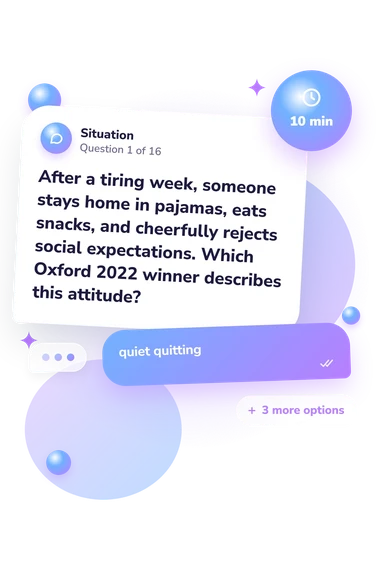
Each item offers a clue or scenario with four answer choices. You select the term, emoji, or historical description that fits. The format tests recognition and contextual recall, not open-ended definition writing. A correct response adds one point; an incorrect choice adds none.
Its conceptual framing is consistent with Words of the Year (Heafner et al., 2018), which treats selected vocabulary as socially situated and connected with public events, discourse, and inquiry. Oxford University Press’s 2024 account, the American Dialect Society’s historical record, Cambridge Dictionary’s Word of the Year archive covering the tested years, and Merriam-Webster’s annual Word of the Year entries supply examples of how organizations select and explain annual words. Those sources support the subject matter, but not psychometric validation of this online version.
Read the bands as descriptive feedback, not population norms or clinical thresholds. The score summarizes performance across the eras, organizations, and meanings represented in this vocabulary knowledge quiz. Media exposure, cultural familiarity, confidence, and guessing may influence the score; it is a focused snapshot, not a complete account of language ability.
- Heafner, Tina L., Nicholas Triplett, Laura Handler, and Dixie Massey. “Situated Word Learning: Words of the Year (WsOY) and Social Studies Inquiry.” Theory & Research in Social Education 46, no. 1 (2018): 110-148. 10.1080/00933104.2017.1333473
- Oxford University Press. “Oxford Word of the Year: defining the past 20 years.” 2024.
- American Dialect Society. “All of the Words of the Year, 1990 to Present.” American Dialect Society, n.d. Accessed September 25, 2026.
- Cambridge Dictionary. “Word of the Year 2025.” Cambridge University Press & Assessment, 2025.
Updated: