
Am I Psychic Quiz
How the Scales are Structured
Who Usually Takes This Test?
See How You Compare
Below is a preview of how scores are typically distributed across each scale.
Example Questions From the Test
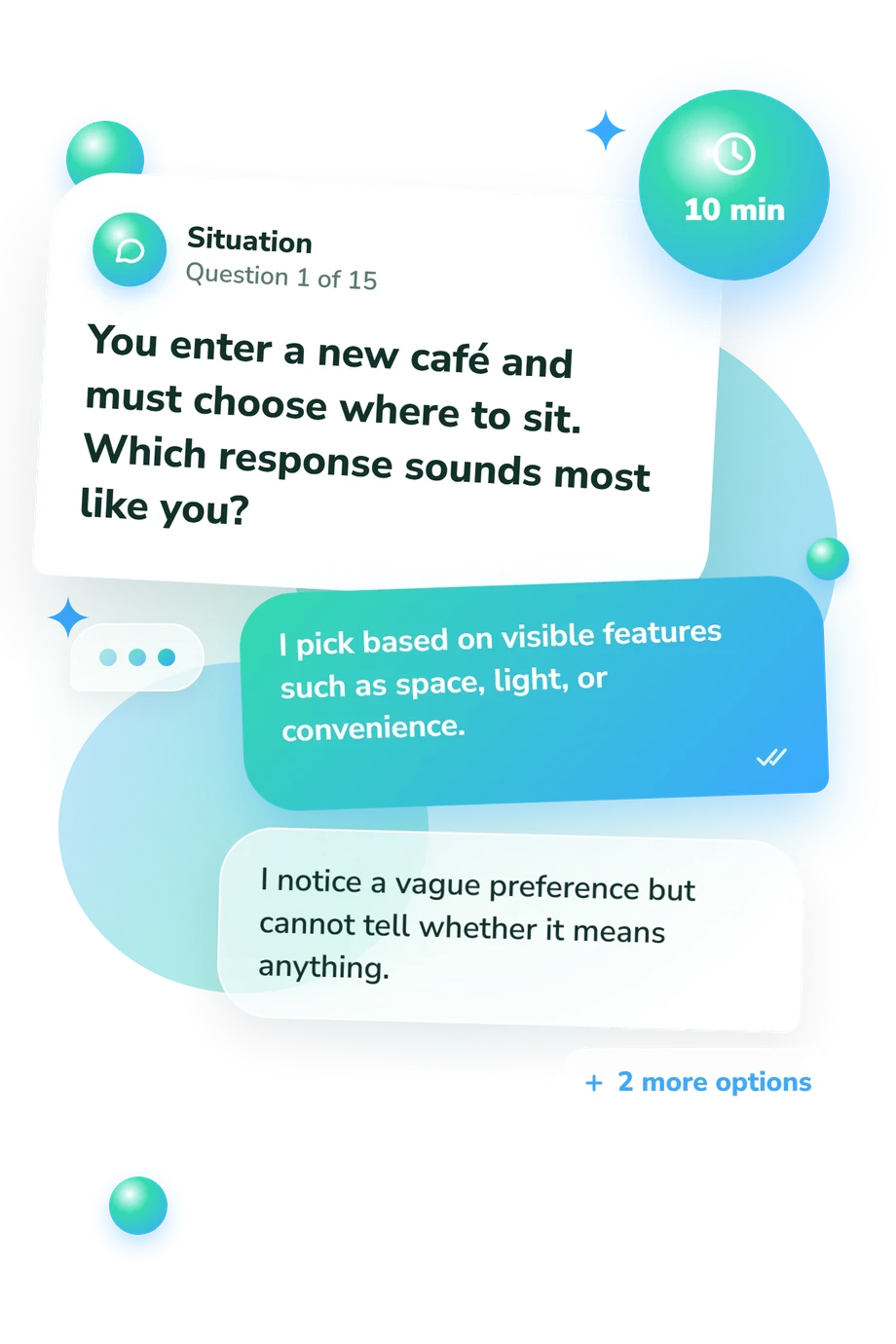
- I pick based on visible features such as space, light, or convenience.
- I notice a vague preference but cannot tell whether it means anything.
- One spot often draws me before I have assessed all the practical details.
- I commonly feel an immediate, definite pull toward or away from a particular spot.
- I compare practical details before forming any preference.
- A slight preference appears, but I mainly follow the available facts.
- I get a fairly clear hunch and weigh it alongside practical details.
- One route often feels distinctly right before I can explain why.
- Almost never, or no more than I would expect by chance.
- Occasionally, though it rarely stands out to me.
- Fairly often, and I tend to notice when it happens.
- Very often, and the timing regularly feels striking to me.
Am I Psychic Quiz - Description and methodology of the test
People who wonder whether unusual impressions reflect intuition, attention, or interpretation can use the Am I Psychic Quiz as a structured self-reflection exercise. It is intended for anyone curious about hunches, coincidences, emotional atmospheres, and subtle environmental cues. Rather than delivering a yes-or-no label, an are you psychic quiz in this format shows how spontaneous impressions and careful evaluation coexist in your reported experience.
What This Assessment Explores
The questionnaire explores hunches, interpretation, and sensitivity to social or environmental change. As a psychic quiz, it offers a profile of reported tendencies, not proof of paranormal perception.
These scales describe what each result range means:
- Intuitive Impressions (0-15) measures hunches before reasoning: Occasional Impressions (0-5) means uncommon; Available Intuition (6-10) means sometimes influential; Strong Intuitive Tendency (11-15) means readily compelling.
- Reflective Discernment (0-15) measures examination of impressions: Immediate Meaning-Making (0-5) settles quickly; Curious Reflection (6-10) considers context; Grounded Inquiry (11-15) tests alternatives.
- Sensitivity to People and Surroundings (0-15) measures subtle cue detection: Broad-Strokes Awareness (0-5) notices prominent signals; Responsive Sensitivity (6-10) registers changes; Highly Attuned (11-15) catches small shifts.
Together, these dimensions distinguish what you notice from how you explain it.
Methodology and Scientific Basis
Each item presents an everyday situation with four ordered response descriptions. Choices move from little awareness or rapid acceptance toward stronger impressions, contextual checking, and deliberate comparison. Responses become totals for the three dimensions and are assigned to the displayed bands; no separate verdict about psychic ability is calculated.
Methodologically, the questionnaire is conceptually consistent with the Australian Sheep-Goat Scale (Thalbourne & Delin, 1993), a published measure of paranormal belief and experience, but it is not presented as an adaptation. Drinkwater et al. (2018) examined that scale’s factor structure and convergent validity, which provides context for comparison, not validation of this online questionnaire.
The balance between spontaneous impressions and deliberate checking also reflects the experiential-rational processing distinction discussed by Pacini and Epstein (1999). For a reader wanting an intuition quiz, this helps separate an impression from its explanation.
Results describe reported experience rather than verify psychic ability; self-report, mood, expectations, attention, memory, and pattern-seeking can shape the profile, and the questionnaire has no stated standardization or clinical norms. Its value is making the difference between noticing and interpreting more explicit.
- Thalbourne, Michael A., and Peter S. Delin. (1993). A new instrument for measuring the sheep-goat variable: Its psychometric properties and factor structure. Journal of the Society for Psychical Research, 59, 172-186.
- Drinkwater, Kenneth, Andrew Denovan, Neil Dagnall, and Andrew Parker. (2018). The Australian Sheep-Goat Scale: An Evaluation of Factor Structure and Convergent Validity. Frontiers in Psychology, 9, 1594. 10.3389/fpsyg.2018.01594
- Pacini, R., and Epstein, S. (1999). The relation of rational and experiential information processing styles to personality, basic beliefs, and the ratio-bias phenomenon. Journal of Personality and Social Psychology, 76(6), 972-987. 10.1037//0022-3514.76.6.972
Updated: