
Workout Quiz
How the Scales are Structured
Who Usually Takes This Test?
See How You Compare
Below is a preview of how scores are typically distributed across each scale.
Example Questions From the Test
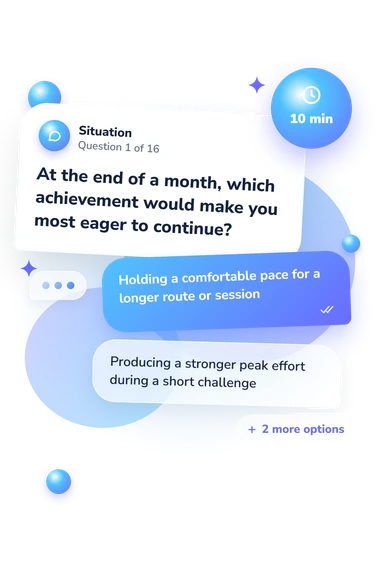
- Holding a comfortable pace for a longer route or session
- Producing a stronger peak effort during a short challenge
- Moving with noticeably greater precision and body awareness
- Keeping my breathing and pace more even throughout cardio
- Work through several resistance exercises with full rests
- Take a long walk, jog, ride, swim, or similar steady session
- Complete a compact workout built around intense bursts
- Follow a quiet sequence focused on breathing and control
- Choose an indoor option that still provides sustained movement
- Use the time for a deliberate mobility or balance flow
- Do a shorter continuous cardio session and adjust my expectations
- Replace it with a varied resistance circuit
Workout Quiz - Description and methodology of the test
People choosing activities they can enjoy and repeat may use the workout quiz to clarify which movement experiences feel motivating, manageable, and rewarding. As an exercise quiz, it turns broad preferences into a practical starting point for selecting pace, variety, equipment, and training style. It suits anyone shaping a routine around personal interest rather than obligation.
What This Test Measures
Questions examine preferences for rhythm, intensity, control, repetition, recovery, and progression. They describe motivating workout experiences, not health, fitness, or ability. As a workout plan quiz, it compares four styles so a person can see where a routine may fit.
The four displayed profiles are:
- Endurance Cardio (0-12) measures sustained rhythm: Short-Format Preference (0-4), Casual Endurance Explorer (5-8), or Rhythm-Seeking Endurer (9-12).
- HIIT (0-12) measures timed bursts and recovery: Steady-Pace Preference (0-4), Selective Sprinter (5-8), or Interval-Energized (9-12).
- Mindful Movement (0-12) measures mobility, breath, and control: Output-Oriented (0-4), Mindful Mixer (5-8), or Mindful Mover (9-12).
- Strength Training (0-12) measures resistance and progression: Variety-Led (0-4), Flexible Lifter (5-8), or Strength-Focused (9-12).
Methodology and Evidence Base
Each item describes a session choice, repetition, technique, recovery, or progress, followed by four alternatives. No answer is correct; this preference-oriented self-report asks the respondent to choose the option matching a personal preference. Choices sort into four movement-style groups rather than measuring performance.
Scoring compares the four profile totals. The highest score shows the strongest affinity; scores within one point indicate a blend. The bands are descriptive categories, not population norms or clinical cutoffs.
Conceptually, the questionnaire is consistent with Box et al. (2019) on individual differences associated with exercise-mode preferences. It also relates to Ekkekakis, Hall, and Petruzzello (2005) on preference and tolerance for intensity, and Reading and LaRose (2022) on exercise preferences. These studies support the construct; they do not make this online tool a reproduction or validated adaptation.
A free personalized workout plan quiz can translate the profile into choices about pacing, variety, equipment, and session structure. Goals, schedule, and access still matter. Mood, recent training, and self-awareness can shift self-report, so the result describes preferred experience rather than physiology.
- Box, Allyson G.; Feito, Yuri; Brown, Chris; Petruzzello, Steven J. (2019). Individual differences influence exercise behavior: how personality, motivation, and behavioral regulation vary among exercise mode preferences. Heliyon, 5(4), e01459. 10.1016/j.heliyon.2019.e01459
- Ekkekakis, Panteleimon; Hall, Eric E.; Petruzzello, Steven J. (2005). Some Like It Vigorous: Measuring Individual Differences in the Preference for and Tolerance of Exercise Intensity. Journal of Sport & Exercise Psychology, 27(3), 350-374. 10.1123/jsep.27.3.350
- Reading, Jean M.; LaRose, Jessica Gokee. (2022). Exercise preferences among emerging adults: Do men and women want different things? Journal of American College Health, 70(5), 1301-1305. 10.1080/07448481.2020.1803878