
Allergy Quiz
How the Scales are Structured
Who Usually Takes This Test?
See How You Compare
Below is a preview of how scores are typically distributed across each scale.
Example Questions From the Test
- Use a room humidifier continuously.
- Spray bedding with a scented air freshener.
- Keep extra fabric cushions on the bed to absorb dust.
- Use allergen-impermeable covers on the mattress and pillows.
- Epinephrine, given promptly according to the emergency plan
- A topical corticosteroid cream
- An antacid
- An oral decongestant
- Mild pain and a small area of redness at the sting site
- Throat tightness with dizziness or faintness
- A stuffy nose beginning the following day
- Itching limited to the skin directly around the sting
Allergy Quiz - Description and methodology of the test
Caregivers, people refining household safety routines, and readers preparing to discuss an allergy concern may find the allergy safety assessment useful. Taking this allergy quiz helps them decide whether to revisit general guidance or bring a personal question to a clinician. Its result organizes learning priorities, making it easier to prepare for a conversation or refresh knowledge after an unfamiliar situation.
What This Assessment Explores
These items cover practical distinctions: immune reactions versus intolerance, exposure reduction, food cross-contact, test interpretation, and warning signs that need urgent action. The questionnaire functions as an allergy knowledge test: its questions do not identify what allergy a person has or which trigger causes symptoms; instead, they examine whether respondents can select sound explanations and safer responses.
The displayed result uses one scale, Allergy Knowledge (0-16), reflecting knowledge of mechanisms, prevention, testing limits, and emergency care. Its three result bands are:
- Foundation to build (0-6) indicates that core concepts and safety responses need reinforcement.
- Developing knowledge (7-12) indicates that many essentials are understood, with practical distinctions still to strengthen.
- Strong knowledge (13-16) indicates broad understanding of allergy basics and safety.
Methodology and Scientific Basis
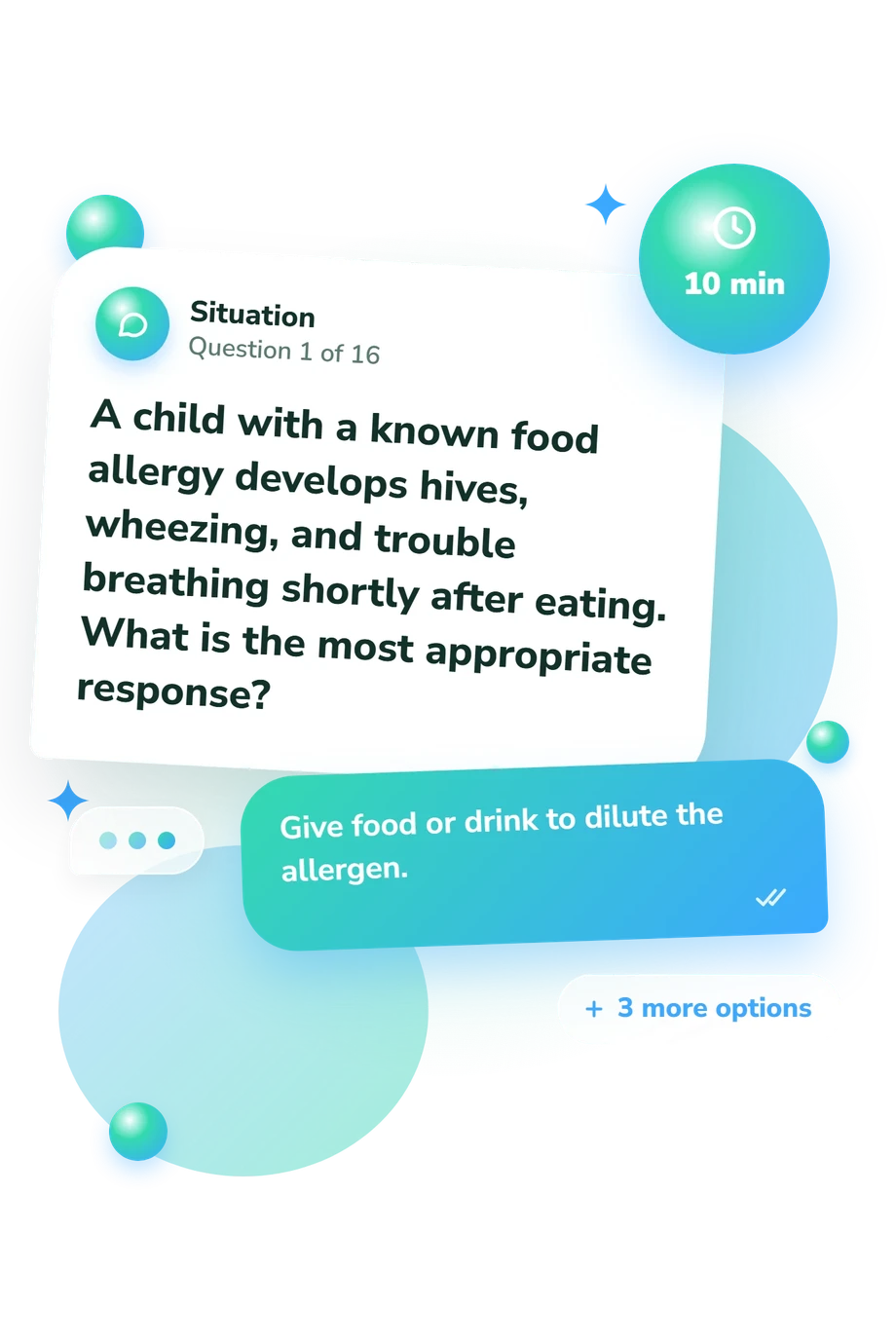
Each item presents a scenario or knowledge question with four answer choices. The format asks the respondent to select the best explanation or action, from using prescribed epinephrine promptly in suspected anaphylaxis to interpreting a positive skin-prick result as sensitization that must be considered with symptoms and history. The questionnaire presents a total knowledge score, while its item-level weighting is unspecified.
Its content overlaps food allergy knowledge domains in the Food Allergy Knowledge Questionnaire, or FAKQ, and in Hahn's 2017 survey and Gupta's 2009 study. This overlap covers shared food-allergy topics only: the online questionnaire is not a reprint, validated adaptation, or validation of the broader assessment.
Emergency scenarios teach recognition of severe symptoms and selection of an appropriate response; they do not turn the assessment into a real-time check of whether someone is having an allergic reaction. As an unvalidated educational score, it cannot diagnose or exclude an allergy, and answers may be influenced by current circumstances, recall, health literacy, and social desirability. It is best used to identify learning topics and questions about personal symptoms or testing.
- Agnes Sze Yin Leung, Nam Sze Cheng, James Wesley Ching-hei Cheng, Jack Pun, and Ting Fan Leung. Development and validation of assessment tools for food allergy-related knowledge and management confidence. Journal of Allergy and Clinical Immunology: Global. 2023;2(3):100098. 10.1016/j.jacig.2023.100098
- Amy L. Hahn, Lynnda M. Dahlquist, Jessica L. Hoehn, and Mary Elizabeth Bollinger. Development of a Food Allergy Knowledge Test for Parents. Journal of Pediatric Psychology. 2017;42(5):598-609. 10.1093/jpepsy/jsw096
- Ruchi S. Gupta, Jennifer S. Kim, Elizabeth E. Springston, Jacqueline A. Pongracic, Xiaobin Wang, and Jane Holl. Development of the Chicago Food Allergy Research Surveys: assessing knowledge, attitudes, and beliefs of parents, physicians, and the general public. BMC Health Services Research. 2009;9:142. 10.1186/1472-6963-9-142
Updated: