
ACLS Quiz
How the Scales are Structured
Who Usually Takes This Test?
See How You Compare
Below is a preview of how scores are typically distributed across each scale.
Example Questions From the Test
- Return of spontaneous circulation may have occurred
- The compression rate has become too fast
- The patient has developed asystole
- The defibrillator pads have lost contact
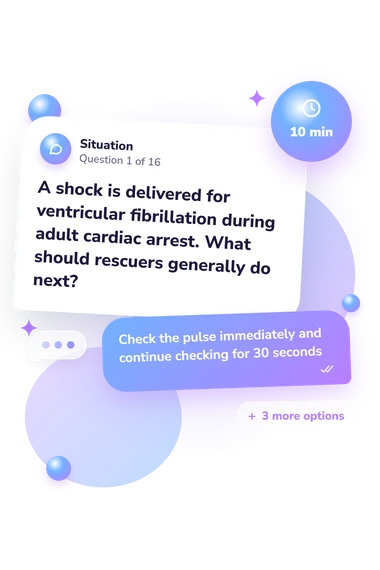
- Resume CPR immediately, beginning with chest compressions
- Wait for the AED to analyze again without touching the patient
- Give two breaths and then perform a prolonged pulse check
- Remove the pads and check blood pressure
- About 1 inch (2.5 cm)
- At least 2 inches (5 cm), while avoiding excessive depth
- About 1.5 inches (4 cm)
- At least 3 inches (7.5 cm)
ACLS Quiz - Description and methodology of the test
People who want to check their grasp of adult resuscitation can use the ACLS Quiz to identify study priorities. It suits learners reviewing emergency decision-making and helps them direct further study toward concepts that need reinforcement. As an ACLS practice quiz, it offers a focused snapshot of knowledge across core resuscitation topics before formal review or skills practice.
What This Assessment Explores
The questions sample linked decisions in adult cardiac arrest and acute rhythm management. They ask the reader to distinguish shockable from nonshockable rhythms, choose CPR actions, identify reversible causes, and recognize when tachycardia, bradycardia, or post-ROSC hypotension requires a different response.
The main result is ACLS Knowledge, reported on a 0-16 scale. Its displayed bands are:
- Foundation to build (0-6) indicates that core arrest rhythms, CPR priorities, and algorithm structure need review.
- Developing knowledge (7-12) indicates recognition of many ACLS principles with room for scenario practice and protocol review.
- Strong knowledge (13-16) indicates a solid grasp of the tested concepts, while continued review of current guidance and team-based skills remains useful.
Algorithm decisions are central to this ACLS algorithm quiz, but its single total reflects performance across the tested topics rather than a specific pathway.
Methodology and Scientific Basis
Each item presents a resuscitation situation with four answer choices and asks the respondent to identify the correct rhythm, intervention, priority or next action. As an adult resuscitation quiz, this four-choice format tests recognition and sequencing rather than written explanation or hands-on demonstration.
The displayed result is a knowledge total. Its bands are educational summaries, not validated clinical or certification cutoffs. A high result reflects recognition of tested concepts, not readiness to provide care, because the quiz does not measure CPR performance, equipment use, team leadership, or adaptation to local protocols.
The clinical framework is conceptually consistent with Wigginton et al. (2025) for adult advanced life support, Kleinman et al. (2025) for adult basic life support, and Hirsch et al. (2025) for care after return of spontaneous circulation. Those publications support the subject matter; this questionnaire is not presented as their instrument or a validated adaptation.
When reflecting on responses, consider whether recall, guessing or familiarity with current guidance shaped the choice; the score cannot capture the difference between knowing an algorithm and performing it in context.
- Wigginton JG, Agarwal S, Bartos JA, Coute RA, Drennan IR, Haamid A, Kudenchuk PJ, Link MS, Panchal AR, Pelter MM, Del Rios M, Rodriguez AJ, Perman SM, Sanko S, Kotini-Shah P, Kurz MC. Part 9: Advanced Life Support: 2025 American Heart Association Guidelines for Cardiopulmonary Resuscitation and Emergency Cardiovascular Care. Circulation. 2025;152(suppl 2):S538-S577. 10.1161/CIR.0000000000001376
- Kleinman ME, Buick JE, Huber N, Idris AH, Levy M, Morgan SG, Nassal MJ, Neth MR, Norii T, Nunnally ME, Rodriguez AR, Walsh BK, Drennan IR. Part 7: Adult Basic Life Support: 2025 American Heart Association Guidelines for Cardiopulmonary Resuscitation and Emergency Cardiovascular Care. Circulation. 2025;152(suppl 2):S448-S478. 10.1161/CIR.0000000000001369
- Hirsch KG, Amorim E, Coppler PJ, Drennan IR, Elliott A, Gordon AJ, Jentzer JC, Johnson NJ, Moskowitz A, Mumma BE, Presciutti AM, Rodriguez AJ, Yen AF, Rittenberger JC. Part 11: Post-Cardiac Arrest Care: 2025 American Heart Association Guidelines for Cardiopulmonary Resuscitation and Emergency Cardiovascular Care. Circulation. 2025;152(suppl 2):S673-S718. 10.1161/CIR.0000000000001375