
Titanic Quiz
How the Scales are Structured
Who Usually Takes This Test?
See How You Compare
Below is a preview of how scores are typically distributed across each scale.
Example Questions From the Test
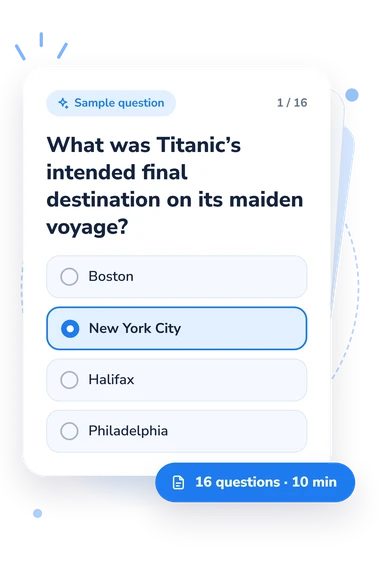
- Boston
- New York City
- Halifax
- Philadelphia
- Charles Lightoller
- Thomas Andrews
- J. Bruce Ismay
- Captain Edward John Smith
- April 10, 1912
- April 12, 1912
- April 14, 1912
- April 15, 1912
Titanic Quiz - Description and methodology of the test
Readers who want to check their understanding of the 1912 disaster can use this titanic quiz as a focused history assessment rather than a test of celebrity facts. For anyone interested in maritime history, it also works as a trivia quiz about Titanic that connects familiar facts with a coherent account of the voyage. The result shows how confidently you connect names, dates, events, evidence, and consequences.
What This Assessment Measures
Its focus is factual, connected knowledge: whether you can place events in sequence, identify people and vessels, and explain why conditions or decisions mattered. The subject suits readers revisiting the maiden voyage, sinking, rescue, inquiries, and discovery of the wreck.
Assessment questions about Titanic examine three connected areas:
- Voyage and ship knowledge shows how well you recognize routes, command, construction, sister ships, and dates.
- Disaster and survival knowledge reflects understanding of flooding, lifeboat capacity, cold-water danger, and the collision.
- Rescue, inquiry, and legacy knowledge captures recognition of distress calls, responding vessels, investigations, wreck discovery, and reforms.
The single displayed scale is Titanic Knowledge: 0-16. Foundations to build (0-6) means central facts need review; Developing knowledge (7-12) reflects a substantial grasp with details to strengthen; Strong knowledge (13-16) indicates a well-rounded command of the subject.
Methodology and Evidence Base
For a quiz about RMS Titanic, each item presents four answer choices and asks for the best-supported historical answer. The prompts combine recall, chronology, causal explanation, and interpretation of documentary evidence. Scoring is shown as one total on the displayed scale; the questionnaire does not state separate item weights, reliability coefficients, or a norm group.
The evidence is historical rather than psychometric. Lynch and Marschall (1992) provide the broad factual framework, while Ballard and Archbold (1987) support material on the wreck’s discovery. The British Board of Trade inquiry anchors questions about lifeboats, wireless communication, the Californian, and the disaster sequence, and the 1912 Nature report supplies period commentary. The questionnaire is conceptually consistent with these sources, not presented as an adaptation of a standardized instrument.
Interpret the outcome as performance on this factual set. Prior reading, films, documentaries, guessing, and familiarity with popular myths can affect performance, and the absence of stated norms or independent psychometric validation limits comparisons beyond this questionnaire.
- Lynch, Donald, and Ken Marschall. Titanic: An Illustrated History. Hodder & Stoughton, 1992. ISBN 0340562714.
- Ballard, Robert D., with Rick Archbold. The Discovery of the Titanic. Warner Books, 1987. ISBN 0446513857.
- Great Britain. Board of Trade. Wreck Commissioner's Court. Loss of the Steamship Titanic: Report of a Formal Investigation into the Circumstances Attending the Foundering on April 15, 1912, of the British Steamship Titanic, of Liverpool, after Striking Ice in or near Latitude 41° 46′ N., Longitude 50° 14′ W., North Atlantic Ocean. London: His Majesty's Stationery Office, 1912.
- The Loss of the Titanic. Nature, vol. 89, 1912, pp. 201-202. DOI 10.1038/089201b0.