
Spelling Bee Quiz
How the Scales are Structured
Who Usually Takes This Test?
See How You Compare
Below is a preview of how scores are typically distributed across each scale.
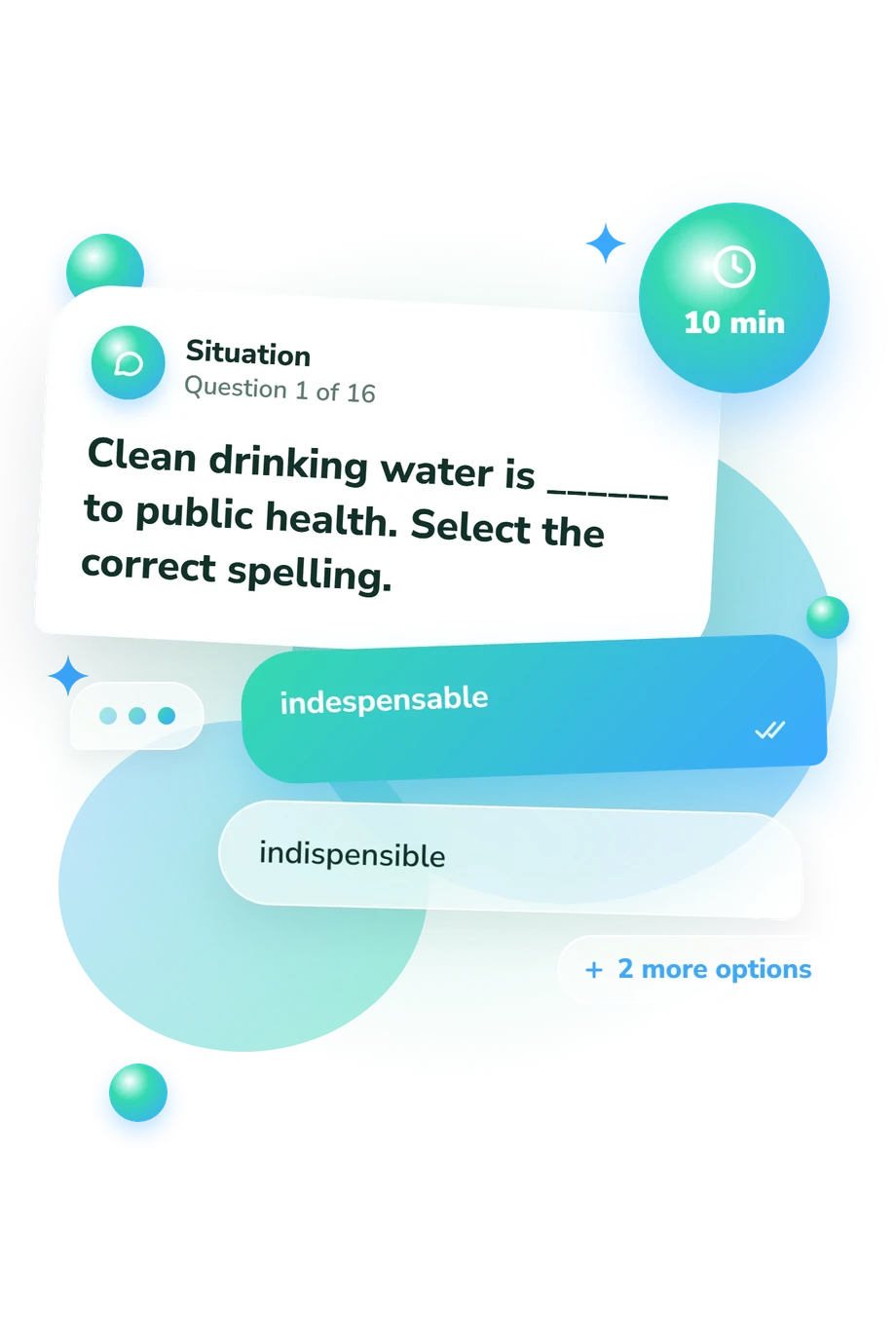
Example Questions From the Test
- indespensable
- indispensible
- indispensable
- indispensabel
- questionaire
- questionnair
- questionnare
- questionnaire
- embarras
- embarass
- embarrass
- embarres
Spelling Bee Quiz - Description and methodology of the test
For learners, writers, and careful proofreaders, this assessment checks how reliably you recognize standard English spellings when distractors look plausible. The Spelling Bee Quiz indicates overall recognition performance on the tested spellings. Completed online, this spelling bee online quiz gives a convenient snapshot for selecting words to review and planning practice.
What This Assessment Measures
Each item places a target word in a sentence and offers four alternatives, so the task examines orthographic recognition rather than free-form composition. Distractors imitate common letter-order and sound-to-letter errors, including doubled consonants, unstable vowel sequences, and confusing endings. It suits spelling practice and proofreading, but its scope is narrower than general writing ability.
The short format supports targeted review of difficult words and focused practice with their standard spellings.
The displayed result uses one scale, Spelling Bee Knowledge: 0-16. Its bands are:
- Foundation to build (0-6) indicates that common spelling patterns and sound-to-letter traps still need focused practice.
- Developing accuracy (7-12) shows recognition of many standard spellings with some less predictable misses.
- Strong command (13-16) reflects accurate recognition across most challenging alternatives.
These bands describe selected multiple-choice recognition, not handwriting, dictation, oral spelling, or independent production.
Methodology and Evidence Base
The questionnaire reports the displayed result bands, but its item-level scoring procedure, including whether weighting or penalties apply, is not specified. Because the format tests recognition among alternatives, it may show orthographic knowledge under choice but not spelling from dictation or independent production. As an online spelling test, it is a focused practice snapshot.
Takanami (2024) is the closest methodological comparison: it treats multiple-choice spelling assessment as an initial way to identify learners who may need support. That parallel concerns format and use, not shared validation; this questionnaire is an online tool, not the published instrument. Zarić, Hasselhorn, and Nagler (2021) connect orthographic knowledge with reading and spelling, while Masterson and Apel (2010) examine developmental sensitivity to written word forms.
These sources support relevance, but they do not establish norms, reliability, or diagnostic cutoffs here. Interpret a lower band as a prompt to review missed words, not as a fixed ability level; a higher band reflects success with this item format rather than complete spelling competence. Attention, effort, guessing, and familiarity with the tested vocabulary can all affect the result.
- Sachiyo Takanami. (2024). Multiple-Choice Spelling Tests With L1 Translation: An Effective First Step in Identifying Japanese EFL Learners Needing Support in Spelling Acquisition. ARELE: Annual Review of English Language Education in Japan, 35, 129-144. 10.20581/arele.35.0_129
- Jelena Zarić, Marcus Hasselhorn, and Telse Nagler. (2021). Orthographic knowledge predicts reading and spelling skills over and above general intelligence and phonological awareness. European Journal of Psychology of Education, 36, 21-43. 10.1007/s10212-020-00464-7
- Julie J. Masterson and Kenn Apel. (2010). The Spelling Sensitivity Score: Noting Developmental Changes in Spelling Knowledge. Assessment for Effective Intervention, 36(1), 35-45. 10.1177/1534508410380039
Updated: