
Christmas Emoji Quiz
How the Scales are Structured
Who Usually Takes This Test?
See How You Compare
Below is a preview of how scores are typically distributed across each scale.
Example Questions From the Test
- Silent Night
- Away in a Manger
- O Holy Night
- The First Noel
- The Holiday
- Christmas with the Kranks
- Miracle on 34th Street
- Home Alone
- A Christmas Carol
- Elf
- The Polar Express
- The Santa Clause
Christmas Emoji Quiz - Description and methodology of the test
People who enjoy Christmas music, films, and traditions can use this activity to test how quickly they connect visual clues with familiar festive references. The christmas emoji quiz gives a focused snapshot of recognition across songs, cinema, characters, customs, and objects. Its response choices also make it a Christmas quiz built from emoji clues with answers available as you work, while the result shows which kinds of references you decode most confidently.
What This Assessment Explores
The clues measure recognition of seasonal symbols and familiar cultural references. They ask you to identify songs, films, figures, objects, and traditions from compact visual combinations, making the activity useful for a festive knowledge check rather than a personality label.
The main clue families contribute different kinds of recognition:
- Songs and carols show whether titles and visual associations guide identification.
- Films and characters reveal how readily you connect a figure or setting with a Christmas story.
- Traditions indicate whether symbolic arrangements point toward seasonal practices.
- Objects and symbols show how accurately you read a direct representation.
Together, these responses form the Christmas Emoji Knowledge scale (0-16). Scores of 0-6 are Festive Starter, 7-12 are Merry Decoder, and 13-16 are Emoji Expert. A Christmas emoji song quiz that includes answers is part of this pattern, alongside film, tradition, character, and object clues.
Methodology and Evidence Base
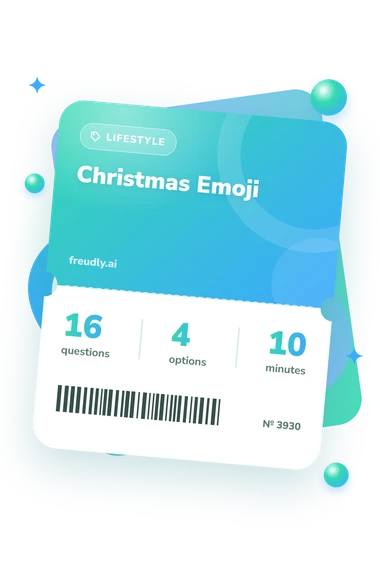
Each item presents an emoji rebus with four answer choices. You interpret a short sequence and select the song, film, character, object, or tradition that best fits. In this Christmas emoji pictionary quiz, answers come from alternatives rather than free text, so the result reflects recognition within a defined choice set.
Threadgold et al. (2018) is the closest comparison: its rebus research treats picture-language combinations as tasks involving shared knowledge and verbal interpretation. This questionnaire is conceptually consistent with that work, not an adaptation of its normative dataset. Miller et al. (2016) shows that emoji meanings vary with context and between users, while Paggio and Tse (2022) examines how emoji are processed alongside written language. These sources support reading the clues as context-dependent visual language rather than universal symbols.
Scoring reports one total on the displayed scale, with higher bands indicating more successful decoding. Because the result is descriptive rather than normed and has no established reliability estimate or clinical cutoff, familiarity with Christmas media and current attention can influence performance; it is best read as a snapshot of festive decoding.
- Threadgold, E., Marsh, J. E., and Ball, L. J. (2018). Normative Data for 84 UK English Rebus Puzzles. Frontiers in Psychology, 9, 2513. 10.3389/fpsyg.2018.02513
- Miller, H., Thebault-Spieker, J., Chang, S., Johnson, I., Terveen, L., and Hecht, B. (2016). "blissfully happy" or "ready to fight": Varying interpretations of emoji. Proceedings of the International AAAI Conference on Web and Social Media, 10(1), 259-268.
- Paggio, P., and Tse, A. P. P. (2022). Are Emoji Processed Like Words? An Eye-Tracking Study. Cognitive Science, 46(2), e13099. 10.1111/cogs.13099
Updated: