
Mom Quiz
How the Scales are Structured
Who Usually Takes This Test?
See How You Compare
Below is a preview of how scores are typically distributed across each scale.
Example Questions From the Test
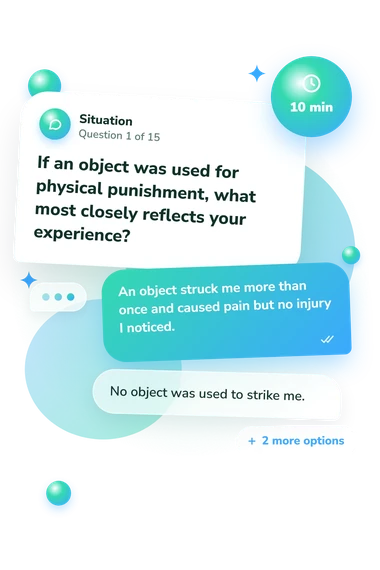
- An object struck me more than once and caused pain but no injury I noticed.
- No object was used to strike me.
- An object struck me once, with only brief discomfort afterward.
- An object caused injury, struck my head or neck, or was used in a way that could cause serious harm.
- I often assume I caused it or deserved it, even when another part of me questions that belief.
- There was no physical punishment for me to interpret this way.
- Someone currently threatens or harms me if I reject the blame or describe the punishment differently.
- I occasionally wonder whether my behavior made the punishment understandable.
- I would like support but feel uncertain about whom to approach or how I will be received.
- There is no related experience or current concern for which I want support.
- Seeking support could trigger threats or retaliation, or I currently have no safe person to contact.
- At least one trusted person is available, although starting the conversation may feel difficult.
Mom Quiz - Description and methodology of the test
People trying to make sense of painful or frightening experiences with a mother or maternal caregiver can use this questionnaire to organize memories, current reactions, and support needs. The mom quiz is intended for self-reflection about physical punishment, intimidation, and control, not for assigning a parenting identity. A physical punishment assessment can help identify experiences that deserve careful attention.
What This Assessment Explores
The items focus on concrete experiences involving a mother or maternal caregiver: hitting, objects, restraint, injury, threats, concealment, self-blame, current distress, boundaries, and access to support. Response choices distinguish isolated, repeated, escalating, and dangerous situations, including cases where leaving or speaking openly felt unsafe.
The questionnaire’s childhood physical abuse screening focus connects remembered conduct with present safety and support. Its three result dimensions are:
- Physical Force and Injury (0-15) shows painful contact, injury, dangerous methods, or escalation. Bands: None selected 0; Review warranted 1-2; Act on concern 3-15.
- Present Impact and Support (0-15) shows effects on daily life, boundaries, coping, safety, and help-seeking. Bands: No present-impact indicated 0; Review warranted 1-2; Act on concern 3-15.
- Threats and Emotional Control (0-15) shows intimidation, retaliation, confinement, coercive language, or monitoring. Bands: No indicator captured 0; Review warranted 1-2; Act on concern 3-15.
Methodology and Evidence Base
Each item presents four answer choices. Rather than a simple agree/disagree scale, options describe what happened, whether it was isolated or repeated, whether danger or injury was involved, and what effect or support need exists now. The format is structured self-report, not a personality inventory.
Scores are reported separately for the three dimensions. The displayed range does not show how many points an answer contributes, so no weighting rule should be inferred. Any concerning response matters independently of the total; a score-3 red flag overrides a lower total, and immediate danger or serious injury calls for urgent help.
The content is conceptually consistent with Kemper, Carlin, and Buntain-Ricklefs (1994) on maternal physical-abuse experiences. Physical force and intimidation also correspond to dimensions examined by Straus et al. (1998), while retrospective exposure resembles the MACE framework described by Teicher and Parigger (2015). This questionnaire is not an adaptation, normed version, or validation of those instruments.
As a maternal caregiver safety assessment, it depends on memory, current context, self-awareness, and willingness to disclose. A low score cannot establish that harm was absent, and the unvalidated bands are reflective summaries rather than severity, legal, or clinical cutoffs.
- Kemper, Kathi J., Albert S. Carlin, and Joanne Buntain-Ricklefs. "Screening for Maternal Experiences of Physical Abuse During Childhood." Clinical Pediatrics 33, no. 6 (1994): 333-339. 10.1177/000992289403300604
- Straus, Murray A., Sherry L. Hamby, David Finkelhor, David W. Moore, and Desmond K. Runyan. "Identification of Child Maltreatment With the Parent-Child Conflict Tactics Scales: Development and Psychometric Data for a National Sample of American Parents." Child Abuse & Neglect 22, no. 4 (1998): 249-270. 10.1016/S0145-2134(97)00174-9
- Teicher, Martin H., and Angelika Parigger. "The ‘Maltreatment and Abuse Chronology of Exposure’ (MACE) Scale for the Retrospective Assessment of Abuse and Neglect During Development." PLOS ONE 10, no. 2 (2015): e0117423. 10.1371/journal.pone.0117423
Updated: