
Will I Ever Find Love Quiz
How the Scales are Structured
Who Usually Takes This Test?
See How You Compare
Below is a preview of how scores are typically distributed across each scale.
Example Questions From the Test
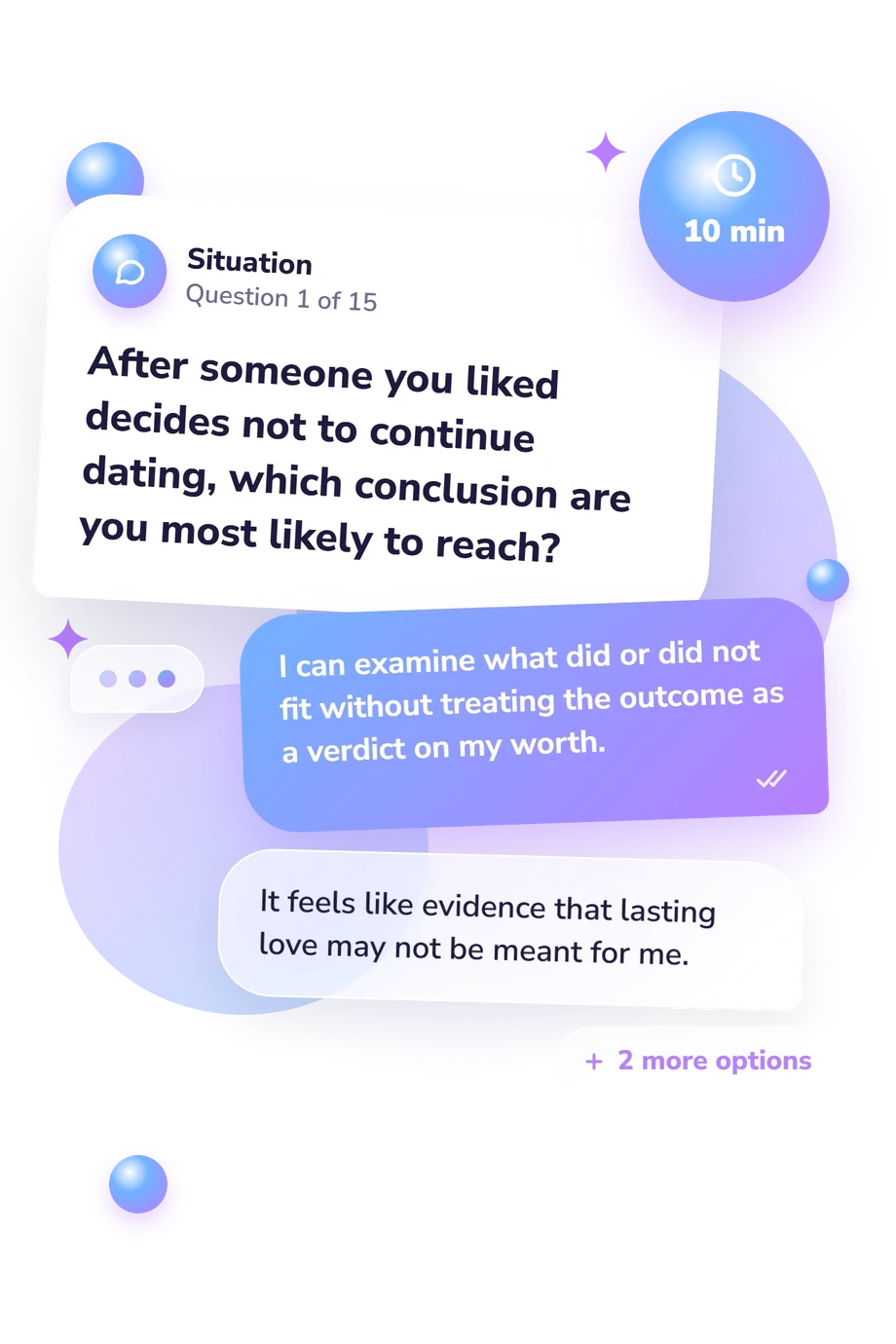
- I can examine what did or did not fit without treating the outcome as a verdict on my worth.
- It feels like evidence that lasting love may not be meant for me.
- I need a recovery period, then I can reconnect with people and activities that steady me.
- I withdraw from dating and wait for the desire to try again to return on its own.
- Keep my familiar routine because consistency matters more to me right now.
- Join a recurring setting or activity where natural conversations could develop over time.
- Wait until I feel more energetic or confident before changing anything.
- Try one new route, such as an introduction or app, though I might use it inconsistently.
- I tend to make a joke, minimize the moment, or move the conversation along.
- I thank them, although I usually keep my deeper reaction to myself.
- I accept it and let them know that their care matters to me.
- I receive it openly and feel able to share care or vulnerability in return.
Will I Ever Find Love Quiz - Description and methodology of the test
People who want to understand their current dating habits can use the Will I Ever Find Love Quiz to examine opportunities, closeness, and partner choice. Its scores describe current actions, openness, and dating judgment rather than future outcomes. Framed as a when will I find love quiz, this profile focuses on changeable choices, including creating openings, communicating interest, and clarifying boundaries.
What This Assessment Explores
Initiative, intimacy, and dating judgment shape the assessment. The resulting profile helps someone wondering whether they will find love examine the actions and judgments involved in dating: creating openings, receiving care, expressing interest, respecting boundaries, and evaluating compatibility when chemistry or uncertainty is strong. As a will I find love quiz, it suits people reviewing dating habits and choices.
Three result dimensions organize those situations:
- Connection-Building Initiative (0-15) shows how actively you create, express, and follow through on openings: Mostly Waiting (0-5), Occasional Initiative (6-10), or Active Engagement (11-15).
- Emotional Availability (0-15) reflects how much emotional and practical room you currently make for intimacy: Guarded (0-5), Selectively Open (6-10), or Available for Closeness (11-15).
- Grounded Dating Judgment (0-15) reflects how you balance attraction with compatibility, boundaries, mixed signals, and setbacks: Emotion-Led Judgment (0-5), Emerging Clarity (6-10), or Grounded Discernment (11-15).
Methodology and Evidence Base
Each item presents a recognizable dating situation with several response options. Choices cover initiating contact, receiving affection, expressing interest, handling boundaries and ambiguity, making practical room for a relationship, and responding to setbacks. The format asks for the reaction closest to your current pattern, not an idealized answer.
Scores are reported separately for the three dimensions. The format shows ranges and descriptive bands but does not document how many points each response contributes. Read higher placement as more of the named tendency. Questions about finding true love become observable choices in this when will I find true love quiz; the bands show current tendencies.
The conceptual frame is consistent with Kredl et al. (2024) on self-clarity and incompatible partners, Harris and Aboujaoude (2016) on online relationship initiation, and Herndon (2017) on emotional availability. The questionnaire is conceptually consistent with these works, not an adaptation of them.
Because this is self-report, mood, recent experiences, self-awareness, and candor can affect responses. The displayed bands are descriptive summaries, while the cited instruments support related constructs without validating this questionnaire itself.
- Kredl, K. F., Kubin, D., & Lydon, J. E. (2024). Self-concept clarity and the evaluation and selection of incompatible dating partners. Personal Relationships, 31(4), 1067-1089. 10.1111/pere.12570
- Harris, K. M., & Aboujaoude, E. (2016). Online friendship, romance, and sex: Properties and associations of the Online Relationship Initiation Scale. Cyberpsychology, Behavior, and Social Networking, 19(8), 487-493. 10.1089/cyber.2016.0164
- Herndon, E. (2017). Emotional availability of adult interpersonal relationships questionnaire (EA-AIRQ): Validation and implications for research and practice. Master's thesis, Colorado State University. 10.25675/3.020877
Updated: