
Nationality Quiz
How the Scales are Structured
Who Usually Takes This Test?
See How You Compare
Below is a preview of how scores are typically distributed across each scale.
Example Questions From the Test
- The country where a person currently resides
- The cultural traditions practiced by a person’s family
- A legal bond of membership between an individual and a state
- The first language a person learned to speak
- Jus sanguinis, or nationality based on descent
- Jus soli, or nationality based on place of birth
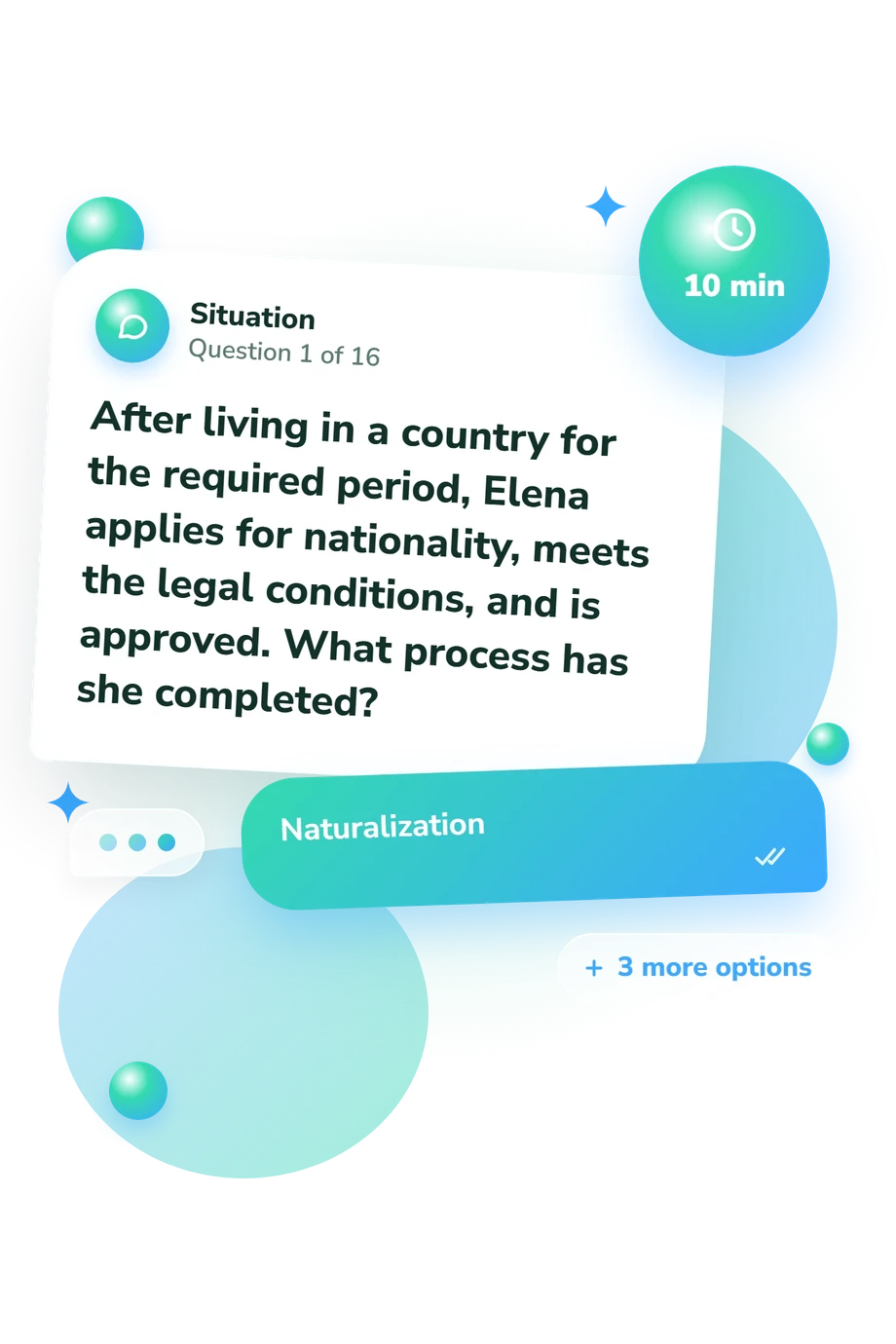
- Naturalization based on residence and application
- Diplomatic protection based on travel abroad
- Permanent migration
- Diplomatic immunity
- Dual nationality
- Stateless residence
Nationality Quiz - Description and methodology of the test
Readers who need to separate legal membership from ancestry, residence, ethnicity, and citizenship can use this nationality quiz as a focused learning check. It clarifies terms used in forms, passports, and public discussions, making it useful as a nationality knowledge test before tackling a real-world question. The result gives an overall indication of conceptual understanding rather than inferring anyone’s status from appearance or family background.
What This Assessment Explores
Nationality is a legal bond between a person and a state. The questions distinguish it from ancestry, ethnicity, language, residence, and passports, and show that cultural identity can coexist with legal nationality. They test naturalization, jus soli, jus sanguinis, dual nationality, statelessness, and refugee status through scenarios. Taken together, these scenarios test whether a respondent can apply those distinctions to situations.
The questions group into three thematic areas:
- Identity distinctions cover how nationality differs from ancestry, ethnicity, residence, and citizenship.
- Status concepts address naturalization, dual nationality, statelessness, and refugee status as distinct legal situations.
- Legal principles examine how jus soli and jus sanguinis operate in context.
This makes the questionnaire a nationality concepts quiz focused on definitions and applications rather than personal identity. Nationality Knowledge is scored 0-16: Foundations to build (0-6), Developing knowledge (7-12), or Strong knowledge (13-16).
Methodology and Scientific Basis
Each item uses a short scenario or definition with four answer choices. Selecting the best option checks recognition and application of a legal concept, not personal storytelling. Responses are summarized in one displayed knowledge total rather than separate topic scores, so the test asks the reader to evaluate principles rather than report a personal identity.
Questions about passports, dual nationality, and citizenship make this a nationality and citizenship quiz as well as a terminology exercise. The test also asks readers to distinguish observable cues such as names, accents, and appearance from appropriate evidence and governing law.
The conceptual reference points are the UNHCR/IPU handbook on nationality and statelessness (2014), alongside van Waas and Recalde Vela’s work. The 1954 Convention defines a stateless person as someone whom no state considers its national under its law. Article 15 of the Universal Declaration of Human Rights supports a right to nationality. This questionnaire is conceptually consistent with those sources, not an adaptation.
The single score reflects conceptual knowledge, while legal nationality depends on jurisdiction-specific law; wording, attention, current context, and prior knowledge can affect responses.
- Achiron, Marilyn, updated by Radha Govil. Nationality and Statelessness: Handbook for Parliamentarians No. 22. 2nd ed. Geneva: Inter-Parliamentary Union and United Nations High Commissioner for Refugees, 2014.
- van Waas, Laura, and María José Recalde Vela. "Nationality and Statelessness." Oxford Bibliographies in International Law. Published 23 March 2012; updated 25 November 2022. 10.1093/obo/9780199796953-0013.
- United Nations. Convention relating to the Status of Stateless Persons. New York, 28 September 1954. United Nations Treaty Series, vol. 360, p. 117.
- United Nations. Universal Declaration of Human Rights. Paris, 10 December 1948.
Updated: