
Wedding Color Quiz
How the Scales are Structured
Who Usually Takes This Test?
See How You Compare
Below is a preview of how scores are typically distributed across each scale.
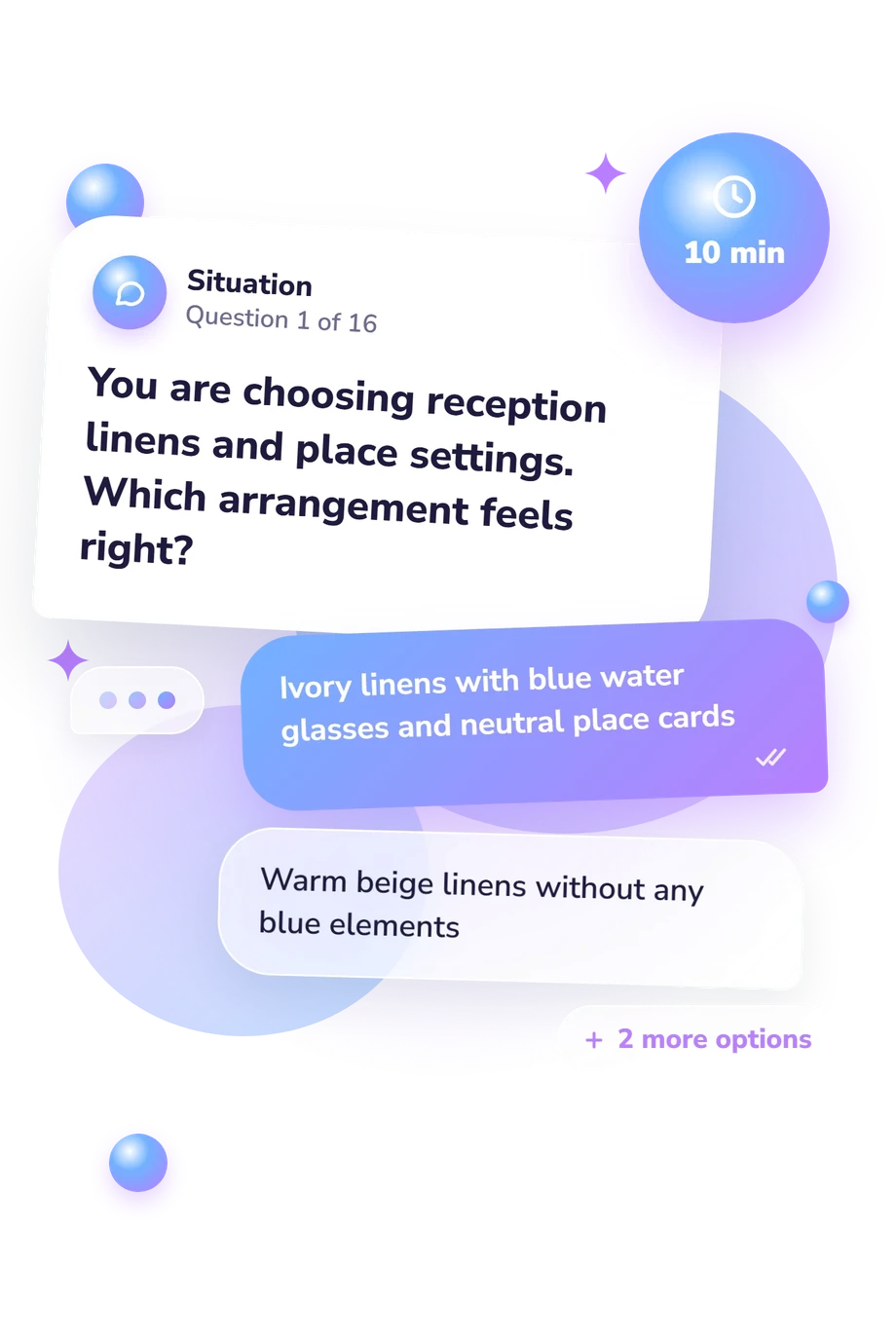
Example Questions From the Test
- Minimal ivory card stock with charcoal lettering
- Deep wine envelopes, blush cards, and romantic floral linework
- Cream paper with a small rose-coloured wax seal
- Soft pink paper with burgundy names and an ivory insert
- A mix of blush, mauve, and burgundy with coordinated floral tones
- Neutral clothing with discreet dusty-pink accessories
- Deep wine attire balanced by blush bouquets or pocket flowers
- Cool blue or grey clothing without pink or red accents
- Mostly bright seasonal flowers tied with a green ribbon
- Ivory roses, eucalyptus-like foliage, and muted sage textures
- White flowers and greenery with a few soft-coloured blooms
- Sculptural blooms in bold colours with almost no foliage
Wedding Color Quiz - Description and methodology of the test
Couples who are still shaping a visual direction can use the wedding color quiz to turn broad preferences into a concrete planning idea. It suits anyone choosing colors for a ceremony, reception, stationery, flowers, attire, or décor. As a wedding color palette quiz, it connects those choices with the atmosphere the celebration should create. It indicates whether one direction leads or whether close scores suggest a deliberate blend.
What This Assessment Explores
Items place preferences in décor, stationery, flowers, attire, and styling. The wedding color schemes quiz presents four directions. The four scales are:
- Botanical Sage & Ivory (0-12) shows fit for greenery, ivory, and natural textures: Light Botanical Note (0-4), minor accent; Fresh Garden Balance (5-8), another accent; Botanical Harmony (9-12), strong layering.
- Coastal Blue & Sand (0-12) shows fit for blue, sand, ivory, and relaxed textures: Coastal Detail (0-4), isolated accent; Breezy Balance (5-8), broad fit; Coastal Calm (9-12), layered coastal atmosphere.
- Modern Black & Champagne (0-12) shows fit for graphic contrast, metallic warmth, and crisp lines: Refined Accent (0-4), finishing detail; Contemporary Contrast (5-8), tempered accents; Modern Celebration (9-12), strong evening match.
- Romantic Blush & Burgundy (0-12) shows fit for blush, berry, wine, and candlelight: Subtle Connection (0-4), small accent; Romantic Accent (5-8), balanced pinks and wine; Rich Romance (9-12), strong layering.
Methodology and Evidence Base
Each item offers four visual alternatives rather than a numerical agreement scale. Respondents choose among wedding details such as stationery, flowers, lighting, and attire. The questionnaire produces four named palette scores, and scores within one point may be blended; the bands describe accent use, balanced influence, or a stronger overall fit.
The format helps couples decide how to choose wedding colors through this quiz: it connects color preference with decisions a couple can make. The choice stays tied to the celebration’s intended mood rather than color alone. For someone taking the what should my wedding colors be quiz, the result shows whether one direction leads or several deserve consideration.
The test’s preference-and-harmony focus is conceptually consistent with Schloss and Palmer (2011), while its mood-related themes are conceptually consistent with Ou et al. (2004).
Interpret the four scores as descriptive guidance: a leading score identifies the palette direction most aligned with the answers, while close scores can support a deliberate blend. Because responses are self-reported, current taste, context, venue, and personal associations may shape the result.
- Schloss, K. B., & Palmer, S. E. (2011). Aesthetic response to color combinations: preference, harmony, and similarity. Attention, Perception, & Psychophysics, 73(2), 551-571. 10.3758/s13414-010-0027-0
- Ou, L.-C., Luo, M. R., Woodcock, A., & Wright, A. (2004). A study of colour emotion and colour preference. Part II: Colour emotions for two-colour combinations. Color Research & Application, 29(4), 292-298. 10.1002/col.20024
Updated: