
Digimon Partner Quiz
How the Scales are Structured
Who Usually Takes This Test?
See How You Compare
Below is a preview of how scores are typically distributed across each scale.
Example Questions From the Test
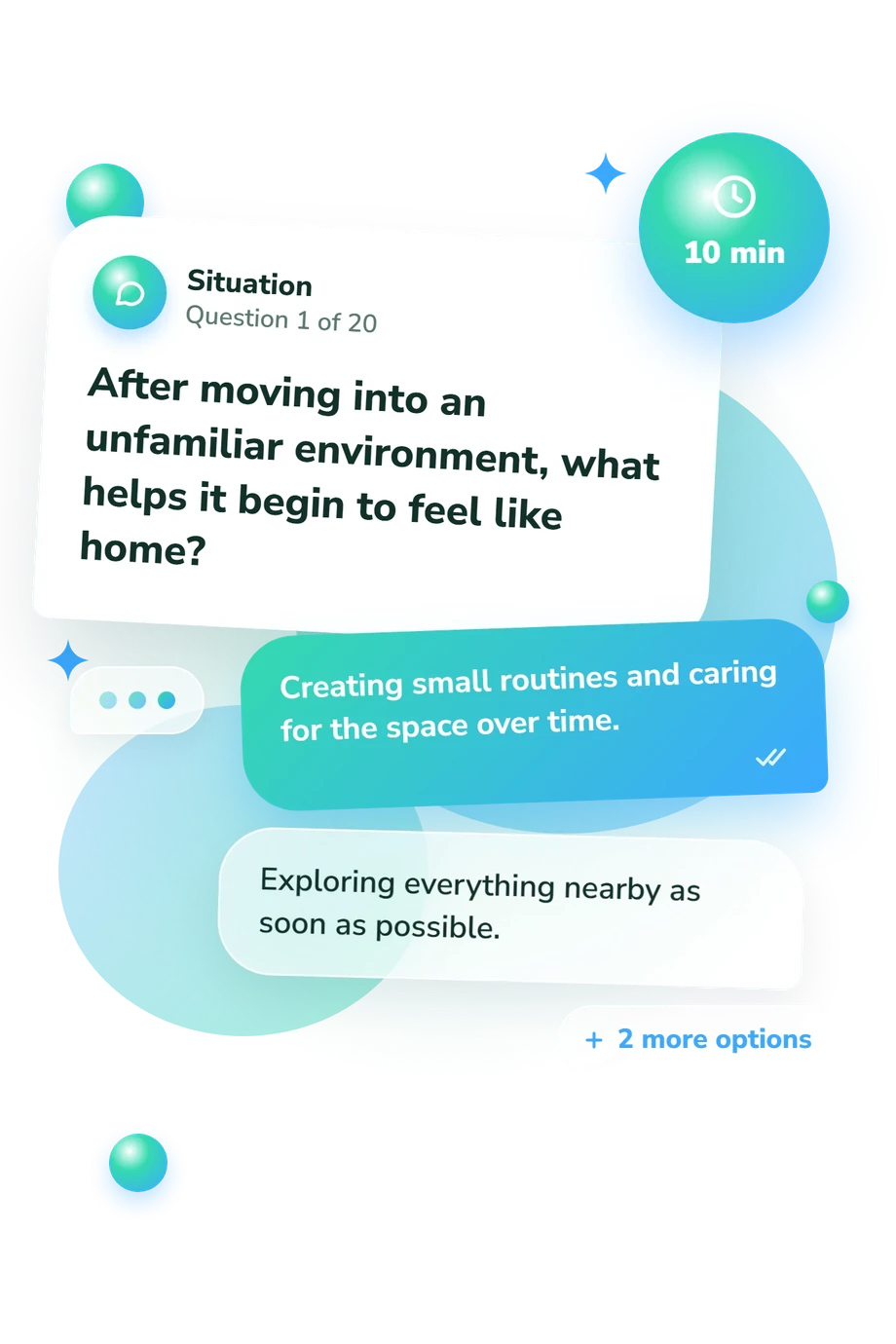
- Creating small routines and caring for the space over time.
- Exploring everything nearby as soon as possible.
- Observing how the place works before settling in.
- Finding the busiest social spot and meeting people there.
- Gradual growth that lets me become more fully myself.
- A dramatic reinvention that opens a completely new chapter.
- Progress measured through clear goals and milestones.
- Change supported by a trusted person who grows beside me.
- Point out their genuine growth and encourage them honestly.
- Brainstorm a daring new direction they could try.
- Analyze the technique and identify what could be refined.
- Lighten the moment before helping them regain perspective.
Digimon Partner Quiz - Description and methodology of the test
Fans who want to connect their own habits with a familiar fictional world can use the Digimon Partner Quiz to consider which partnership style feels most natural. As a digimon personality quiz, it suits readers who want playful self-reflection rather than a fixed identity label. The result compares five Digimon affinities and shows whether your preferences lean toward partnership styles emphasizing courage, loyalty, playfulness, emotional growth, or analytical curiosity.
What This Assessment Explores
Items cover routines, setbacks, support, planning, and spontaneity.
- Agumon Partner Affinity (0-12) reflects Agumon's wholehearted, courage-forward style: Deliberate Counterbalance (0-4), Adventure Spark (5-8), Courageous Match (9-12).
- Gabumon Partner Affinity (0-12) reflects Gabumon's reserved, steadfast, loyal style: Open-Channel Connection (0-4), Trusted Companion (5-8), Steadfast Match (9-12).
- Gomamon Partner Affinity (0-12) reflects Gomamon's playful, sociable, improvisational style: Structured Rhythm (0-4), Flexible Companion (5-8), Playful Match (9-12).
- Palmon Partner Affinity (0-12) reflects Palmon's sincere, expressive, growth-oriented style: Independent Evolution (0-4), Growing Connection (5-8), Flourishing Match (9-12).
- Tentomon Partner Affinity (0-12) reflects Tentomon's observant, analytical, inquisitive style: Experiential Explorer (0-4), Curious Collaborator (5-8), Insightful Match (9-12).
The quiz about what Digimon partner you would have compares styles: highest affinity leads; scores within one point blend.
Methodology and Scientific Basis
Each item presents a scenario with four response options. Choices cover uncertainty, social tension, change, practical problems, and supporting someone, turning familiar situations into preference signals without technical personality vocabulary.
Conceptually, the questionnaire is consistent with Park and Henley (2007), who linked personality with preferences for fictional game characters, and Rain and Mar (2021), who connected attachment patterns with engagement with fictional figures. The Big Five, discussed by John and Srivastava (1999), supplies general background for the trait vocabulary, not a scoring model for these partner affinities.
Scoring compares five character-affinity dimensions as separate affinity scores. The highest scale leads the result, while scores within one point create a blended profile. In this digimon rookie partner quiz, the scores compare affinity with action-, loyalty-, play-, growth-, and analysis-oriented partner styles rather than declaring one character universally superior.
Online self-report results express relative affinity among the five partner styles through 0-12 ranges, not population norms or clinical cutoffs. Mood, imagined context, response bias, and self-awareness can shape answers, so the result works best as a focused reflection prompt.
- Park, Anna E., and Tracy B. Henley. “Personality and Fantasy Game Character Preferences.” Imagination, Cognition and Personality, vol. 27, no. 1, 2007, pp. 37-46. 10.2190/IC.27.1.d
- Rain, Marina, and Raymond A. Mar. “Adult attachment and engagement with fictional characters.” Journal of Social and Personal Relationships, vol. 38, no. 9, 2021, pp. 2792-2813. 10.1177/02654075211018513
- John, Oliver P., and Sanjay Srivastava. “The Big Five Trait Taxonomy: History, Measurement, and Theoretical Perspectives.” In Handbook of Personality: Theory and Research, 2nd ed., edited by Lawrence A. Pervin and Oliver P. John, Guilford Press, 1999, pp. 102-138.
Updated: