
First 20 Elements Quiz
How the Scales are Structured
Who Usually Takes This Test?
See How You Compare
Below is a preview of how scores are typically distributed across each scale.
Example Questions From the Test
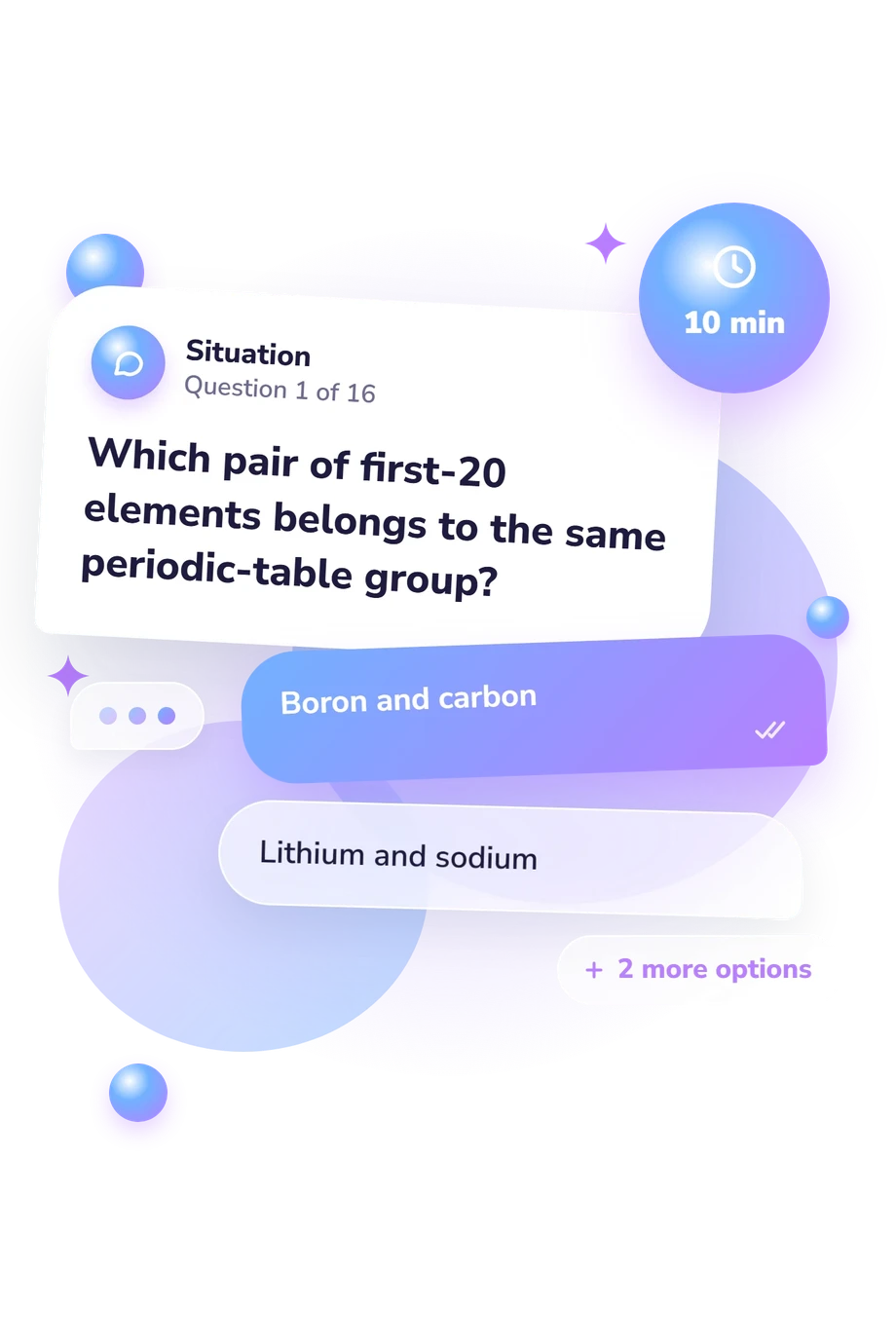
- Boron and carbon
- Lithium and sodium
- Nitrogen and oxygen
- Magnesium and aluminium
- Sodium
- Magnesium
- Aluminium
- Silicon
- NaCl
- CuCl₂
- ZnS
- FeO
First 20 Elements Quiz - Description and methodology of the test
Students, teachers, and curious learners can use this assessment to check whether they connect names with chemical structure and recognize the first 20 elements confidently. The first 20 elements quiz reports an overall knowledge score or interpretive band rather than a multidimensional profile. As a quiz about the first 20 elements of the periodic table, it can support revision before lessons, exams, or independent study.
What This Assessment Measures
Questions test whether learners connect names, symbols, atomic numbers, positions, and basic atomic structure. They cover proton counts, shells, ions, formulas, sequence, groups, and periods, checking recognition as well as recall. It suits anyone reviewing introductory chemistry or testing memorized facts.
The main dimensions represented in the items are:
- Names and symbols show whether you match an element with its standard abbreviation.
- Atomic numbers and order indicate whether proton counts and sequence are secure.
- Groups and periods reveal whether table position helps you recognize families.
- Atomic structure and formulas show whether shells, ions, and compounds identify elements.
The single result scale is First 20 Elements Knowledge (0-16): Foundations to build (0-6), Developing knowledge (7-12), or Strong command (13-16). This periodic-table quiz tests the first 20 elements and is most useful when the band guides focused review.
Methodology and Evidence Base
Each item offers four choices. Prompts test recognition, comparison, ordering, or application of elementary relationships, so performance depends on selecting the chemically correct option. The elements 1 20 quiz format samples factual recall and short reasoning across the first 20 entries.
The test reports one overall result rather than subscores, giving a broad snapshot across the symbols, sequence, table structure, and atomic models addressed. In a periodic table 1 20 quiz, the emphasis remains foundational rather than advanced chemistry.
The content is conceptually consistent with Chemistry 2e (Flowers et al., 2019) on atomic structure, ions, compounds, and periodic organization. IUPAC conventions support the element identities, symbols, atomic numbers, and arrangement used here. Questions apply these concepts to shell arrangements, ions, families, and simple formulas; the questionnaire is not a direct adaptation of any cited source.
This online knowledge check has no stated population norms or independently reported reliability for its result. Guessing, recent study, attention, and familiarity with notation can affect performance, so it describes this item set at completion rather than a fixed level of scientific ability.
- Flowers, Paul, Klaus Theopold, Richard Langley, and William R. Robinson. Chemistry 2e. Houston, TX: OpenStax, 2019.
- Holden, Norman E., Tyler B. Coplen, John K. Böhlke, Lauren V. Tarbox, James Benefield, John R. de Laeter, Peter G. Mahaffy, Gerald O'Connor, Eric Roth, David H. Tepper, Tomas Walczyk, Michael E. Wieser, and Shige Yoneda. IUPAC Periodic Table of the Elements and Isotopes (IPTEI) for the Education Community (IUPAC Technical Report). Pure and Applied Chemistry, 90(12), 1833-2092, 2018. 10.1515/pac-2015-0703
- Mendeleev, Dmitri Ivanovich. The Relation between the Properties and Atomic Weights of the Elements. Journal of the Russian Chemical Society, 1, 60-77, 1869. English translation by C. Giunta.
Updated: