
Spanish Vocab Quiz
How the Scales are Structured
Who Usually Takes This Test?
See How You Compare
Below is a preview of how scores are typically distributed across each scale.
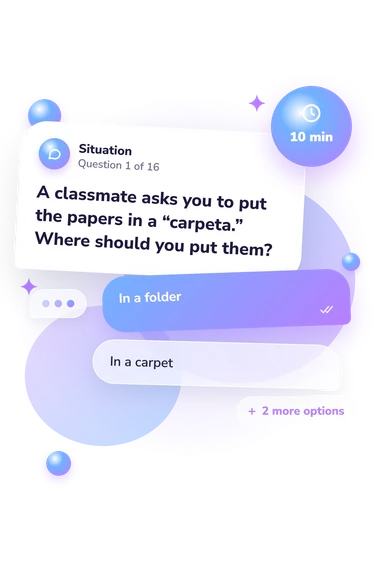
Example Questions From the Test
- In a folder
- In a carpet
- In a notebook
- In a briefcase
- The purchase price
- The repair cost
- The rent
- The utility bill
- They lost their wallet
- They forgot their keys
- They locked the door
- They found their keys
Spanish Vocab Quiz - Description and methodology of the test
For learners who want a quick, practical sense of their Spanish word knowledge, the Spanish Vocab Quiz focuses on recognizing meaning rather than testing every part of language ability. It suits people studying independently, refreshing familiar material, or deciding which vocabulary to review next. As a Spanish vocabulary quiz, it turns everyday examples into a clear starting point for further practice.
What This Assessment Explores
The questions examine receptive vocabulary: connecting a Spanish word or expression with the meaning that fits an English prompt and situation. Themes include everyday nouns, routines, verbs, adjectives, false cognates, and phrases. This Spanish words quiz suits learners checking recognition before review.
The item themes show what the result draws on:
- Everyday nouns and places indicate recognition of words used in situations.
- Actions and routines show understanding of common verbs in context, keeping this basic Spanish vocabulary quiz focused on usable language.
- False cognates and contextual phrases reveal whether similar forms are distinguished and surrounding words guide the intended translation.
The result uses Spanish Vocabulary Knowledge (0-16): Foundation 0-6, Developing 7-12, and Strong 13-16. These bands range from core vocabulary needing review to broad recognition of common words and meanings in context; they are not a complete measure of Spanish proficiency.
Methodology and Evidence Base
Each item presents a Spanish word, expression, or sentence with four English choices. This contextual multiple-choice method tests recognition, translation, and sensitivity to surrounding clues; distractors may reflect a false cognate, a nearby concept, or a literal reading. The displayed result is 0-16, but the questionnaire does not document individual point weighting, so no extra conversion should be assumed.
The assessment is an online vocabulary snapshot, not a standardized reproduction of a published test. The closest conceptual comparison is 3K-LEx-MC (Robles-García et al., 2022), a Spanish-English multiple-choice measure developed for placement. This questionnaire is conceptually consistent with that format but is not an adaptation and does not carry its norms. Lextale-Esp (Izura et al., 2014) provides a second comparison: it uses word/nonword lexical decisions to estimate vocabulary size, whereas this online Spanish vocabulary quiz asks for meanings in context.
Use the result to choose study priorities rather than judge overall language level. Prior exposure, guessing, learning context, and inference skills can affect performance. The test does not cover grammar, pronunciation, listening, speaking, or sustained reading.
- Robles-García, Pablo, Glen H. Wallace, and Claudia Helena Sánchez-Gutiérrez. “3K-LEx-MC: The creation and validation of a multiple-choice vocabulary placement test for Spanish language learners.” ITL - International Journal of Applied Linguistics, vol. 174, no. 1, 2023, pp. 135-165. 10.1075/itl.22008.rob
- Izura, Cristina, Fernando Cuetos, and Marc Brysbaert. “Lextale-Esp: A test to rapidly and efficiently assess the Spanish vocabulary size.” PSICOLOGICA, vol. 35, no. 1, 2014, pp. 49-66.
Updated: