
College Mascot Quiz
How the Scales are Structured
Who Usually Takes This Test?
See How You Compare
Below is a preview of how scores are typically distributed across each scale.
Example Questions From the Test
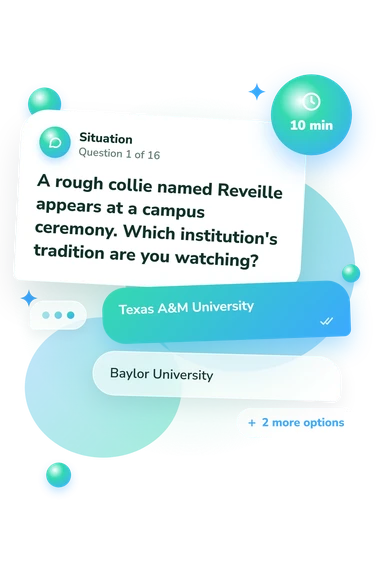
- Texas A&M University
- Baylor University
- Southern Methodist University
- Texas Christian University
- Mississippi State University
- University of Arkansas
- University of Alabama
- University of Mississippi
- A ram
- A buffalo
- A mustang
- A bear
College Mascot Quiz - Description and methodology of the test
Readers who enjoy campus traditions, alumni culture, or college sports can use this college mascot quiz to check how accurately they connect recognizable university symbols with their schools. It also works as a college football mascot quiz for people testing familiarity with game-day identities beyond one team or conference. Results show which associations feel secure and which mascot stories, animals, or affiliations deserve a closer look.
What This Assessment Explores
The assessment measures recognition of prominent college mascots and the links connecting each figure to a university, animal, team, color tradition, or campus setting. A college mascot test suits students, alumni, sports viewers, and curious readers because it examines cultural knowledge rather than loyalty or athletic ability.
The result can be understood through three related themes:
- College Mascot Knowledge (0-16) counts correct identifications: Starting Lineup (0-6), Developing Fan (7-12), and Standout Expert (13-16) describe increasing command of the tested associations.
- Animal and character recognition reflects how readily you identify named mascots, live animals, and costumed figures from brief clues.
- School affiliation and tradition recognition reflects whether you connect each mascot with its university and a distinctive campus or game-day setting.
A higher result means more intended relationships were identified correctly in this set, not that it measures intelligence or fandom.
Methodology and Scientific Basis
Each item presents a short clue with four answer choices. Depending on the clue, you select a school, animal, or mascot; every correct response contributes one point. The format therefore tests recognition and matching rather than open-ended recall, so prior exposure to particular conferences, regions, or televised sports can influence performance.
Yarbrough (1998) supplies historical context for college mascot names, nicknames, symbols, and traditions. The questionnaire is conceptually consistent with that work, but it is not presented as a reproduction or adaptation of the book. Patterson et al. (2021) offer a closer perspective on live mascot programs and stakeholder experiences, supporting the relevance of live-animal traditions without validating this online questionnaire.
The result should be read as performance on this selected knowledge set. Its scoring is not standardized against population norms, and the bands are interpretive labels rather than clinical cutoffs. Because one response is chosen for each clue, the university mascot quiz may reflect prior exposure and regional familiarity as much as broader interest in college athletics.
- Yarbrough, Roy E. Mascots: The History of Senior College and University Mascots/Nicknames. Bluff University Communications, 1998. ISBN 9781891248252.
- Patterson, Clinton A., Don M. Beach, Juanita M. Reyes, and Stephen M. Sloan. "Stakeholder Perceptions and Experiences of a College Live Mascot Program: A Study of Higher Education Ad Hoc Change." Innovative Higher Education, vol. 46, no. 4, 2021, pp. 377-392. 10.1007/s10755-021-09547-9.