
Dog Breed Identification Quiz
How the Scales are Structured
Who Usually Takes This Test?
See How You Compare
Below is a preview of how scores are typically distributed across each scale.
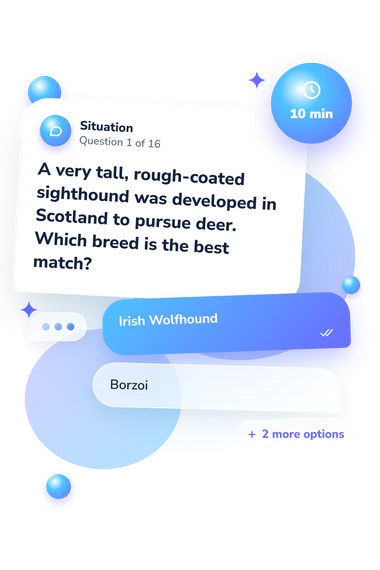
Example Questions From the Test
- Irish Wolfhound
- Borzoi
- Greyhound
- Scottish Deerhound
- Tibetan Mastiff
- Chinese Shar-Pei
- Keeshond
- Chow Chow
- Papillon
- Japanese Chin
- Cavalier King Charles Spaniel
- Pekingese
Dog Breed Identification Quiz - Description and methodology of the test
Curious dog lovers can use this dog breed identification quiz to gauge their current knowledge and choose which breed groups to study next. Matching breed names to clues makes this a practical name-that-dog-breed quiz, while the result can suggest unfamiliar groups for further comparison. It offers a starting point for more deliberate learning about breed differences.
What This Assessment Measures
Questions link visible features with breed names, covering build, coat, ears, tails, head shape, vocalization, origin, and traditional work. The result reflects breed knowledge, not personality or behavior. Recognition is tested through a dog identification quiz that asks you to connect breed names with recognizable clues and distinguish close visual similarities.
Results use the Dog Breed Identification Knowledge scale, from 0 to 16, with three displayed bands:
- Foundation (0-6) indicates recognition of some prominent traits and suggests that you may benefit from comparing purpose, build, coat, and origin.
- Developing Identifier (7-12) shows that many breeds, including close look-alikes, are distinguishable, while unfamiliar clues may need practice.
- Strong Identifier (13-16) reflects broad, accurate knowledge across companion, herding, sporting, hound, terrier, and working breeds.
These bands describe general breed knowledge, not the ancestry of an individual dog.
Methodology and Evidence Base
Each item gives a breed description and four choices. Clues combine appearance with purpose, origin, or history, so you choose the best overall match rather than rely on one feature. The format measures recognition and comparison, not observation of an individual dog.
Olson et al. (2015) offers the closest evidence connection: visual identification of pit bull-type dogs varied between trained shelter observers. Gunter et al. (2018) likewise shows that appearance-based labels and genetic heritage are not interchangeable. This questionnaire is conceptually consistent with those findings, not an adaptation of either study.
The AKC’s 2023 breed reference supplies practical guidance on purpose, structure, coat, and origin. The online questionnaire has no established standardization, norms, reliability, or validity.
Scoring reports the number of correct responses. Rather than functioning as a mixed breed dog identification quiz, the questionnaire asks you to match named breeds with defining clues. Current familiarity with breed clues can affect performance, so the result is best read as a snapshot of what you recognize now.
- Olson KR, Levy JK, Norby B, Crandall MM, Broadhurst JE, Jacks S, Barton RC, Zimmerman MS. Inconsistent identification of pit bull-type dogs by shelter staff. The Veterinary Journal. 2015;206(2):197-202. 10.1016/j.tvjl.2015.07.019
- Gunter LM, Barber RT, Wynne CDL. A canine identity crisis: Genetic breed heritage testing of shelter dogs. PLOS ONE. 2018;13(8):e0202633. 10.1371/journal.pone.0202633
- American Kennel Club. The New Complete Dog Book, 23rd Edition: Official Breed Standards and Profiles for Over 200 Breeds. CompanionHouse Books; 2023.