
Does My Crush Like Me Quiz for Girls
How the Scales are Structured
Who Usually Takes This Test?
See How You Compare
Below is a preview of how scores are typically distributed across each scale.
Example Questions From the Test
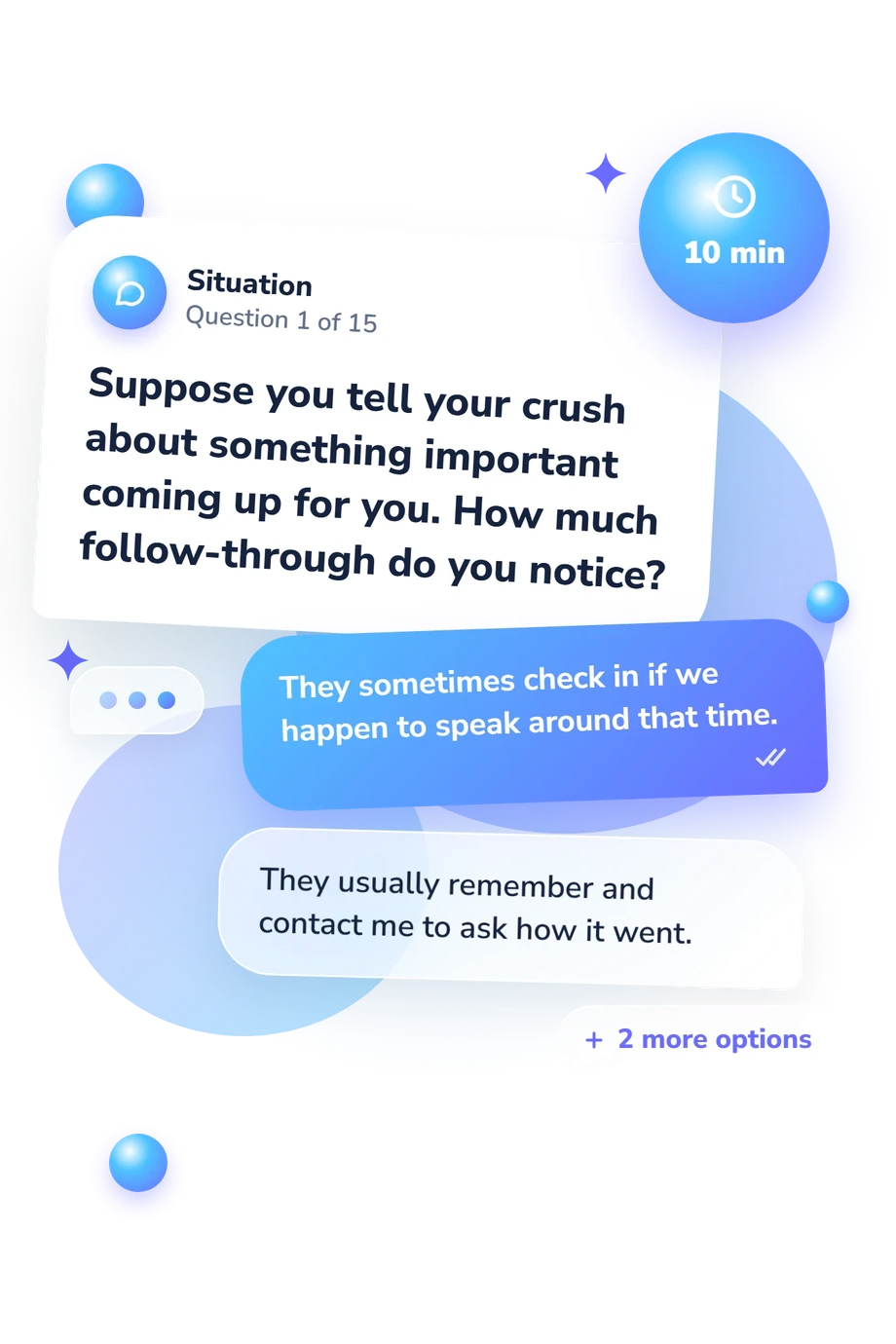
- They sometimes check in if we happen to speak around that time.
- They usually remember and contact me to ask how it went.
- They respond in the moment but do not usually return to it later.
- We do not yet share that kind of information, or I have seen no follow-up.
- They sometimes return to it if there was something specific left unfinished.
- The conversation generally ends there.
- They reliably find a way to continue or ask what I was about to say.
- They continue only if I bring the subject up again.
- They suggest a specific time or activity and help make it happen.
- The idea remains vague unless I take the next step.
- We have not discussed spending time together outside our usual setting.
- They sometimes follow up, although plans do not always come together.
Does My Crush Like Me Quiz for Girls - Description and methodology of the test
People who are unsure how to read a crush’s behavior can use Does My Crush Like Me Quiz for Girls to organize repeated observations rather than focus on one memorable interaction. This crush quiz for girls is intended for self-reflection about attention, warmth, and effort in a developing connection. It offers a structured profile of possible signals while leaving room for uncertainty, context, and the other person’s own words.
What This Assessment Explores
Instead of producing a yes-or-no verdict, the questionnaire examines repeated patterns in how a crush responds, remembers, initiates, and shows personal warmth. It suits people reflecting on an emerging connection shaped by school, shared activities, friends, or limited one-to-one contact. When the person you like is a classmate, this classmate crush quiz keeps attention on observable patterns rather than one dramatic moment.
The result groups those observations into three dimensions:
- Attentive Engagement, 0-15, shows how consistently the person is present and responsive: Limited signal 0-5, Mixed signal 6-10, Strong pattern 11-15.
- Distinctive Affection and Openness, 0-15, shows whether warmth seems personal or romantically open: Limited signal 0-5, Ambiguous warmth 6-10, Distinctive warmth 11-15.
- Initiative and Follow-Through, 0-15, shows whether the person creates opportunities and follows through: Limited initiative 0-5, Shared/uneven initiative 6-10, Consistent investment 11-15.
Methodology and Evidence Base
As a self-report tool, each item presents a situation involving memory, follow-up, attention, or warmth. Response options range from limited contact to repeated initiative and engagement, helping the respondent choose a fitting description. This questionnaire is directed to girls, not to a different audience.
In this crush interest quiz, responses combine into three displayed dimensions, with each total placed in a named band. The bands describe the strength and consistency of observed signals, not a decisive answer, proof of attraction, or consent. Shyness, communication style, social setting, and unequal opportunities can alter how interest appears.
The questionnaire is conceptually consistent with, but not presented as an adaptation of, published instruments. Muehlenhard et al. (1986) examines cues that can communicate dating interest. Crasta et al. (2021) supports attention to perceived responsiveness, while Hall et al. (2010) addresses individual differences in romantic-interest communication. These sources offer a traceable framework, not standardization, norms, reliability, or validity for this exact online version. Memory, hopes, and selective attention may shape responses, so use the profile for organized reflection alongside respectful communication and boundaries.
- Muehlenhard, Charlene L., Mary A. Koralewski, Sandra L. Andrews, and Cynthia A. Burdick. "Verbal and Nonverbal Cues That Convey Interest in Dating: Two Studies." Behavior Therapy 17, no. 4 (1986): 404-419. 10.1016/S0005-7894(86)80071-5
- Crasta, Dev, Ronald D. Rogge, Michael R. Maniaci, and Harry T. Reis. "Toward an Optimized Measure of Perceived Partner Responsiveness: Development and Validation of the Perceived Responsiveness and Insensitivity Scale." Psychological Assessment 33, no. 4 (2021): 338-355. 10.1037/pas0000986
- Hall, Jeffrey A., Steve Carter, Michael J. Cody, and Julie M. Albright. "Individual Differences in the Communication of Romantic Interest: Development of the Flirting Styles Inventory." Communication Quarterly 58, no. 4 (2010): 365-393. 10.1080/01463373.2010.524874
Updated: