
Gen Alpha Slang Quiz
How the Scales are Structured
Who Usually Takes This Test?
See How You Compare
Below is a preview of how scores are typically distributed across each scale.
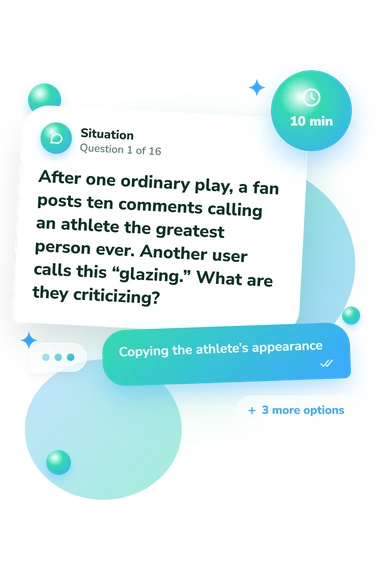
Example Questions From the Test
- As proof that the video was filmed in Ohio
- As shorthand for something strange, chaotic, or surreal
- As praise for a popular Midwestern trend
- As a warning that the video is fictional
- A gamer loses points for leaving a match
- A streamer charges viewers to enter a chat
- A fan pays extra for concert merchandise
- A friend takes a few fries from someone else’s meal
- Memorize answers without understanding them
- Ask friends to complete the work
- Focus seriously and commit to the task
- Stop studying because preparation is complete
Gen Alpha Slang Quiz - Description and methodology of the test
People who want to understand the fast-moving language of memes, comments, and short-form video can use the Gen Alpha Slang Quiz as a self-check. Readers encountering youth internet slang can use this gen alpha quiz to check whether they recognize terms such as “rizz,” “aura,” or “lock in” online. The result indicates knowledge and accuracy in recognizing the meanings, tone, and context represented by the quiz rather than merely vocabulary.
What This Test Measures
These questions measure practical interpretation rather than age or identity. Each item places slang in a social, gaming, school, fashion, or meme scenario and asks which explanation fits. The result helps readers who know words but want confidence with tone and context.
The main themes are:
- The Gen Alpha Slang Knowledge scale runs from 0 to 16, with one point per correct answer. Getting Oriented (0-6), In the Loop (7-12), and Slang Fluent (13-16) mark increasing command of the meanings, tone, and context represented here.
- Evaluative and social-image terms test recognition of praise, criticism, comparison, presence, independence, and charm.
- Meme and conversational terms test whether context clarifies flexible expressions such as “brainrot,” “Fanum tax,” “lock in,” and “skibidi.”
Because this generation alpha quiz asks for contextual interpretations, its result is a snapshot rather than a fixed label.
Methodology and Evidence Base
Each item uses a short scenario, a target expression, and four answer choices. The respondent selects the explanation that best matches the expression in context, so the task tests interpretation rather than recall of a dictionary definition. The displayed score awards one point for each correct response, and the total is interpreted through the catalogue’s supplied result categories.
The content is conceptually consistent with Adhi and Masykuroh (2025), whose analysis highlights slang as socially situated language in short-form video comments. Ishita and Mamidi (2025) discuss rapid change, hybrid meanings, and translation difficulty, while Madsen (2026) describes meme-driven language as shaped by digital platforms. These studies provide conceptual context for the quiz’s examples; they do not validate this online questionnaire or establish norms for its scores, so interpretation remains catalogue-defined rather than a standardized language-proficiency judgment.
The result from this slang quiz can reflect online exposure, familiarity with particular platforms, and the respondent’s current cultural context. Slang changes quickly, making the result a time-specific knowledge snapshot, and careful reading still affects performance.
- Ilham Murti Adhi and Qanitah Masykuroh. 2025. Sociolinguistic Analysis of Gen Alpha’s Slang in YouTube Shorts Comments of Meme Content Creators. Journal of English Language Teaching and Literature (JELITA), 6(1), 299-316. 10.56185/jelita.v6i1.920
- Ishita and Radhika Mamidi. 2025. The Evolution of Gen Alpha Slang: Linguistic Patterns and AI Translation Challenges. In Proceedings of the 63rd Annual Meeting of the Association for Computational Linguistics (Volume 4: Student Research Workshop), 678-686. Association for Computational Linguistics. 10.18653/v1/2025.acl-srw.43
- Dag Øivind Madsen. 2026. Generation alpha speaks in memes: a conceptual framework for platformed language. Frontiers in Communication, 11, Article 1695863. 10.3389/fcomm.2026.1695863