
What Hair Color Looks Best on Me Quiz
How the Scales are Structured
Who Usually Takes This Test?
See How You Compare
Below is a preview of how scores are typically distributed across each scale.
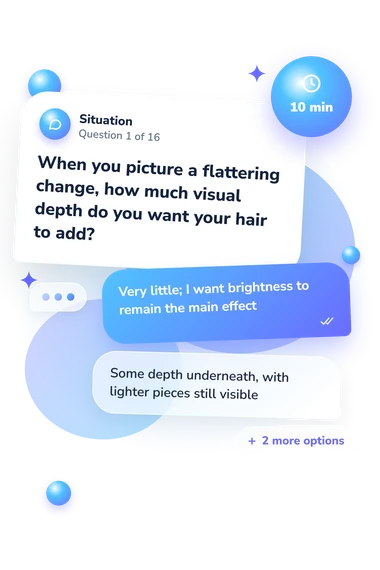
Example Questions From the Test
- Very little; I want brightness to remain the main effect
- Some depth underneath, with lighter pieces still visible
- A rich brunette base with dimensional variation
- Strong, glossy espresso depth that frames my features
- I would want to neutralize it promptly for an icy finish
- I would soften it slightly but keep a beige result
- I would enjoy the warmth if it looked glossy and intentional
- I would alternate between neutral and gently warm toners
- Silver jewelry, charcoal clothing, and a smoky finish
- Mixed metals, denim, and a neutral-beige finish
- Gold jewelry, cream clothing, and a sunlit finish
- Mostly neutral clothing with just a slight cool cast
What Hair Color Looks Best on Me Quiz - Description and methodology of the test
People considering a noticeable color change can use the What Hair Color Looks Best on Me Quiz to organize preferences before speaking with a stylist. It focuses on the relationship between desired contrast, warmth, finish, clothing palette, and willingness to maintain the shade. It is not a hair color quiz for skin tone: skin tone is not assessed directly, and the profile instead compares preferred directions and maintenance comfort.
What This Assessment Explores
The questionnaire maps color directions through preference and upkeep. The questionnaire is a practical quiz about what hair color would look best on me, according to my preferences, comparing four shade directions.
The four displayed scales are:
- Chocolate and Espresso (0-12) measures glossy brunette-depth affinity: Lighter or Softer Lean (0-4), Brunette Dimension (5-8), and Rich Depth (9-12) show increasing fit.
- Cool Ash (0-12) measures cool-finish affinity: Warmer Direction (0-4), Soft Ash Potential (5-8), and Cool Clarity (9-12) show increasing fit.
- Copper and Auburn (0-12) measures red-warmth affinity: Restrained Warmth (0-4), Copper Curious (5-8), and Copper Character (9-12) show increasing fit.
- Golden Blonde (0-12) measures golden-brightness affinity: Cool or Subtle Lean (0-4), Golden Possibility (5-8), and Golden Glow (9-12) show increasing fit.
The highest is strongest; scores within one point suggest a blend, so the profile helps narrow salon options.
Methodology and Evidence Base
Each item presents a hair-color scenario with four choices. Options vary effects and tolerance, including depth, brassiness control, root contrast, glossing, and copper refreshment. Results compare scale scores by strength: the highest direction leads, while scores within one point indicate a blend.
This quiz addresses what hair color would look good on me by translating choices into shade families and upkeep preferences. Saegusa and Watanabe's 2014 study provides the closest conceptual support, connecting hair-color choices with self-evaluation and judgments by others. This questionnaire is conceptually consistent with that work, not an adaptation.
Fink and colleagues' 2018 research adds context for considering hair color alongside appearance in impressions of attractiveness, health, and age. Those findings do not validate these items or establish universal rules.
Interpret the profile as a current preference map. The questionnaire uses self-report, and its bands are catalogue-defined profile categories; results may shift with mood, color experience, lighting, or willingness to maintain a shade. Discuss options with a colorist while considering hair condition and natural depth.
- Saegusa, Chihiro, and Katsumi Watanabe. "Hair Color Suitability and Perceived Attractiveness: Self-evaluation versus Evaluation by Others." Transactions of Japan Society of Kansei Engineering 13, no. 1 (2014): 253-258. 10.5057/jjske.13.253
- Fink, Bernhard, Katharina Liebner, Ann-Kathrin Müller, Thomas Hirn, Graham McKelvey, and John Lankhof. "Hair colour and skin colour together influence perceptions of age, health and attractiveness in lightly pigmented young women." International Journal of Cosmetic Science 40, no. 3 (2018): 303-312. 10.1111/ics.12467