
Baby Name Quiz
How the Scales are Structured
Who Usually Takes This Test?
See How You Compare
Below is a preview of how scores are typically distributed across each scale.
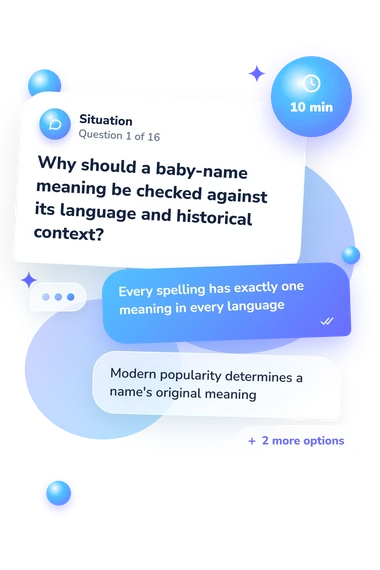
Example Questions From the Test
- Cognates
- Palindromes
- Homophones
- Initialisms
- Etymology
- Transliteration
- Translation
- Abbreviation
- R.D.E.
- E.R.D.
- R.E.D.
- D.E.R.
Baby Name Quiz - Description and methodology of the test
People choosing a name, comparing family traditions, or checking unfamiliar terminology can use this assessment as a focused knowledge check. The baby name quiz helps readers judge claims about meanings, origins, spelling, popularity, and naming rules before relying on them. A person taking a what should i name my baby quiz can use the result to identify gaps in the information behind a possible choice.
What This Assessment Measures
The questionnaire measures practical knowledge of name formation, interpretation, recording, and comparison. It suits readers exploring family naming choices or unfamiliar terms. As a baby boy name quiz, it tests origins, forms, spelling, popularity evidence, and naming rules.
The result gives a profile, not a recommendation. It highlights concepts to review before choosing. Someone taking a what should i name my son quiz can identify gaps in a proposed meaning, ranking, spelling, or family-name explanation.
The questions cover these areas:
- Meanings and origins show how language shapes interpretation.
- Naming terms show whether forms, diminutives, patronymics, initials, and transliteration are distinguished.
- Popularity and records show how rankings, rates, spellings, and diacritics affect comparisons.
- Legal context shows why naming rules vary by jurisdiction.
Results show Baby Name Knowledge (0-16): Foundation Builder (0-6), Developing Name Explorer (7-12), or Strong Name Knowledge (13-16).
Methodology and Evidence Base
Each item presents a naming problem with four answer choices. One point is awarded for every correct response, so the score is the sum of correct answers. The displayed bands are catalogue interpretations, not population norms.
It is a structured knowledge check, not a preference poll. Readers approaching it as a baby girl name quiz will find that the format keeps the focus on naming language and evidence rather than preferred style.
The questionnaire is conceptually consistent with Hanks, Hardcastle, and Hodges (2006), whose work supports distinctions involving first-name meanings, origins, and forms. It also aligns with Lieberson and Bell (1992), treating popularity as changing social taste rather than a fixed quality.
Popularity items use principles reflected in the Social Security Administration (2026), including reading rankings alongside counting rules. Questions about restrictions acknowledge jurisdictional variation discussed by Larson (2011). It is not an adaptation of a published instrument or a standardized clinical measure.
Interpret the result as a snapshot of the concepts sampled. Unfamiliar terms or guesses can lower performance, while spelling, legal rules, and popularity figures vary by place, year, and source; the score cannot decide which name suits a family.
- Hanks, Patrick, Kate Hardcastle, and Flavia Hodges. A Dictionary of First Names. 2nd ed. Oxford University Press, 2006.
- Lieberson, Stanley, and Eleanor O. Bell. "Children's First Names: An Empirical Study of Social Taste." American Journal of Sociology 98, no. 3 (1992): 511-554. 10.1086/230048
- Social Security Administration. Background Information for Popular Names. 2026.
- Larson, Carlton F. W. "Naming Baby: The Constitutional Dimensions of Parental Naming Rights." The George Washington Law Review 80, no. 1 (2011): 159-201. 10.2139/ssrn.1747858