
Style Quiz Men
How the Scales are Structured
Who Usually Takes This Test?
See How You Compare
Below is a preview of how scores are typically distributed across each scale.
Example Questions From the Test
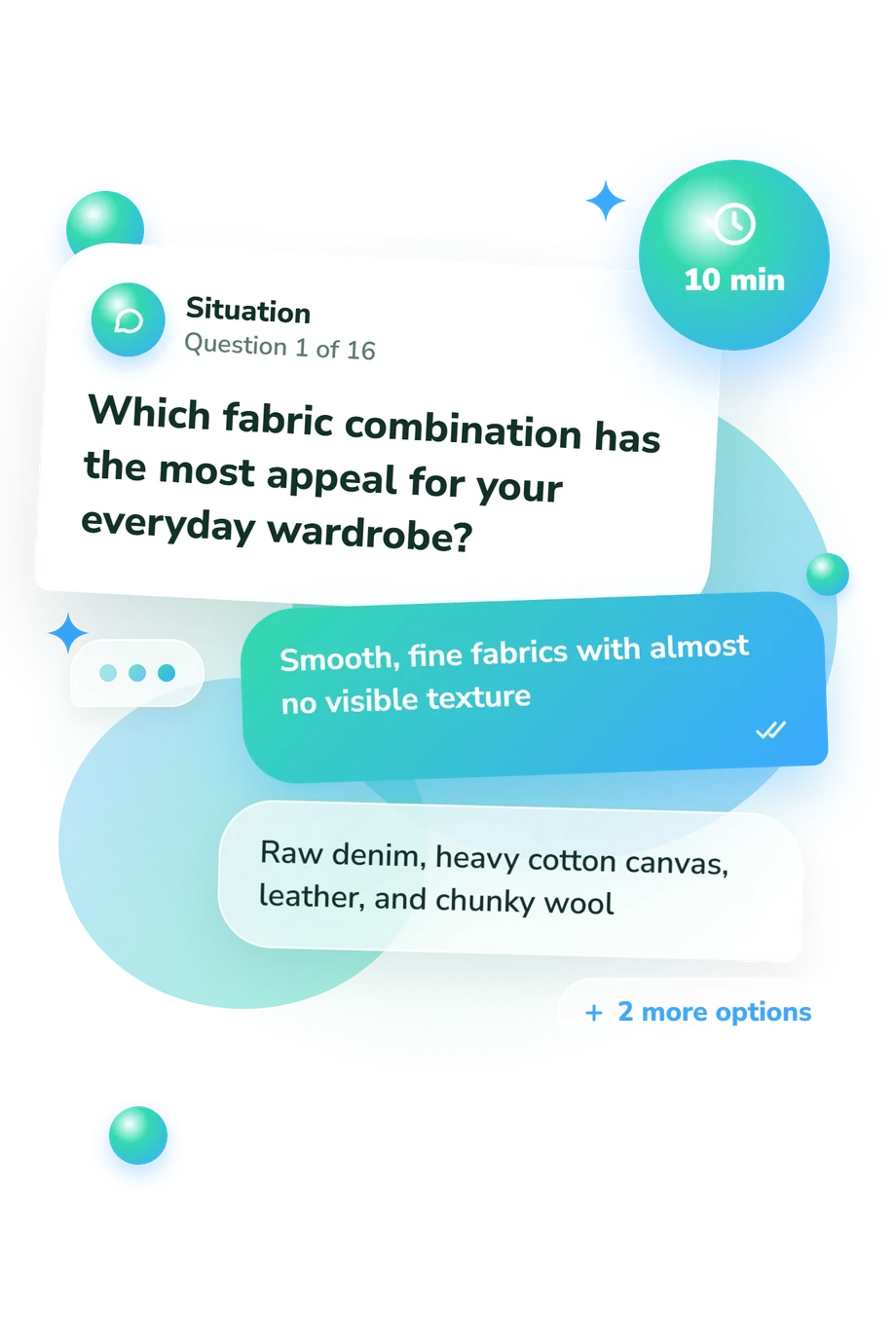
- Smooth, fine fabrics with almost no visible texture
- Raw denim, heavy cotton canvas, leather, and chunky wool
- Refined wool, cotton twill, and softly textured knitwear
- Contrasting fabrics mixed for a surprising visual effect
- “That look is memorable—it feels completely like you.”
- “That one detail is clever without taking over the outfit.”
- “You always look polished and appropriately dressed.”
- “Everything works together without calling attention to itself.”
- Try the full silhouette soon and explore how to make it your own
- Adapt one element of it to clothes you already wear
- Wait to see whether it becomes established before considering it
- Stay with familiar shapes that already work for you
Style Quiz Men - Description and methodology of the test
Men choosing clothes with more intention can use Style Quiz Men to clarify the preferences behind their reactions to fit, fabric, coordination, practicality, and visual impact. Its role is closer to a mens fashion quiz for self-reflection than a rulebook about correct dressing. The profile suits anyone refining a wardrobe, comparing outfit directions, or trying to understand why some garments feel immediately natural.
What This Assessment Explores
Style means aesthetic preference. Items cover fabric, tailoring, wear, branding, novelty, practicality, and dress. This men's clothing style quiz links choices.
These are the dimensions:
- Classic Style (0-12) measures aesthetic affinity for convention, tailoring, and polished coordination: Subtle Classic (0-4), Selective Classic (5-8), Strong Classic (9-12).
- Expressive Style (0-12) measures aesthetic affinity for experimentation, memorable combinations, and individuality: Quiet Expression (0-4), Focused Expression (5-8), Strong Expressive (9-12).
- Minimalist Style (0-12) measures aesthetic affinity for versatility, clean lines, and low visual clutter: Detail-Seeking (0-4), Streamlined Selectivity (5-8), Strong Minimalist (9-12).
- Rugged Style (0-12) measures aesthetic affinity for workwear, robust construction, substantial or tactile materials, and patina: Light Rugged (0-4), Practical Rugged (5-8), Strong Rugged (9-12); it does not measure toughness or outdoor ability.
Scores within one point blend; highest leads. Lower bands reflect preference, not taste or discipline.
Methodology and Evidence Base
Each item presents a wardrobe situation with four answer options. The alternatives contrast texture, novelty, coordination, function, and visibility, so the respondent selects personal preference rather than a correct answer. This is self-report.
Selections produce four scores. The scores compare affinities within your profile; they do not provide population norms or a ranking against other respondents.
To learn how to find your style, male readers can use this quiz to notice recurring preferences across settings rather than treating one garment as decisive. Mood, context, and self-awareness may influence answers.
Conceptually, it is closest to Noh et al. (2015), which connects men’s clothing preferences and avoidance with identity. It is consistent with Anand and Kaur (2018) on fashion self-congruity and Johnson, Lennon, and Rudd (2014) on dress and self, but is not presented as an adaptation of those works. These sources support the framing, not this questionnaire’s validation.
As a mens fashion style quiz, it gives you labels for recurring preferences, while the result remains a snapshot of stated choices. Compare it with actual wear, practical needs, and everyday settings.
- Noh, M., Li, M., Martin, K., & Purpura, J. (2015). College men’s fashion: clothing preference, identity, and avoidance. Fashion and Textiles, 2, Article 27. 10.1186/s40691-015-0052-7
- Anand, S., & Kaur, H. (2018). Fashion self-congruity: scale development and validation. Journal of Fashion Marketing and Management: An International Journal, 22(2), 158-175. 10.1108/JFMM-05-2017-0048
- Johnson, K., Lennon, S. J., & Rudd, N. (2014). Dress, body and self: research in the social psychology of dress. Fashion and Textiles, 1, Article 20. 10.1186/s40691-014-0020-7
Updated: