
Poker Quiz
How the Scales are Structured
Who Usually Takes This Test?
See How You Compare
Below is a preview of how scores are typically distributed across each scale.
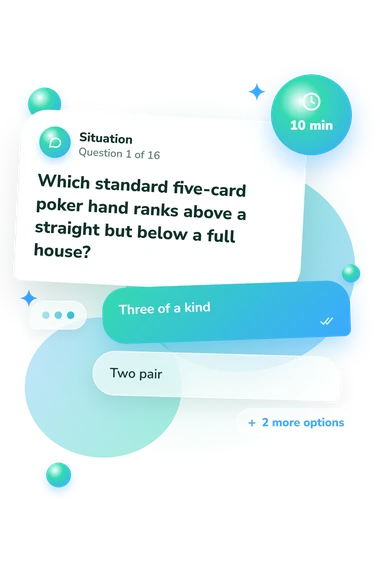
Example Questions From the Test
- Three of a kind
- Two pair
- A flush
- Four of a kind
- When there is no outstanding bet for that player to call
- Only from the dealer button
- Only when holding at least one pair
- Whenever calling would require the player to go all-in
- 18%
- 27%
- 35%
- 45%
Poker Quiz - Description and methodology of the test
Players who want to check their grasp of poker rules, calculations, and table decisions can use this poker quiz as a focused knowledge check. A poker hand quiz of this kind suits beginners building a foundation and experienced players revisiting concepts that are easy to misapply under pressure. The result identifies areas for practice, while live performance still depends on judgment, context, emotional control, and experience.
What This Assessment Explores
The questionnaire checks practical knowledge used when reading hands and applying rules. A poker rules quiz like this suits learners refreshing standard concepts or testing less obvious situations in Texas Hold’em and pot-limit Omaha.
Across the items, four areas receive attention:
- Hand evaluation shows whether you can recognize rankings, best five-card hands, kickers, and ties.
- Rules and mechanics measure your understanding of checking, raises, side pots, position, and Omaha’s exact-two-hole-card rule.
- Probability and equity show whether you can estimate draw chances and break-even calls.
- Strategy concepts indicate whether you can distinguish value bets, bluffs, drawing-dead situations, and implied odds.
The result is Poker Knowledge, reported from 0-16: Foundation to Build (0-6), Developing Knowledge (7-12), and Strong Knowledge (13-16). It reflects quiz knowledge, not guaranteed playing results.
Methodology and Scientific Basis
Each item presents a concrete poker situation or rule with four answer choices. The respondent selects the best answer, so the format combines recognition with applied reasoning about hand strength, legal actions, probabilities, and strategy terms. The displayed result condenses performance into one knowledge result rather than separate skill ratings. As a Texas Holdem quiz, it emphasizes rules and calculations rather than subjective self-description.
Meinz et al. (2012) connects domain knowledge with components of Texas Hold’em skill and cognitive demands. Leonard et al. (2015) provides a relevant comparison through the Poker Skills Measure, while Palomäki et al. (2020) places poker within expertise research. These works support the questionnaire’s emphasis on knowledge and applied reasoning; they do not make it an adaptation or validation of those instruments.
Because this online assessment is not norm-referenced, its bands describe performance on this item set rather than population percentiles. Prior study, guessing, terminology familiarity, and current concentration can affect the result, while timing, emotional control, opponent modelling, bankroll decisions, and pressure performance remain outside its scope.
- Meinz, E. J., Hambrick, D. Z., Hawkins, C. B., Gillings, A. K., Meyer, B. E., and Schneider, J. L. (2012). Roles of domain knowledge and working memory capacity in components of skill in Texas Hold’Em poker. Journal of Applied Research in Memory and Cognition, 1(1), 34-40. 10.1016/j.jarmac.2011.11.001
- Leonard, C. A., Staples, J., and Williams, R. J. (2015). Development and Validation of the Poker Skills Measure (PSM). Journal of Gambling Studies, 31(3), 849-866. 10.1007/s10899-014-9475-0
- Palomäki, J., Laakasuo, M., Cowley, B. U., and Lappi, O. (2020). Poker as a Domain of Expertise. Journal of Expertise, 3(2), 66-87.
Updated: