
Sikh Quiz
How the Scales are Structured
Who Usually Takes This Test?
See How You Compare
Below is a preview of how scores are typically distributed across each scale.
Example Questions From the Test
- Kesh, kangha, kara, kachera, kirpan
- Kesh, kangha, kara, tilak, kirpan
- Kesh, kara, kirpan, turban, mala
- Kesh, kara, kachera, chauri, kirpan
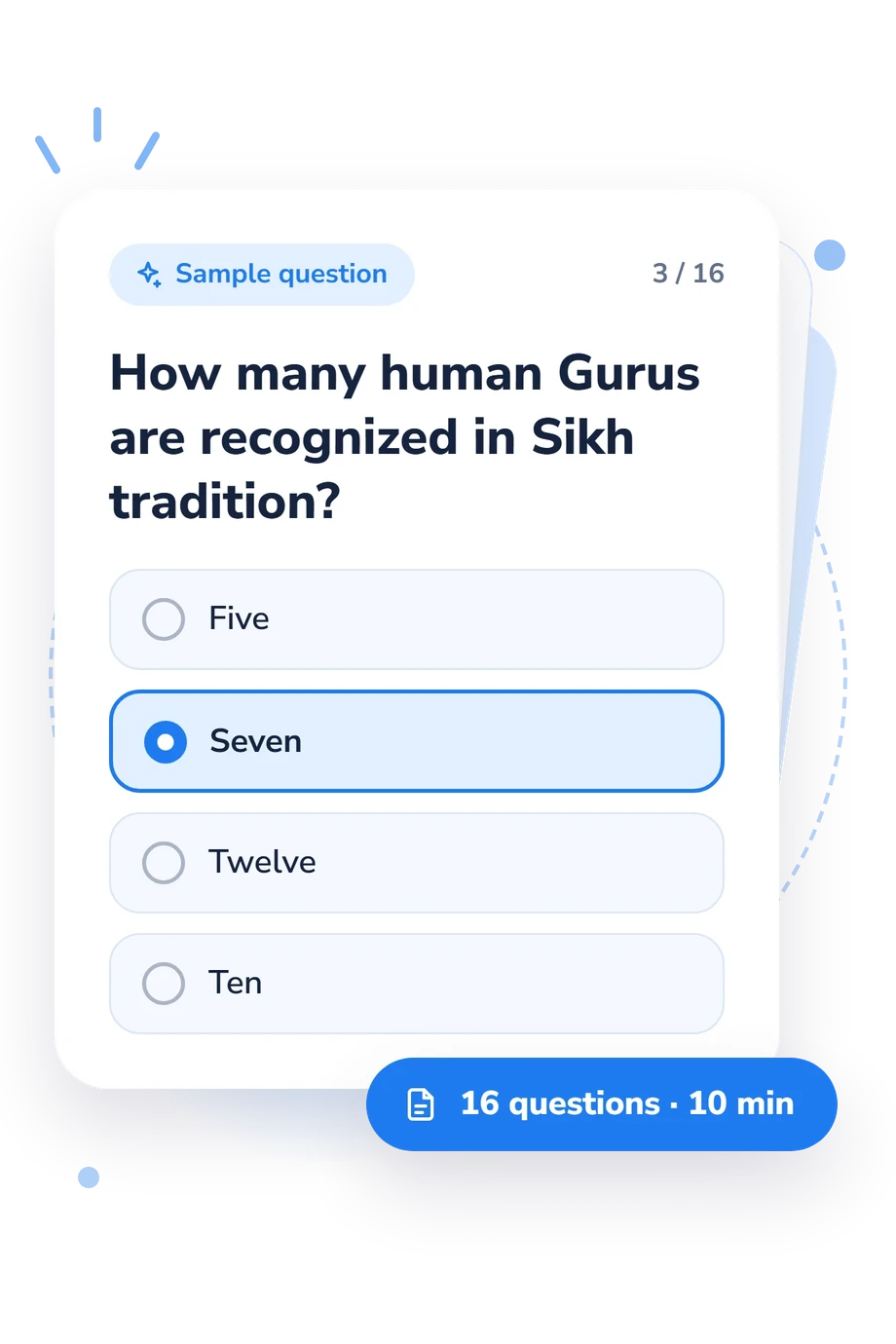
- Five
- Seven
- Twelve
- Ten
- Only one language may be used in worship
- There is one ultimate Creator and reality
- One Guru founded every major religion
- Spiritual life requires living alone
Sikh Quiz - Description and methodology of the test
Curious visitors, students, and anyone exploring Sikh traditions can use the Sikh Quiz to check their recognition of core ideas and decide where further reading may help. The questions use concrete examples instead of asking for personal testimony. This Sikh knowledge quiz suits readers who want to review the covered material. The result gives an overall indication of performance on the covered topics.
What This Assessment Explores
This knowledge-focused questionnaire examines Sikh principles, history, scripture, symbols, and community practices. Items move from ideas such as honest work, sharing, service, and the common good to questions about Gurus, sacred texts, gurdwara etiquette, and langar. The quiz tests knowledge of Sikhism by helping readers connect individual terms with the traditions and institutions they describe.
The result uses one scale, Sikh Knowledge: 0-16. Foundations to build (0-6) indicates some recognized ideas; Developing understanding (7-12) indicates many essentials with room to make stronger connections; Strong knowledge (13-16) indicates a well-rounded grasp of foundational history, beliefs, and community life.
The main themes are:
- Beliefs and principles show how teachings appear in everyday choices.
- History and scripture show recognition of major Gurus, texts, origins, and milestones.
- Practices and community life show familiarity with worship, symbols, gurdwara customs, and langar.
Methodology and Evidence Base
Each item pairs a prompt with four answer choices. The format is recognition-based multiple choice: the respondent selects the option that best fits a teaching, historical fact, text, institution, or practice. Several questions use brief situations, so the test checks both recall and basic application rather than asking for extended explanations.
For a reader interested in beliefs, this Sikh beliefs quiz works best when the score is read as a count of correct answers, not as a complete account of religious understanding. One point is assigned for each correct response, and the resulting total is organized into descriptive bands. Those bands do not define commitment, identity, or spiritual maturity.
The content is conceptually consistent with Nikky-Guninder Kaur Singh (2011), the Sikh Rehat Maryada, and scholarship edited by Pashaura Singh and Louis E. Fenech (2014). These sources supply historical, doctrinal, ethical, and institutional context; this questionnaire is not presented as an adaptation of any one of them. The knowledge check covers principles, Gurus, scripture, gurdwaras, symbols, and community practices; interpretation stays within selected topics and the respondent’s familiarity with Sikh terms.
- Singh, Nikky-Guninder Kaur. Sikhism: An Introduction. London: I.B. Tauris, 2011. ISBN 9781848853218.
- Shiromani Gurdwara Parbandhak Committee. Sikh Rehat Maryada: Sikh Code of Conduct and Conventions. Amritsar: Dharam Parchar Committee, 1997.
- Singh, Pashaura, and Louis E. Fenech, editors. The Oxford Handbook of Sikh Studies. Oxford: Oxford University Press, 2014. DOI 10.1093/oxfordhb/9780199699308.001.0001.
Updated: