
AP World History Quiz
How the Scales are Structured
Who Usually Takes This Test?
See How You Compare
Below is a preview of how scores are typically distributed across each scale.
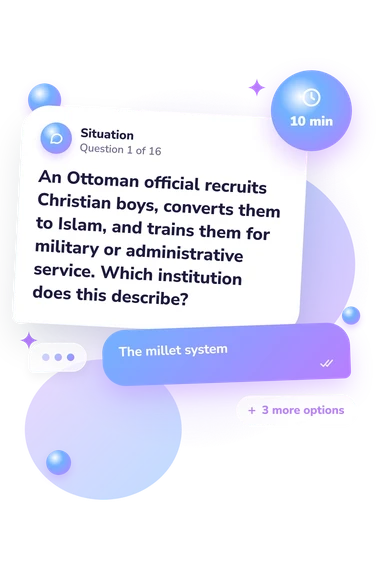
Example Questions From the Test
- The millet system
- The encomienda system
- The zamindar system
- The devshirme system
- Containment
- Appeasement
- Nonalignment
- Collective security under a colonial alliance
- The replacement of overland trade by Atlantic shipping
- The permanent end of warfare between Eurasian states
- Greater security and coordination along major Silk Road routes
- A Mongol ban on foreign merchants and diplomats
AP World History Quiz - Description and methodology of the test
Students seeking a focused check of course knowledge can use the AP World History Quiz to revisit major developments and the reasoning that connects them. It suits learners who want an AP World History practice quiz to check their grasp of course content before more study. The emphasis is on recognition, comparison, cause and effect, continuity, and context across global periods, giving respondents a way to gauge their historical reasoning.
What This Assessment Explores
The questionnaire samples world-history knowledge through empires, trade, labor systems, political ideas, industrialization, colonialism, decolonization, and conflict. It asks respondents to connect developments across regions and periods. The practice questions in this AP World quiz highlight chronology, comparison, causation, and contextualization.
The displayed AP World History Knowledge scale (0-16) summarizes this practice set, not an official AP score prediction. Foundation to build (0-6) points to review of chronology, regions, and connections; Developing command (7-12) shows many central patterns; Strong command (13-16) reflects consistent knowledge and reasoning across sampled periods.
The main thematic groups are:
- Chronology and regional change connect events with their historical settings.
- States and governance show how institutions and political ideas shaped societies.
- Exchange, labor, and economic change trace movement, production, coercion, and industry.
- Revolutions and global conflict examine resistance, nationalism, and shifting power.
Methodology and Scientific Basis
Each item presents a historical situation, development, or claim with four answer choices. Questions span postclassical, early modern, modern, and contemporary periods and ask for the best identification or explanation. The approach joins content recall with chronology, comparison, cause, consequence, and context. For learners, it works as an AP World practice quiz when a missed answer prompts review of the underlying relationship.
The displayed score summarizes performance on this practice set and is not an official AP score prediction. Its content is conceptually consistent with the AP World History: Modern framework, Seixas and Morton’s historical-thinking concepts, and Wineburg’s emphasis on contextual reading; these connections describe its approach, not authorship or formal adaptation.
In practical terms, this online quiz for AP World History is a practice questionnaire, not a complete course assessment. Its items move among political institutions, economic systems, exchange networks, imperial power, resistance, and global conflict, so a short set cannot capture every area of historical knowledge. Preparation, wording, attention, and chance can affect performance; use the result as a study signal alongside fuller coursework and varied practice.
- College Board. AP World History: Modern Course and Exam Description, Effective Fall 2026. College Board, 2026.
- Samuel S. Wineburg. On the Reading of Historical Texts: Notes on the Breach Between School and Academy. American Educational Research Journal, 1991, 28(3), 495-519. 10.3102/00028312028003495.
- Peter Seixas and Tom Morton. The Big Six: Historical Thinking Concepts. Nelson Education, 2013.
Updated: