
Italian Quiz
How the Scales are Structured
Who Usually Takes This Test?
See How You Compare
Below is a preview of how scores are typically distributed across each scale.
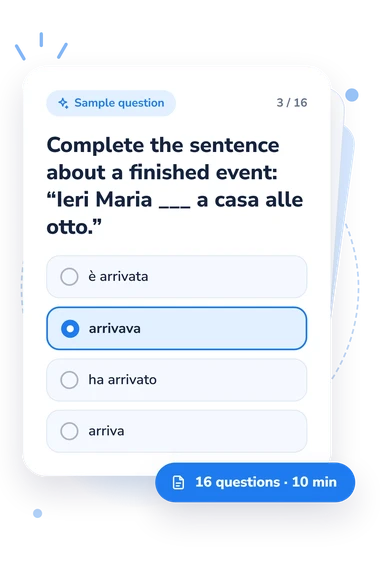
Example Questions From the Test
- Voglio un cappuccino.
- Vorrò un cappuccino domani.
- Ho voluto un cappuccino.
- Vorrei un cappuccino, per favore.
- è arrivata
- arrivava
- ha arrivato
- arriva
- gli ho visti
- li ho visto
- la ho vista
- le ho viste
Italian Quiz - Description and methodology of the test
People considering an intermediate practice check can decide whether their Italian skills are at an intermediate level and whether this format suits their goals. This Italian quiz asks learners to interpret everyday messages and choose appropriate forms. Self-directed learners can use the Italian language quiz to review how grammar, vocabulary, and practical comprehension work together. Reviewing answers can help them choose what to practise next.
What This Assessment Explores
Intermediate performance here means more than recalling isolated words: items ask whether forms fit time, politeness, reference, comparison, location, and everyday meaning. Cafés, travel, public notices, and formal requests test transfer into practical interpretation. The Italian Knowledge scale runs from 0-16: Foundations to build (0-6), Developing intermediate knowledge (7-12), and Strong intermediate command (13-16). This single score summarizes performance across the tested set; individual responses may suggest topics for practice.
The questionnaire covers four connected areas:
- Grammar control is represented by items on tense, mood, pronouns, agreement, and prepositions.
- Contextual vocabulary concerns whether familiar words fit practical situations.
- Functional communication covers interpretation of requests, instructions, and politeness.
- Reading inference involves combining details into a sensible conclusion.
Vocabulary-related responses in this Italian vocab quiz can indicate which words or contexts deserve review, while the single score summarizes all four themes.
Methodology and Evidence Base
Each item presents a sentence, dialogue, notice, or practical scenario with four answer choices. Tasks require selecting grammar forms, interpreting messages, or following timing and location details. This selected-response format combines knowledge checks with contextual reading, so answers reflect both form recognition and meaning in use.
The content is conceptually consistent with Italian Language Profile (Spinelli & Parizzi, 2010), which describes progression across CEFR-related abilities. Its contextual focus also fits the CEFR Companion Volume. Research on COLL-IT (La Russa, Zanda, & Suadoni, 2024) is relevant to lexical competence, but this questionnaire is not an adaptation of that instrument. The ALTE manual offers a general framework for CEFR-related test development; the displayed bands are practice summaries, not formal proficiency certification.
Interpret the band as a practical snapshot of performance on the included tasks. The selected-response tasks summarize performance in the language situations included here and do not sample speaking, listening, or writing. The result from this Italian vocabulary quiz can guide revision by directing attention to vocabulary-related responses within the overall snapshot.
- Spinelli, Barbara, and Francesca Parizzi. Profile of the Italian Language: CEFR Reference Levels A1, A2, B1, B2. La Nuova Italia, 2010. ISBN 978-88-221-6327-1.
- La Russa, Francesca, Fabio Zanda, and Anna Suadoni. COLL-IT: An Instrument for Assessing Collocational Competence: Realisation and Administration of a Verb-Noun Collocation Test for Learners of Italian L2/LS. Italiano LinguaDue, 16(2), 75-103, 2024. 10.54103/2037-3597/27759.
- Council of Europe. Common European Framework of Reference for Languages: Learning, Teaching, Assessment - Companion Volume. Council of Europe Publishing, Strasbourg, 2020. ISBN 978-92-871-8621-8.
- Association of Language Testers in Europe. Manual for Language Test Development and Examining for Use with the CEFR. Council of Europe, 2011.
Updated: