
Gun Quiz
How the Scales are Structured
Who Usually Takes This Test?
See How You Compare
Below is a preview of how scores are typically distributed across each scale.
Example Questions From the Test
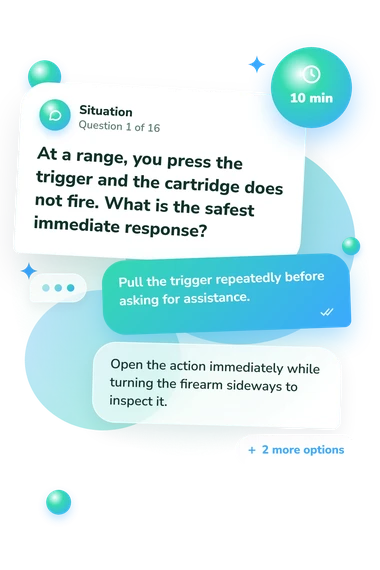
- Pull the trigger repeatedly before asking for assistance.
- Open the action immediately while turning the firearm sideways to inspect it.
- Look into the muzzle to see whether something is blocking it.
- Keep the muzzle pointed safely downrange, keep your finger off the trigger, and follow the range and manufacturer misfire procedure.
- Accept the statement if the person is experienced.
- Maintain a safe muzzle direction and personally verify the chamber, magazine, and feed path according to that model's procedure.
- Check only that the magazine has been removed.
- Pull the trigger in a safe-looking direction to confirm its condition.
- Carry it carefully to the nearest adult.
- Hide it so another child cannot find it.
- Do not touch it, leave the area, and immediately tell a responsible adult.
- Remove the magazine before going for help.
Gun Quiz - Description and methodology of the test
People who want a focused check of firearm-safety knowledge can use this gun quiz to examine how they respond to common handling, storage, transport, and range situations. It is suited to learners, owners, family members, and anyone preparing for formal instruction. This firearms quiz can reveal which principles are familiar and which deserve careful review before practical training.
What This Assessment Explores
The questions measure recognition of safer decisions rather than shooting skill. Scenarios cover an unknown firearm, a misfire, a dropped gun, cleaning, transport, storage, impairment, protective equipment, muzzle direction, and the area around a target. The result therefore describes rule recognition in common situations, not physical shooting ability.
The gun knowledge quiz focuses on hazard recognition, trigger and muzzle control, secure access, chamber checks, and responsible action around others. The content suits people learning firearm safety, reviewing class material, or preparing for supervised instruction.
The result uses one displayed scale:
- Gun Safety Knowledge (0-16) indicates how many of the quiz’s safety questions were answered correctly. Foundations to strengthen (0-6) signals that several core principles need review; Developing knowledge (7-12) reflects recognition of many principles with gaps to revisit; Strong knowledge base (13-16) indicates broad understanding while still not proving practical competence.
Methodology and Evidence Base
Scenario-based multiple-choice items present four answer choices, and the respondent selects the option that best follows safe practice. The situations test judgment about what to do next rather than technical knowledge in isolation.
Each correct answer contributes one point to the displayed total, and the result bands interpret that total. The score is a learning check against the answer key, not a measure of shooting performance. Taking this gun test quiz can help locate topics to review.
A 2026 study by Morgan et al. examines firearm-safety knowledge and behavior and offers related evidence about firearms-safety education; it does not validate or establish the provenance of this questionnaire. The ShootSafe randomized trial and its 2021 study protocol likewise evaluate interactive approaches to firearms-safety teaching, but they do not establish this quiz's rationale or validity.
As a how well do you know guns quiz, this assessment can identify teachable gaps, but a correct choice shows recognition of a written rule, not reliable hands-on performance. The result is not certification or legal advice; local laws, range rules, and the firearm manual still control. Memory, confidence, wording, and attention can also affect answers.
- Morgan, Casie H., D. Leann Long, Yixin Wang, Anna Johnston, Julia M. W. Hall, and David C. Schwebel. "Early Adolescents' Knowledge and Behavior with Firearms: How Experience, Parents, and Safety Training Contribute to Behavior." Prevention Science, 2026. 10.1007/s11121-026-01976-2
- Schwebel, David C., D. Leann Long, Anna Johnston, Yefei He, Casie H. Morgan, Joan Severson, Gregory Taylor, and Katelyn Trullinger. "Evaluation of ShootSafe, an Interactive, Sequential Website to Teach Youths Firearms Safety: A Randomized Clinical Trial." American Journal of Public Health, 115(12), 1971-1977, 2025. 10.2105/AJPH.2025.308267
- Schwebel, David C., D. Leann Long, Marissa Gowey, Joan Severson, Yefei He, and Katelyn Trullinger. "Study protocol: developing and evaluating an interactive web platform to teach children hunting, shooting and firearms safety: a randomized controlled trial." BMC Public Health, 21, 308, 2021. 10.1186/s12889-021-10345-3