
Chronic Fatigue Syndrome Quiz
How the Scales are Structured
Who Usually Takes This Test?
See How You Compare
Below is a preview of how scores are typically distributed across each scale.
Example Questions From the Test
- Only difficulty falling asleep before important events
- Consistently needing no more than four hours of sleep
- Waking unrefreshed despite getting substantial sleep
- Feeling fully restored after every daytime nap
- Temporary loss of motivation
- Ordinary muscle soreness
- Seasonal sleepiness
- Post-exertional malaise
- Activities, symptom changes, and whether worsening appears later
- Only the total number of hours spent in bed each month
- Energy levels on good days while omitting difficult days
- A self-selected diagnosis without details about daily function
Chronic Fatigue Syndrome Quiz - Description and methodology of the test
People who want a clearer grasp of ME/CFS can use this chronic fatigue syndrome quiz to review core concepts before discussing persistent or disabling symptoms with a qualified clinician. Designed as a knowledge check, the CFS quiz suits learners, patients, supporters, and health-information readers who want to distinguish ordinary tiredness from characteristic illness features. The knowledge-focused result highlights concepts to revisit before a clinical conversation or further reading.
What This Assessment Measures
This assessment examines whether a respondent recognizes central ME/CFS features and practical responses to them.
Within this chronic fatigue quiz, questions address delayed worsening after exertion, upright-related symptoms, cognitive difficulty, unrefreshing sleep, activity limits, accommodations, evaluation, and urgent warning signs.
The thematic groups are:
- Post-exertional malaise is recognized as delayed, prolonged worsening after physical, mental, or emotional effort.
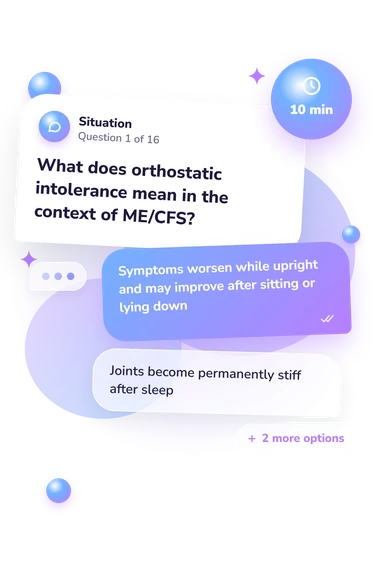
- Orthostatic intolerance is understood through symptoms that intensify while upright and may ease after sitting or lying down.
- Cognitive and sleep-related features are identified through brain fog and waking unrefreshed despite substantial sleep.
- Pacing, accommodations, and safety are linked to energy limits, planned rest, flexible demands, and urgent responses to alarming changes.
Chronic Fatigue Syndrome Knowledge (0-16) is displayed with Foundations to build (0-6), Developing understanding (7-12), and Strong understanding (13-16). Lower bands flag concepts to review; the highest indicates appropriate support.
Methodology and Evidence Base
As an ME/CFS knowledge test, it uses selected-response items with four answer choices. Questions ask for the option that best matches established concepts or appropriate practical action across symptoms, pacing, accommodations, evaluation, and safety. The format does not ask respondents to rate personal severity.
The score is presented as an educational result; the questionnaire does not specify how each answer contributes points.
The questionnaire is conceptually consistent with the ME/CFS knowledge audit by Hng and colleagues, published in 2021, and with Froehlich and colleagues’ 2023 educational intervention for health professionals; it is not an adaptation of either publication. The International Consensus Criteria and the Institute of Medicine report provide the clinical framework for concepts used here.
As an unvalidated educational score, it cannot determine whether someone has ME/CFS; persistent or disabling symptoms need clinical evaluation, while severe chest pain, major breathing difficulty, fainting, or other alarming changes warrant urgent help.
- Hng K.N., Geraghty K., Pheby D.F.H. An Audit of UK Hospital Doctors’ Knowledge and Experience of Myalgic Encephalomyelitis. Medicina. 2021;57(9):885. 10.3390/medicina57090885
- Froehlich L., Niedrich J., Hattesohl D.B.R., Behrends U., Kedor C., Haas J.-P., Stingl M., Scheibenbogen C. Evaluation of a Webinar to Increase Health Professionals’ Knowledge about Myalgic Encephalomyelitis/Chronic Fatigue Syndrome (ME/CFS). Healthcare. 2023;11(15):2186. 10.3390/healthcare11152186
- Carruthers B.M., van de Sande M.I., de Meirleir K.L., Klimas N.G., Broderick G., Mitchell T., et al. Myalgic encephalomyelitis: International Consensus Criteria. Journal of Internal Medicine. 2011;270(4):327-338. 10.1111/j.1365-2796.2011.02428.x
- Institute of Medicine. Beyond Myalgic Encephalomyelitis/Chronic Fatigue Syndrome: Redefining an Illness. Washington, DC: The National Academies Press; 2015.