
Dating Quiz
How the Scales are Structured
Who Usually Takes This Test?
See How You Compare
Below is a preview of how scores are typically distributed across each scale.
Example Questions From the Test
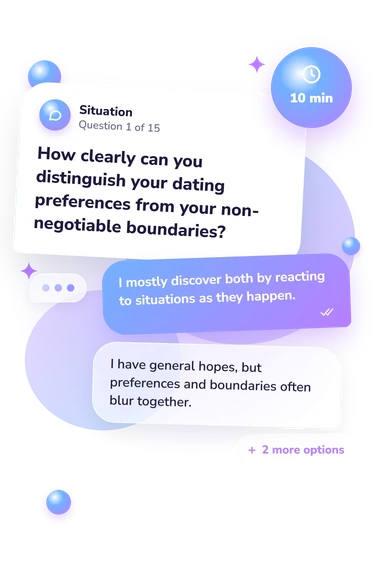
- I mostly discover both by reacting to situations as they happen.
- I have general hopes, but preferences and boundaries often blur together.
- I can identify several of each, although some remain uncertain.
- I can usually explain which things are flexible and which limits I need to maintain.
- We reconnect when our schedules naturally become easier.
- One of us usually keeps things moving while the other focuses on existing demands.
- We both make some adjustments, even if the resulting time together is limited.
- We jointly find a realistic way to stay connected without ignoring other responsibilities.
- Conversation would probably pause until there was a practical reason to reconnect.
- The other person might check in, although I would not strongly expect it.
- The other person would likely initiate because contact usually goes both ways.
- The shift would be noticeable because we both maintain contact consistently.
Dating Quiz - Description and methodology of the test
People who are trying to understand a current dating situation can use this dating quiz to organize observations about intentions, closeness, and shared effort. It suits someone who wants a structured reflection rather than a simple yes-or-no verdict. As an online questionnaire about dating, it turns everyday experiences into a profile that can clarify what feels established, uncertain, or worth discussing next.
What This Assessment Explores
The assessment focuses on a current dating situation, not on assigning a relationship label. Its items ask about preferences and boundaries, emotional openness, disagreement, care, reliability, planning, and whether effort is shared. Because it is a free questionnaire for reflecting on dating, its profile is most useful when read as a snapshot of patterns you can recognize and discuss.
The three result dimensions are:
- Dating Direction (0-15) shows clarity about preferences, boundaries, pace, and desired connection; its bands are Still Exploring (0-5), Emerging Direction (6-10), and Clear Direction (11-15).
- Emotional Connection (0-15) reflects felt understanding, responsiveness, and openness; its bands are Connection Taking Shape (0-5), Growing Connection (6-10), and Established Connection (11-15).
- Mutual Investment (0-15) reflects shared time, effort, planning, and follow-through; its bands are Limited Evidence (0-5), Developing Reciprocity (6-10), and Consistent Reciprocity (11-15).
Methodology and Scientific Basis
Each item presents four response options, moving from less defined experiences toward clearer, more reciprocal patterns. Choose the statement closest to your usual experience. Responses become three displayed scores; the displayed range alone does not show how each answer is weighted.
Conceptually, the structure is closest to the Perceived Relationship Quality Components Inventory (Fletcher et al., 2000), a multidimensional approach. Its themes parallel Fletcher et al. (2000) on relationships, the Investment Model Scale's attention to investment, and the PAIR Inventory's focus on intimacy. These sources do not show that this questionnaire reproduces their items, scoring, or validation.
In practice, a free web-based questionnaire about dating offers self-reflection rather than standardized administration of one instrument. Its dimensions can show mixed patterns: clear intentions may coexist with uncertain connection or uneven effort. Its questionnaire about whether you are dating still focuses on direction, connection, and reciprocity.
Interpretation should stay close to the present situation. Mood, memory, self-awareness, and the other person’s behavior can affect self-report, so results describe perceived patterns rather than proving compatibility or commitment.
- Fletcher, G. J. O., Simpson, J. A., & Thomas, G. (2000). The measurement of perceived relationship quality components: A confirmatory factor analytic approach. Personality and Social Psychology Bulletin, 26(3), 340-354. 10.1177/0146167200265007
- Fletcher, G. J. O., Simpson, J. A., & Thomas, G. (2000). Ideals, perceptions, and evaluations in early relationship development. Journal of Personality and Social Psychology, 79(6), 933-940. 10.1037/0022-3514.79.6.933
- Rusbult, C. E., Martz, J. M., & Agnew, C. R. (1998). The Investment Model Scale: Measuring commitment level, satisfaction level, quality of alternatives, and investment size. Personal Relationships, 5(4), 357-387. 10.1111/j.1475-6811.1998.tb00177.x
- Schaefer, M. T., & Olson, D. H. (1981). Assessing Intimacy: The PAIR Inventory. Journal of Marital and Family Therapy, 7(1), 47-60. 10.1111/j.1752-0606.1981.tb01351.x