
Body Planes Quiz
How the Scales are Structured
Who Usually Takes This Test?
See How You Compare
Below is a preview of how scores are typically distributed across each scale.
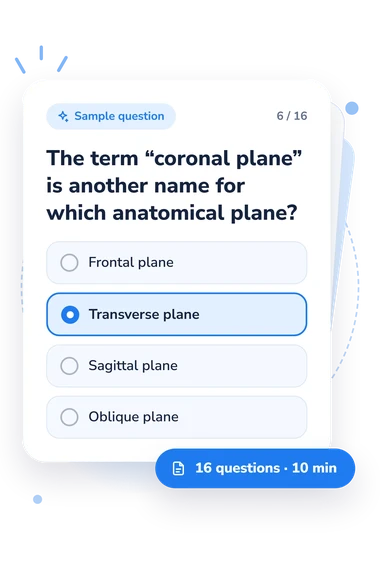
Example Questions From the Test
- Frontal plane
- Sagittal plane
- Transverse plane
- Midsagittal plane
- Anteroposterior axis
- Longitudinal axis
- Oblique axis
- Mediolateral axis
- Frontal plane
- Sagittal plane
- Oblique plane
- Transverse plane
Body Planes Quiz - Description and methodology of the test
Designed for students, trainees, and curious readers, this body planes quiz checks whether anatomical terminology is understood as a system rather than as isolated labels. It connects orientation, sectioning, axes, and movement so a result can show where a learner is secure and where review may be useful. As a quiz on the planes of the body, it suits imaging discussions and introductory kinesiology.
What This Assessment Explores
Across its questions, the assessment checks frontal, sagittal, transverse, and oblique orientations, then moves to midsagittal and parasagittal sections. It links each plane with its corresponding axis and with movements such as flexion, lateral flexion, abduction, adduction, and rotation. Framed as an anatomical planes quiz, it measures transfer of terminology across imaging descriptions and ordinary movement.
The result gives one profile of body-plane knowledge rather than a broad measure of anatomy. Its three bands describe how consistently the respondent distinguishes principal planes, related sections, and movement patterns:
- Body Planes Knowledge (0-16) places a result in Foundations to build (0-6) when orientations and uses may need review.
- Developing orientation (7-12) indicates that many concepts can be applied in several imaging or movement contexts.
- Strong orientation (13-16) indicates consistent distinction and application of principal planes, related sections, and movement patterns.
Methodology and Evidence Base
Each item presents a prompt with four answer choices. It may ask you to name a plane or axis, classify a section, or connect a movement with the plane in which it mainly occurs. Imaging descriptions and familiar actions make the method a mix of terminology recall and spatial application.
The displayed result uses three bands to summarize recognition of planes and axes, classification of sections, and application of plane terminology to imaging and movement examples, rather than providing a complete estimate of anatomical expertise.
The design is conceptually consistent with Dickson and colleagues' study of spatial and non-spatial anatomy knowledge, but this questionnaire is not adapted from or validated by that work. Terminology follows Drake, Vogl, and Mitchell, while movement examples align with Hamilton, Weimar, and Luttgens.
As a quiz for studying anatomy planes, it is useful when missed concepts guide review. Guessing, wording familiarity and current study context can affect performance, so the profile is a focused learning signal rather than a complete assessment of anatomical competence.
- Dickson J, Shaw DJ, Gardiner A, Rhind S. Testing anatomy: Dissecting spatial and non-spatial knowledge in multiple-choice question assessment. Anatomical Sciences Education. 2024;17(1):102-113. 10.1002/ase.2323
- Drake RL, Vogl AW, Mitchell AWM. Gray's Anatomy for Students. 5th ed. Elsevier; 2023.
- Hamilton N, Weimar W, Luttgens K. Kinesiology: Scientific Basis of Human Motion. 12th ed. McGraw-Hill; 2012.