
Hockey Quiz
How the Scales are Structured
Who Usually Takes This Test?
See How You Compare
Below is a preview of how scores are typically distributed across each scale.
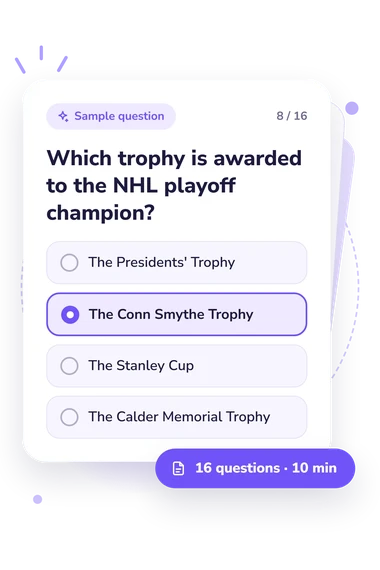
Example Questions From the Test
- Three assists by one player in a game
- A goal in each period by either team
- Three consecutive saves during a shootout
- Three goals by one player in a game
- Offside
- Icing
- High-sticking
- Too many men on the ice
- The neutral zone from the attacking and defending zones
- The faceoff circles from the goal creases
- The benches from the penalty boxes
- Each team's half from the center-ice area
Hockey Quiz - Description and methodology of the test
Curious fans, newer viewers, and experienced followers can use this hockey quiz to check how securely they understand professional hockey. It separates familiar terms from reliable recall across rules, history, and game statistics. The format suits readers who want a clear self-assessment before choosing topics to review. A fun quiz about ice hockey can also turn focused learning into an enjoyable challenge.
What This Assessment Explores
This assessment samples NHL rules, hockey terminology, traditions, awards, and basic statistics. It suits anyone who follows the sport and wants to test recognition and application without turning the result into a personality judgment. The scenarios make it useful as an NHL rules quiz, while factual items cover history and scorekeeping.
The question themes fall into three groups:
- Rule situations test icing, offside, penalties, line changes, delayed penalties, and shorthanded conventions.
- Terminology, traditions, awards, and history measure recognition of hockey language, trophies, championships, and the Original Six.
- Statistics and officiating items require save-percentage and standings-point calculations or knowledge of linespersons’ duties.
Together, these themes separate rule application from recall. The Hockey Knowledge scale runs from 0-16: Starting Lineup (0-6) reflects some essentials, Developing Fan (7-12) a useful grasp with gaps to strengthen, and Hockey Expert (13-16) broad, reliable knowledge.
Methodology and Evidence Base
Each item presents a rule situation, hockey fact, award, officiating duty, or calculation with four answer choices. Choosing the best option tests recall and practical application rather than agreement with a personality statement. The format suits an ice hockey trivia quiz combining recognition and reasoning.
Scoring is direct: the result counts correct selections, so it reflects demonstrated knowledge on this questionnaire rather than a hidden trait. Fixed choices make guessing possible when a term or rule is unfamiliar.
The closest published comparison is the Deitz and Frech hockey knowledge test (1940), which supports structured factual questions as a way to sample sport knowledge. This questionnaire is conceptually consistent with that work, not presented as a direct adaptation. Current NHL rules for 2025-2026 support the rule situations, while Duplacey (2001) and Diamond and Zweig (2003) provide context for rule history, traditions, awards, and earlier NHL eras.
Results are best read as a snapshot of performance on this questionnaire, showing how accurately you handle its rules, terminology, traditions, awards, and calculations. Recent viewing, memory, vocabulary familiarity, and chance selection can influence performance, so missed areas prompt review.
- Deitz, Dorothea, and Beryl Frech. "Hockey Knowledge Tests for Girls." The Journal of Health and Physical Education, vol. 11, no. 6, 1940, pp. 366-388. 10.1080/23267240.1940.10622679.
- National Hockey League. Official Rules 2025-2026. National Hockey League, 2025.
- Duplacey, James. The Official Rules of Hockey: An Anecdotal Look at the Rules of Hockey-and How They Came to Be. Edited by Dan Diamond. Lyons Press, 2001. ISBN 1585740527.
- Diamond, Dan, and Eric Zweig. Hockey’s Glory Days: The 1950s and ’60s. Andrews McMeel Publishing, 2003. ISBN 0740738291.