
Is the Relationship Over Quiz
How the Scales are Structured
Who Usually Takes This Test?
See How You Compare
Below is a preview of how scores are typically distributed across each scale.
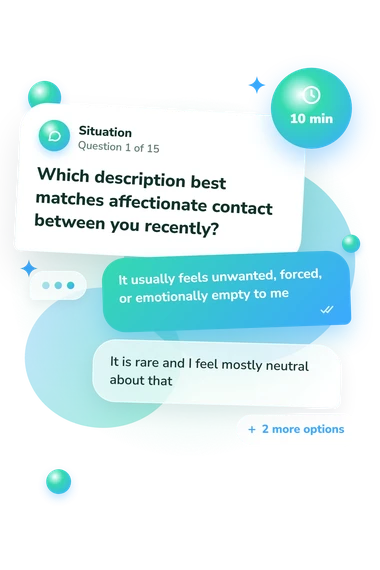
Example Questions From the Test
- It usually feels unwanted, forced, or emotionally empty to me
- It is rare and I feel mostly neutral about that
- It appears naturally at times and usually feels welcome
- It is a wanted and meaningful part of how we connect
- I feel disappointed that the time apart is ending
- I feel little change either way
- I look forward to some parts of being together again
- I genuinely miss them and feel eager to reconnect
- Neither of us found a workable way to engage with it
- Most of the effort came from one person
- Both of us made some effort, though not always at the same time
- Both of us stayed engaged and contributed meaningful changes
Is the Relationship Over Quiz - Description and methodology of the test
People weighing whether to continue, reconnect, or make a deliberate change can use the Is the Relationship Over Quiz to organize feelings that are otherwise difficult to compare. It suits anyone reflecting on a current partnership, including someone considering the Is My Marriage Worth Saving Quiz. The result helps compare present connection, future fit, and both partners’ willingness to repair strain.
What This Assessment Explores
Rather than forcing a yes-or-no answer about whether a relationship has ended, the assessment examines closeness, shared direction, and repair after strain.
Questions cover warmth, affection, closeness, plans, priorities, emotional needs, responsibility, and what follows disagreement. Patterns show whether strain centres on connection, life fit, or repair in the Is Your Relationship Over Quiz.
The dimensions are:
- Emotional Connection (0-15) reflects present warmth, interest, affection, and desire for closeness; Connection depleted (0-5), Connection mixed (6-10), and Connection active (11-15) identify the bands.
- Future Alignment (0-15) reflects whether staying together feels freely chosen and compatible with both partners’ desired lives; Divergent paths (0-5), Unsettled future (6-10), and Shared future (11-15) describe the bands.
- Mutual Repair (0-15) reflects whether both partners address strain, adjust, and follow through on change; Repair stalled (0-5), Repair uneven (6-10), and Repair collaborative (11-15) describe the bands.
Methodology and Evidence Base
Each item presents four response choices, moving from withdrawal, uncertainty, or stalled effort toward closeness, shared choice, and collaborative change. Someone considering the Can I Save My Marriage Quiz may find the repair dimension useful, but the questionnaire does not specify how many points each option contributes. The numerical ranges therefore should not be reverse-engineered into a scoring rule.
As a structured self-report questionnaire, it uses themes conceptually consistent with several distinct studies: Rhoades et al.’s study of commitment and relationship stability; Fletcher, Simpson, and Thomas’s relationship-quality research; Gottman and Krokoff’s conflict-interaction study; and Stanley and Markman’s work on voluntary commitment and pressure-free choice. It is not presented as an adaptation of those instruments, and those studies do not establish norms for this online version.
For someone considering the Is My Relationship Ending Quiz, interpretation remains a self-report snapshot shaped by context, memory, self-awareness, and honesty. The displayed bands are interpretive labels rather than population norms or clinical cutoffs. Fear, coercion, threats, or violence warrant support regardless of the total score.
- Rhoades, Galena K., Scott M. Stanley, and Howard J. Markman. (2010). Should I stay or should I go? Predicting dating relationship stability from four aspects of commitment. Journal of Family Psychology, 24(5), 543-550. 10.1037/a0021008
- Fletcher, Garth J. O., Jeffry A. Simpson, and Geoff Thomas. (2000). The Measurement of Perceived Relationship Quality Components: A Confirmatory Factor Analytic Approach. Personality and Social Psychology Bulletin, 26(3), 340-354. 10.1177/0146167200265007
- Gottman, John M., and Lowell J. Krokoff. (1989). Marital interaction and satisfaction: A longitudinal view. Journal of Consulting and Clinical Psychology, 57(1), 47-52. 10.1037/0022-006X.57.1.47
- Stanley, Scott M., and Howard J. Markman. (1992). Assessing Commitment in Personal Relationships. Journal of Marriage and the Family, 54(3), 595-608. 10.2307/353245