
Honeymoon Quiz
How the Scales are Structured
Who Usually Takes This Test?
See How You Compare
Below is a preview of how scores are typically distributed across each scale.
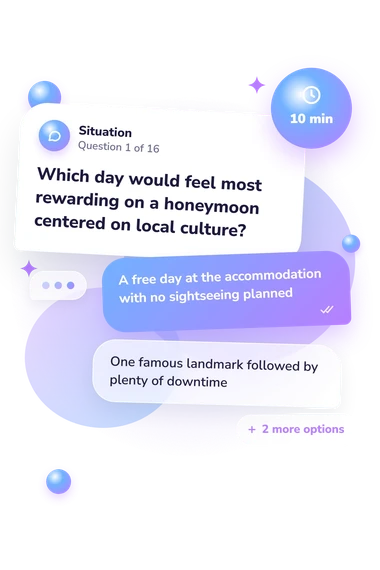
Example Questions From the Test
- A free day at the accommodation with no sightseeing planned
- One famous landmark followed by plenty of downtime
- A guided historic walk, a café break, and an evening performance
- A market visit, artisan workshop, neighborhood meal, and live local music
- I would pass and keep the evening quiet
- I would consider it if we had no other plans
- I would rearrange the evening if the show suited our tastes
- I would book it immediately and build a special night around it
- Skip it and enjoy the view from the lodge later
- Take a gentler trail at a more relaxed hour
- Join if conditions are good and we can take our time
- Set the alarm—the shared climb and sunrise sound worth the effort
Honeymoon Quiz - Description and methodology of the test
For couples choosing a trip together, the honeymoon quiz turns preferences about place, pace, comfort, and shared activities into a practical profile. It suits partners who want to compare what feels romantic before committing to an itinerary, especially when their ideas overlap but are not identical. A honeymoon destination quiz can clarify whether shared enthusiasm leans toward culture, cities, mountains, or the coast.
What This Assessment Explores
The questionnaire compares four honeymoon styles rather than naming one best destination. Its scenarios cover culture, city energy, wilderness, and coastal rest, including food, weather, transfers, hotels, and activity versus comfort. It helps answer where I should honeymoon by showing which shared atmosphere feels most natural.
The result compares these profiles:
- Culture & Cuisine Getaway (0-12) shows how central local discovery is: Light Cultural Accent (0-4), Curious Explorer (5-8), or Immersive Romantic (9-12).
- Glamorous City Escape (0-12) shows how strongly polished urban experiences fit: City Stopover (0-4), Metropolitan Mix (5-8), or City Lights Match (9-12).
- Mountain & Wilderness Adventure (0-12) shows how much remote scenery and shared effort appeal: Scenic Side Trip (0-4), Active Escape (5-8), or Trailbound Pair (9-12).
- Tropical Beach Retreat (0-12) shows whether warm coastal ease fits: Different Rhythm (0-4), Coastal Spark (5-8), or Island State of Mind (9-12).
Methodology and Evidence Base
Each item presents four response options that move from low interest or an alternative preference toward enthusiastic engagement. The situations make choices concrete through food, weather, city evenings, outdoor effort, and beach time. Answers feed four outcome scores: the highest indicates strongest affinity, while scores within one point indicate a blended style.
The pattern helps answer where I should go on my honeymoon by turning preferences into itinerary priorities rather than naming a mandatory destination. Conceptually, the content aligns most closely with Honeymooner Motivation Scale (Chen et al., 2020), a framework for honeymoon travel motivation. It is also consistent with research on multidimensional honeymoon attributes and couples’ destination-choice processes, including Fakfare and Lee (2019) and Jang et al. (2007).
This online self-reflection format is not a direct adaptation or normed administration of those published instruments. Self-report results can shift with current priorities, budget, travel experience, or one partner answering for both. For couples considering where we should honeymoon, the strongest score offers a direction, while a close second can support a blended itinerary.
- Chen, Ganghua, Kevin Kam Fung So, Mutita Poomchaisuwan, and Xianyang Hu. (2020). Examining affection-based travel: Development and validation of a measurement scale for honeymooners’ motivation. Journal of Destination Marketing & Management, 17, 100452. 10.1016/j.jdmm.2020.100452
- Fakfare, Pipatpong, and Jin-Soo Lee. (2019). Developing and Validating a Scale for Multidimensional Attributes of Honeymoon Tourism. Journal of Hospitality & Tourism Research, 43(8), 1199-1224. 10.1177/1096348019850279
- Jang, Hochan, Seokho Lee, Sang-Woo Lee, and Sung-kwon Hong. (2007). Expanding the individual choice-sets model to couples’ honeymoon destination selection process. Tourism Management, 28(5), 1299-1314. 10.1016/j.tourman.2006.11.008
Updated: