
GPA Quiz
How the Scales are Structured
Who Usually Takes This Test?
See How You Compare
Below is a preview of how scores are typically distributed across each scale.
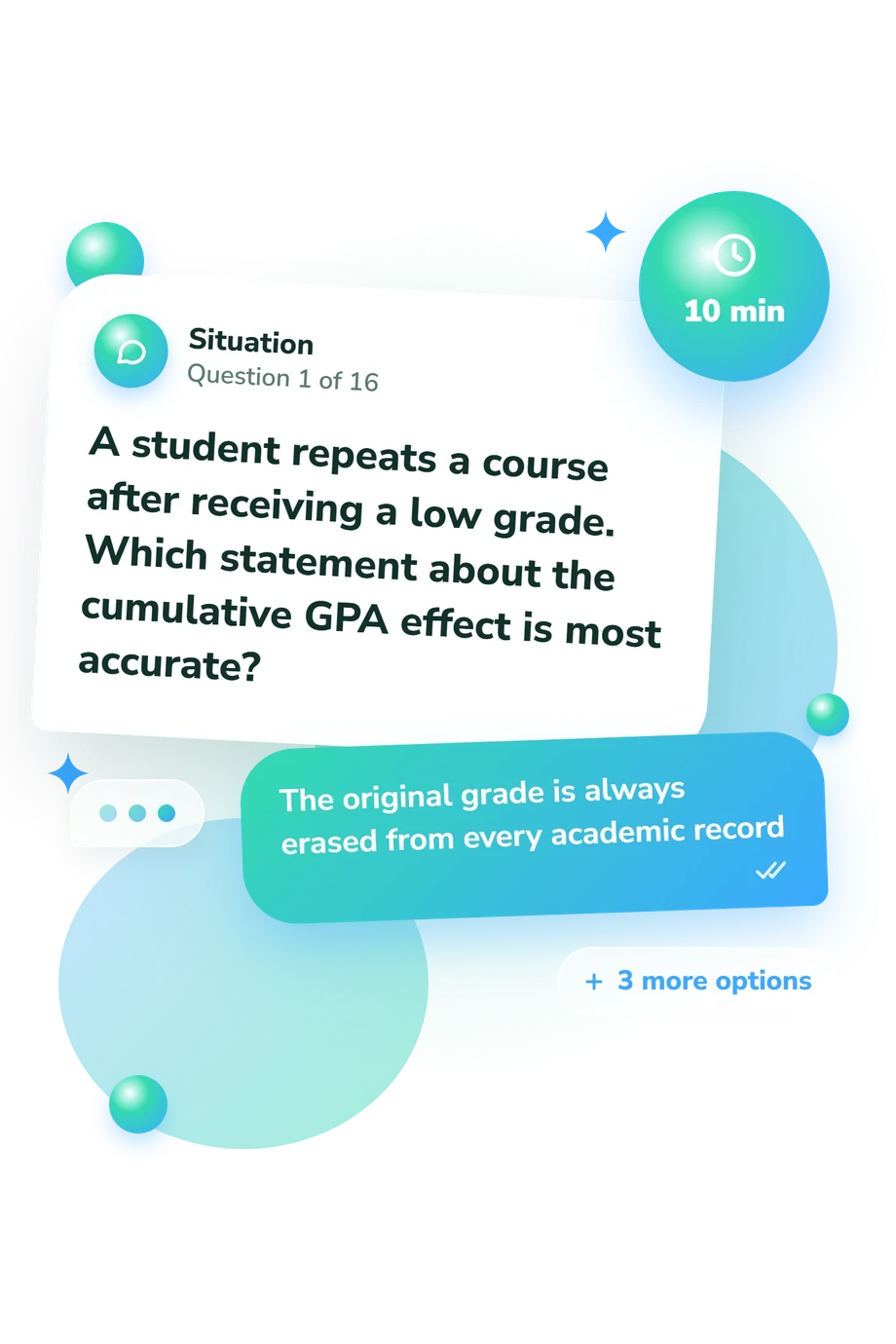
Example Questions From the Test
- The number of letter grades earned
- The total quality points earned
- The attempted credits included under the school's GPA policy
- All credits required for the degree
- 3 quality points
- 9 quality points
- 3 quality points
- 3 quality points
- Only the most recent term counts toward a cumulative GPA
- A cumulative GPA always drops older grades
- Term GPAs use percentages, while cumulative GPAs use letters
- The terms may contain different numbers of GPA credits
GPA Quiz - Description and methodology of the test
Students, applicants, advisers, and anyone checking an academic record can use the GPA Quiz to test whether their reasoning matches common credit-weighted calculations. Readers wondering what this GPA-based quiz measures will find a structured knowledge check, not a transcript calculator. The result shows which core ideas feel secure and which deserve review before you interpret or plan around academic records.
What This Assessment Explores
This assessment checks whether you can apply GPA rules in realistic academic situations rather than recognize terminology. It covers credit weighting, quality points, cumulative averages, rounding, weighted and unweighted systems, and policy-dependent cases such as repeats and pass/fail courses. Wondering what my GPA-based assessment covers means looking beyond a single average: the items connect arithmetic with the institutional rules that determine which credits and grades count.
The result organizes understanding around four areas:
- Credit weighting shows why higher-credit courses usually influence an average more.
- Quality points show how grade points and included credits combine.
- Cumulative calculations show how earlier and planned coursework change an average.
- Academic policies show why repeats, pass/fail work, and school rules can alter it.
The catalogue reports one scale, GPA Knowledge (0-16): Foundations to Review, 0-6; Developing Understanding, 7-12; and Strong Understanding, 13-16. These bands describe understanding of tested concepts, not an official GPA.
Methodology and Evidence Base
Each item presents an academic scenario or calculation with answer choices. The respondent selects the option that fits the stated scale, arithmetic, or policy, and responses are combined into the reported result. Because no separate weighting scheme or per-answer value is stated, read the score through the displayed bands rather than reverse-engineering it.
The methodology is conceptually consistent with NCES GPA calculation guidance (2011) and University of North Texas advising guidance on quality points, GPA credits, weighting, rounding, and institutional variation. The questionnaire is not an adaptation of either source or a standardized GPA measure with institutional norms.
In practical terms, the GPA calculation quiz tests calculation knowledge rather than reproducing a school’s official record. Research adds context: Kuncel, Credé, and Thomas (2005) reviewed the accuracy of self-reported academic indicators, while Westrick (2017) examined reliability in undergraduate GPA. In this self-report format, attention, self-awareness, and familiarity with school policy can affect performance, so consequential calculations should be confirmed against institutional rules.
- National Center for Education Statistics. (2011). NAEP High School Transcript Study: How Is Grade Point Average Calculated? U.S. Department of Education, Institute of Education Sciences.
- University of North Texas. (n.d.). Calculating Your GPA. Office of Advising and Academic Support.
- Kuncel, Nathan R., Marcus Credé, and Lisa L. Thomas. (2005). The validity of self-reported grade point averages, class ranks, and test scores: A meta-analysis and review of the literature. Review of Educational Research, 75(1), 63-82. 10.3102/00346543075001063
- Westrick, Paul A. (2017). Reliability Estimates for Undergraduate Grade Point Average. Educational Assessment, 22(4), 231-252. 10.1080/10627197.2017.1381554
Updated: