
Sleep Disorder Quiz
How the Scales are Structured
Who Usually Takes This Test?
See How You Compare
Below is a preview of how scores are typically distributed across each scale.
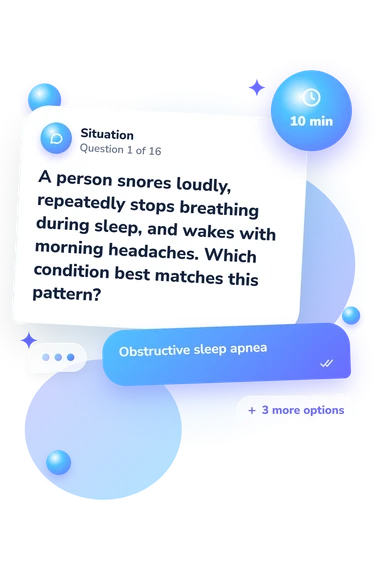
Example Questions From the Test
- During REM sleep near morning, usually with vivid dream recall
- During deep non-REM sleep, often earlier in the night
- Only during the brief transition into sleep
- After the person is fully awake and alert
- Worrying about tomorrow while trying to fall asleep
- Witnessed breathing pauses followed by choking or gasping
- Checking the clock repeatedly during the night
- Feeling more alert after an evening activity
- Remaining in bed longer whenever sleep does not come
- Using alcohol at bedtime to shorten sleep onset
- Cognitive behavioral therapy for insomnia, or CBT-I
- Taking an over-the-counter sleep aid indefinitely without review
Sleep Disorder Quiz - Description and methodology of the test
People who want to check sleep terminology before discussing concerns with a clinician, recognize patterns worth discussing, or prepare for a clinical conversation may find this sleep disorder quiz useful. It is an educational check connecting symptoms, conditions, tests, and treatments without rating symptom severity. The result can help a reader asking whether they have a sleep disorder use this quiz to prepare for that conversation.
What This Assessment Explores
These items test sleep concepts, not symptom severity. They connect breathing pauses, late timing, leg movement urges, dream enactment, paralysis, or emotion-triggered weakness with the right term. They also address what sleep disorder a person might have, distinguish insufficient sleep opportunity from insomnia, and flag urgent situations.
The content falls into three groups:
- Symptom recognition shows whether you can match descriptions with sleep disorders and phenomena.
- Evaluation knowledge shows whether you understand sleep diaries and polysomnography.
- Care and safety knowledge shows whether you recognize behavioral treatment, medication risks, and urgent warning signs.
Together, these topics guide a review of how sleep symptoms are described. Sleep Disorder Knowledge runs from 0-16: Foundation (0-6) reflects basic familiarity, Developing (7-12) shows solid knowledge with distinctions to strengthen, and Strong (13-16) indicates well-developed understanding of common disorders and appropriate responses.
Methodology and Evidence Base
Each item presents a short scenario or knowledge question with four answer choices. You select the best-fitting disorder, term, test, treatment, or safety response. The questionnaire does not state how individual answers are weighted.
The displayed educational score is unvalidated and has no stated normative interpretation. Its content is conceptually consistent with the ASKME Survey (Zozula et al., 2001), which assessed sleep knowledge for medical education. It also overlaps with the Dartmouth survey developed by Sateia et al. (2005). This quiz is not an adaptation of either instrument.
As a free online quiz about sleep disorders, its role in sleep health education is practical: it can organize learning and questions for later discussion. Clinical sleep evaluation methods, including diaries and polysomnography, belong to broader assessment. Prior knowledge may make terminology easier, guessing can raise a score by chance, wording can steer interpretation, and inattention can lower performance. The result is not a sleep disorder diagnosis quiz and cannot establish whether a condition is present; persistent or concerning symptoms need qualified interpretation, while severe breathing difficulty or unresponsiveness requires urgent help.
- Zozula R, Bodow M, Yatcilla D, Cody R, Rosen RC. Development of a brief, self-administered instrument for assessing sleep knowledge in medical education: “the ASKME Survey.” Sleep. 2001;24(2):227-233. 10.1093/sleep/24.2.227
- Sateia MJ, Reed VA, Jernstedt GC. The Dartmouth sleep knowledge and attitude survey: development and validation. Sleep Medicine. 2005;6(1):47-54. 10.1016/j.sleep.2004.07.013
- Roth T, Zammit G, Kushida C, Doghramji K, Mathias SD, Wong JM, Buysse DJ. A new questionnaire to detect sleep disorders. Sleep Medicine. 2002;3(2):99-108. 10.1016/S1389-9457(01)00131-9