
Devil Fruit Quiz
How the Scales are Structured
Who Usually Takes This Test?
See How You Compare
Below is a preview of how scores are typically distributed across each scale.
Example Questions From the Test
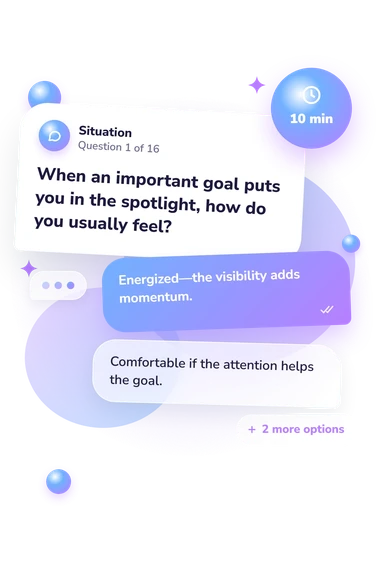
- Energized—the visibility adds momentum.
- Comfortable if the attention helps the goal.
- Willing to be seen, though I would rather share the focus.
- Most effective when I can contribute outside the spotlight.
- I check what my friend wants before getting involved.
- I address the challenge immediately and plainly.
- I lower the temperature, then discuss it privately.
- I give them space to handle it unless they ask for support.
- I gather more information and wait for the right opening.
- I suggest a small starting step without becoming the focal point.
- I make a clear call and invite everyone to move with me.
- I support whichever direction another person chooses.
Devil Fruit Quiz - Description and methodology of the test
Designed for fans and curious readers who want a playful personality lens, this devil fruit quiz connects everyday choices with four fictional styles of action, control, versatility, and recovery. It suits anyone who wants a concrete way to reflect on handling pressure, cooperation, obstacles, and changing demands. As a Devil Fruit personality test, it turns imaginative preferences into a readable profile without requiring detailed knowledge of the source world.
What This Assessment Explores
The highest score shows strongest affinity; scores within one point blend. This fictional personality quiz invites discussion.
The displayed dimensions are:
- Hana Hana no Mi (0-12) measures composed versatility: Single Focus (0-4) concentrates, Branching Approach (5-8) balances angles, and Many-Petaled Mind (9-12) extends quiet reach.
- Mera Mera no Mi (0-12) measures expressive momentum: Banked Ember (0-4) prefers restraint, Rising Flame (5-8) combines action and control, and Blazing Presence (9-12) favors visible leadership.
- Ope Ope no Mi (0-12) measures precision-centered control: Adaptive Improviser (0-4) favors flexibility, Tactical Operator (5-8) balances structure, and Master of the Room (9-12) reflects deliberate intervention.
- Tori Tori no Mi, Model: Phoenix (0-12) measures restorative resilience: Independent Recovery (0-4), Steady Renewal (5-8), and Phoenix Spirit (9-12) move from self-reliance to sustained support.
Methodology and Scientific Basis
Each item presents a situation with four response choices. The options contrast direct action, precise control, parallel attention, and restorative support, so respondents choose the response that feels most characteristic. This forced-choice self-report format is not a canon-knowledge test.
Scoring is comparative: the highest result indicates the clearest affinity, while near-tied results form a blend. The ranges describe profile bands, not clinical thresholds.
Conceptually, the format aligns with Social Style Profile (Merrill and Reid, 1981), which distinguishes action, analysis, support, and adaptability. Parallel-demand themes connect with the Multitasking Preference Inventory (Poposki and Oswald, 2010). Systems-focused items relate to the Systems Thinking Scale (Dolansky et al., 2020), while recovery themes relate to the Connor-Davidson Resilience Scale (Connor and Davidson, 2003). These are reference points, not evidence that the online questionnaire is an adaptation or validated by those studies.
Used as a Devil Fruit character quiz, the profile turns choices into discussion of everyday habits. Because it is an original online self-report tool rather than a standardized instrument, mood, self-awareness, and the appeal of a flattering answer can influence the outcome.
- Merrill, D. W., & Reid, R. H. (1981). Personal Styles & Effective Performance: Make Your Style Work for You. Radnor, PA: Chilton Book Company.
- Poposki, E. M., & Oswald, F. L. (2010). The Multitasking Preference Inventory: Toward an Improved Measure of Individual Differences in Polychronicity. Human Performance, 23(3), 247-264. 10.1080/08959285.2010.487843
- Dolansky, M. A., Moore, S. M., Palmieri, P. A., & Singh, M. K. (2020). Development and Validation of the Systems Thinking Scale. Journal of General Internal Medicine, 35(8), 2314-2320. 10.1007/s11606-020-05830-1
- Connor, K. M., & Davidson, J. R. T. (2003). Development of a New Resilience Scale: The Connor-Davidson Resilience Scale (CD-RISC). Depression and Anxiety, 18(2), 76-82. 10.1002/da.10113