
Signs You Like Someone Quiz
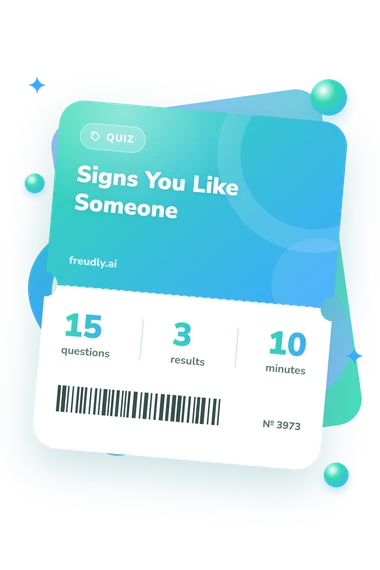
How the Scales are Structured
Who Usually Takes This Test?
See How You Compare
Below is a preview of how scores are typically distributed across each scale.
Example Questions From the Test
- I appreciate it and continue with my day.
- It gives me a small lift for a little while.
- It noticeably improves my mood, and I think about the message again.
- I feel a strong rush of happiness and keep revisiting what they wrote.
- I usually think first of people already central to that part of my life.
- I might mention it when we next happen to talk.
- They are often one of the people I actively want to tell.
- They are among the first people I want to contact because their response feels especially meaningful.
- Almost never; that is not where my mind naturally goes.
- Once or twice as a passing possibility.
- Sometimes, with genuine interest in the possibility.
- Often; those possibilities feel vivid or emotionally appealing.
Signs You Like Someone Quiz - Description and methodology of the test
People sorting through a new or uncertain connection may want more than a sudden emotional impression. The signs you like someone quiz gives those feelings a structured frame. It is intended for personal reflection when attraction, friendship, admiration, and novelty may overlap. The questionnaire also gives structure to the question behind a how to know if u like someone quiz, helping readers compare attention, closeness, and emotional importance in one profile.
What This Assessment Explores
This questionnaire looks beyond a yes-or-no verdict at how one person occupies your mental and emotional space. Its situations cover recurring thoughts, interest in the person’s life, one-to-one time, imagined affection, sensitivity to their attention, and the wish to become closer. As a quiz to tell if you like someone, it treats attraction as a pattern rather than a single sign.
The result groups that pattern into three dimensions:
- Attention and Curiosity (0-15) measures repeated notice: Occasional notice (0-5), Recurring curiosity (6-10), or Strong mental pull (11-15).
- Desire for Closeness (0-15) measures pull toward personal or romantic connection: Comfortable distance (0-5), Emerging closeness (6-10), or Strong closeness pull (11-15).
- Emotional Investment (0-15) measures the weight given to the person and their responses: Light stake (0-5), Meaningful investment (6-10), or Deep significance (11-15).
Methodology and Scientific Basis
Each prompt presents an ordinary interpersonal situation with four ordered responses, moving from little or no reaction toward stronger attention, closeness, or emotional impact. This self-report format works best when answers reflect current experience rather than wishful thinking, anxiety, or the novelty of a new connection.
Readers using a how to tell if i like someone quiz can use the profile to notice patterns rather than chase a verdict. Scores are organized through the displayed result bands; they are descriptive levels, not universal clinical cutoffs, and the questionnaire does not state a point-by-point weighting rule. Interpret the profile from the bands shown instead of assuming how answers become points.
Conceptually, its themes align most closely with the Infatuation and Attachment Scales (Langeslag et al., 2013), while also relating to Hatfield and Sprecher’s passionate-love framework and Langeslag et al. (2015) research on attention to beloved-related information. These sources support comparison; the online questionnaire is not presented as a standardized administration, adaptation, or validated equivalent. For anyone turning to a how do you know you like someone quiz, the result can identify patterns while reminding you that affection, admiration, compatibility, and mutual feeling are not interchangeable.
- Langeslag, S. J. E., Muris, P. E. H. M., & Franken, I. H. A. (2013). Measuring romantic love: Psychometric properties of the Infatuation and Attachment Scales. The Journal of Sex Research, 50(8), 739-747. 10.1080/00224499.2012.714011
- Hatfield, E., & Sprecher, S. (1986). Measuring passionate love in intimate relationships. Journal of Adolescence, 9(4), 383-410. 10.1016/S0140-1971(86)80043-4
- Langeslag, S. J. E., Olivier, J. R., Köhlen, M. E., Nijs, I. M., & Van Strien, J. W. (2015). Increased attention and memory for beloved-related information during infatuation: Behavioral and electrophysiological data. Social Cognitive and Affective Neuroscience, 10(1), 136-144. 10.1093/scan/nsu034