
Sex Addict Quiz
How the Scales are Structured
Who Usually Takes This Test?
See How You Compare
Below is a preview of how scores are typically distributed across each scale.
Example Questions From the Test
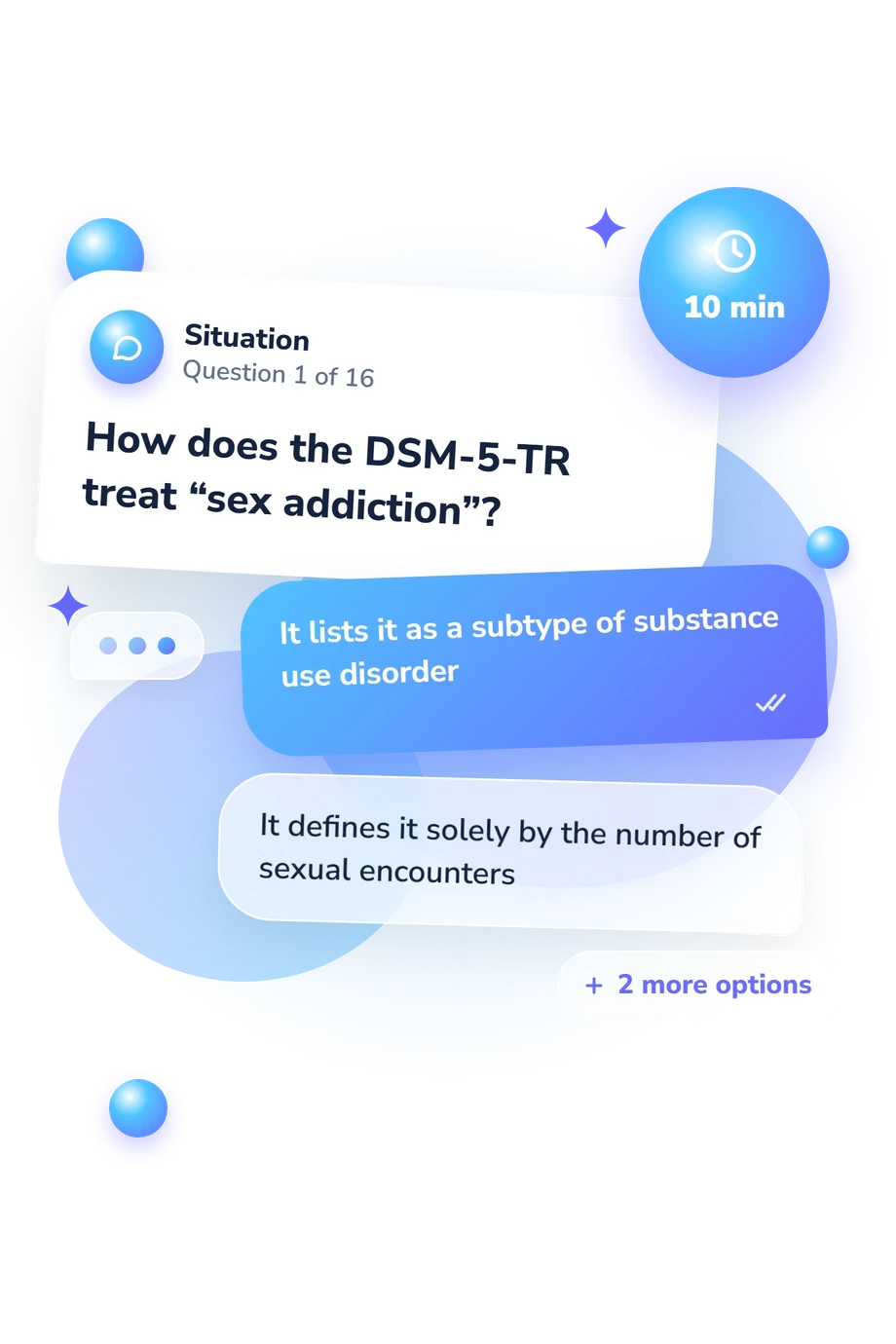
- It lists it as a subtype of substance use disorder
- It defines it solely by the number of sexual encounters
- It does not list sex addiction as a standalone diagnosis
- It classifies every recurring sexual urge as an addictive disorder
- Possible effects of substances, medications, mood episodes, and other health conditions
- Whether the person’s behavior differs from the clinician’s own values
- Whether friends use the informal label “sex addict”
- Only how many sexual partners the person has had
- Substance dependence disorders
- Personality disorders
- Impulse control disorders
- Paraphilic disorders
Sex Addict Quiz - Description and methodology of the test
People who want a clearer, less judgmental introduction to compulsive sexual behavior may use the sex addict quiz to examine control, consent, consequences, and appropriate support. It suits readers unsure whether troubling behavior reflects impaired control or simply a difference in desire, as well as anyone seeking a grounded starting point for reflection. The result addresses whether they may be addicted to sex without treating a label as an answer.
What This Assessment Explores
The questionnaire measures knowledge about compulsive sexual behavior rather than sexual frequency, libido, or diagnosis. It tests whether respondents distinguish impaired control from strong desire, recognize the role of harm and functioning, and understand why moral disapproval alone does not establish a disorder. Other themes include consent, responsibility, shame, safety, partner boundaries, relapse, and tailored treatment.
As an educational exercise, the questionnaire shows how well someone recognizes core principles and where further learning may help. The displayed scale is Sexual Addiction Knowledge (0-16), with these result bands:
- Foundations to build (0-6) signals that key distinctions about control, consequences, consent, or context may need review.
- Developing understanding (7-12) shows recognition of many central ideas, with assessment or support principles needing more attention.
- Strong understanding (13-16) reflects a well-rounded grasp of the topic and practical nuances.
Methodology and Evidence Base
Each item presents a short scenario or proposition with four answer choices. Selecting the most accurate principle makes the result a measure of educational knowledge, not a symptom checklist or clinical interview. The online format reports selected responses without establishing an additional scoring rule or diagnostic threshold.
The content is conceptually consistent with Kraus et al. (2018), which places compulsive sexual behaviour disorder within the ICD-11 impulse-control disorders and links it to persistent difficulty controlling repetitive sexual impulses or urges that cause marked distress or impairment. WHO guidance and WFSBP guidelines add context about differential factors, treatment goals, and safety. The DSM-5-TR is relevant because sex addiction is not a standalone diagnosis.
Someone considering whether they are a sex addict can use the questions to check understanding. Interpretation should consider behavior and circumstances. A concern about whether they have a sex addiction may require attention to health, mood, substances, relationships, and functioning; self-report can be affected by shame, context, and self-awareness, while its bands are educational summaries rather than validated clinical cutoffs and the questionnaire cannot diagnose compulsive sexual behavior.
- Kraus SW, Krueger RB, Briken P, First MB, Stein DJ, Kaplan MS, Voon V, Abdo CHN, Grant JE, Atalla E, Reed GM. Compulsive sexual behaviour disorder in the ICD-11. World Psychiatry. 2018;17(1):109-110. 10.1002/wps.20499
- World Health Organization. Clinical descriptions and diagnostic requirements for ICD-11 mental, behavioural and neurodevelopmental disorders. Geneva: World Health Organization; 2024. ISBN 978-92-4-007726-3
- Turner D, Briken P, Grubbs JB, Malandain L, Mestre-Bach G, Potenza MN, Thibaut F. The World Federation of Societies of Biological Psychiatry guidelines on the assessment and pharmacological treatment of compulsive sexual behaviour disorder. Dialogues Clin Neurosci. 2022;24(1):10-69. 10.1080/19585969.2022.2134739
- American Psychiatric Association. Diagnostic and Statistical Manual of Mental Disorders, Fifth Edition, Text Revision (DSM-5-TR). Washington, DC: American Psychiatric Association Publishing; 2022. 10.1176/appi.books.9780890425787
Updated: