
Am I Being Love Bombed Quiz
How the Scales are Structured
Who Usually Takes This Test?
See How You Compare
Below is a preview of how scores are typically distributed across each scale.
Example Questions From the Test
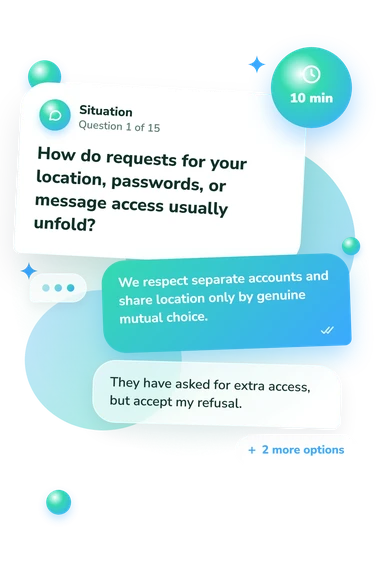
- We respect separate accounts and share location only by genuine mutual choice.
- They have asked for extra access, but accept my refusal.
- They frame monitoring as proof of love or suggest privacy means disloyalty.
- They track me, access accounts without permission, or coerce me into surrendering privacy.
- They are specific and leave room for me to be a complicated, imperfect person.
- They sometimes feel exaggerated, although they can also acknowledge ordinary differences.
- They repeatedly put me on a pedestal despite barely knowing me.
- They insist on an idealized version of me and become intense or hostile when I do not match it.
- They accept my answer without keeping score.
- They ask once whether I am sure, then let the matter go.
- They repeatedly press me to accept or imply that refusal is insulting.
- They use what they offered to demand access, money, commitment, or another repayment I did not agree to.
Am I Being Love Bombed Quiz - Description and methodology of the test
For someone questioning whether intense affection is moving faster than trust, this questionnaire examines pressure, entitlement, and lost independence in a developing relationship, including whether a partner is love bombing you. The Am I Being Love Bombed Quiz is intended for people reflecting on a current or recent connection. As a love bombing quiz, it can help organize observations when warmth, urgency, and discomfort appear together.
What This Assessment Explores
The items cover idealized praise, rapid plans, grand gestures, persistent contact, jealousy, monitoring, punishment, and boundary pressure. They examine affection when trust or independence are tested by the is he lovebombing me quiz.
Displayed dimensions are:
- Accelerated Idealization (0-15) reflects unusually rapid closeness, idealization, and attention that may outpace genuine knowledge of you; bands: No scored endorsement (0), Worth noticing (1-2), Act on concern (3-15).
- Boundary Response and Obligation (0-15) reflects reactions to slowing pace, saying no, unavailability, or declining; bands: No scored endorsement (0), Worth noticing (1-2), Act on concern (3-15).
- Isolation and Emotional Control (0-15) reflects whether intense affection is paired with monitoring, jealousy, isolation, or punishment that narrows your independence; bands: No scored endorsement (0), Worth noticing (1-2), Act on concern (3-15).
Results identify patterns, not motive, and help answer the was i love bombed quiz question.
Methodology and Scientific Basis
Each prompt offers four response choices, moving from mutual, respectful interaction toward pressuring, controlling, or threatening behavior. The situations cover gifts, account access, time apart, conflict, social connections, independence, and attempts to leave.
Responses are grouped by the pattern they represent, but the questionnaire does not publish a point-by-option rule. Totals should therefore be read through the displayed reflective bands, not reverse-engineered into severity, clinical, or legal cutoffs.
Methodologically, this questionnaire is conceptually consistent with the Love-Bombing Scale (Strutzenberg et al., 2017), but it is not the published instrument or a validated adaptation of it; that scale addresses rapid idealization and intense relationship formation. Tolman (1989) and Stark (2007) offer related frameworks for psychological maltreatment, coercive pressure, monitoring, isolation, and reduced freedom.
The displayed bands are unvalidated reflective prompts and do not provide normed, clinical, or legal severity estimates. Consider relationship red flags, the love bombing or genuine quiz question, boundary responses, and available support; context, memory, and self-report can affect answers, so a concerning experience matters even when a total is low.
- Strutzenberg, Claire C., Jacquelyn D. Wiersma-Mosley, Kristen N. Jozkowski, and Jennifer N. Becnel. (2017). Love-bombing: A Narcissistic Approach to Relationship Formation. Discovery, The Student Journal of Dale Bumpers College of Agricultural, Food and Life Sciences, 18(1), 81-89. 10.54119/discovery.zxgc9960
- Tolman, Richard M. (1989). The development of a measure of psychological maltreatment of women by their male partners. Violence and Victims, 4(3), 159-177.
- Stark, Evan. (2007). Coercive Control: The Entrapment of Women in Personal Life. Oxford University Press. 10.1093/oso/9780195154276.001.0001
Updated: