
Derealization Quiz
How the Scales are Structured
Who Usually Takes This Test?
See How You Compare
Below is a preview of how scores are typically distributed across each scale.
Example Questions From the Test
- Because every first episode automatically confirms a chronic dissociative disorder
- Because psychological factors can be considered only after symptoms have lasted a year
- Because the person should immediately stop every prescribed medication without advice
- Because clinicians may need to consider substance, medication, neurological, medical, and psychological explanations
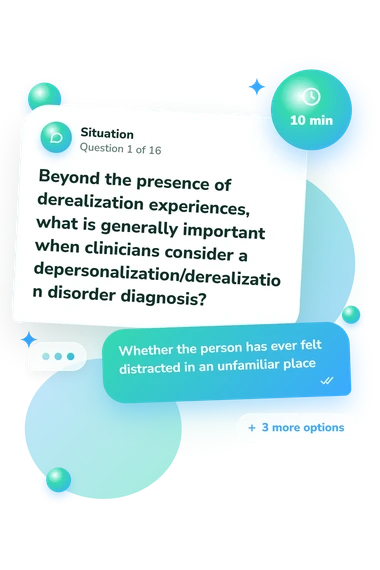
- Whether the person has ever felt distracted in an unfamiliar place
- Whether every episode occurs at precisely the same time of day
- Whether the person uses the exact word “derealization” without prompting
- Whether the experiences cause significant distress or impairment and are not better explained by another cause
- Choose a diagnosis based only on which online description sounds most familiar
- Arrange an assessment with a qualified healthcare or mental health professional
- Ignore the episodes because intact reality testing means they cannot be disruptive
- Use risky physical tests to determine whether the environment is real
Derealization Quiz - Description and methodology of the test
People seeking a clear introduction to episodes in which the world feels unreal may use this derealization quiz to organize core concepts and next-step questions. It is intended for curious readers, people supporting someone else, and anyone preparing to discuss unusual perceptual experiences with a professional. Its depersonalization distinction gives the topic a precise boundary, while the result concerns knowledge rather than symptom endorsement.
What This Assessment Explores
The questionnaire asks whether a reader can recognize derealization as surroundings feeling unreal, distant, dreamlike, flat, or visually altered while reality testing may remain intact. It also checks distinctions from depersonalization, panic-related experiences, psychosis, memory problems, and neurological warning signs.
Someone wondering whether they have derealization may seek a yes-or-no label, but this assessment instead checks definitions, evaluation factors, practical responses, and supportive communication. That framing keeps the focus on understanding rather than self-labeling. It clarifies DPDR distinctions as educational signposts, not evidence that a condition is present.
The result is organized around these thematic groups:
- Recognizing the experience shows whether the reader identifies external-world unreality without confusing it with memory loss or a fixed belief.
- Assessing context indicates understanding that distress, impairment, substances, medication changes, medical factors, and neurological symptoms can alter next steps.
- Applying support principles reflects knowledge of sensory grounding, balanced coping, and help-seeking rather than avoidance or risky checking.
Methodology and Scientific Basis
The items use multiple-choice alternatives built around definitions, brief scenarios, differential distinctions, grounding choices, supportive responses, and urgent-safety decisions. The best option is the one most consistent with the concept being tested, so the total reflects educational knowledge rather than personal symptom frequency or intensity.
The displayed scale is Derealization Knowledge (0-16), with Foundational (0-6), Developing (7-12), and Strong (13-16) bands. Foundational reflects partial recognition of core ideas; Developing shows many essentials with distinctions or support principles to strengthen; Strong reflects broad understanding of derealization and appropriate support.
The framework is conceptually consistent with DSM-5-TR (American Psychiatric Association, 2022), including distinctions involving derealization, depersonalization, distress, impairment, other causes, and reality testing. It is not an adaptation of the Cambridge Depersonalization Scale or SCI-DER; those instruments are comparison points for construct and assessment practice, not this questionnaire’s scoring rule. The bands address knowledge only-not symptoms, severity, or diagnosis-and, because the online measure is unvalidated, a result cannot establish depersonalization disorder; performance may reflect prior reading, wording interpretation, guessing, and attention, while persistent or disruptive experiences need assessment beyond the score.
- American Psychiatric Association. (2022). Diagnostic and Statistical Manual of Mental Disorders, Fifth Edition, Text Revision (DSM-5-TR). American Psychiatric Association Publishing. 10.1176/appi.books.9780890425787
- Sierra, Mauricio, and Berrios, German E. (2000). The Cambridge Depersonalization Scale: a new instrument for the measurement of depersonalization. Psychiatry Research, 93(2), 153-164. 10.1016/S0165-1781(00)00100-1
- Mula, Marco, Pini, Stefano, Calugi, Simona, Preve, Matteo, Masini, Matteo, Giovannini, Ilaria, Conversano, Ciro, Rucci, Paola, and Cassano, Giovanni B. (2008). Validity and reliability of the Structured Clinical Interview for Depersonalization-Derealization Spectrum (SCI-DER). Neuropsychiatric Disease and Treatment, 4(5), 977-986. 10.2147/NDT.S3622