
6th Grade Math Quiz
How the Scales are Structured
Who Usually Takes This Test?
See How You Compare
Below is a preview of how scores are typically distributed across each scale.
Example Questions From the Test
- $10.00
- $12.50
- $15.00
- $18.75
- 9 pages
- 12 pages
- 11 pages
- 10 pages
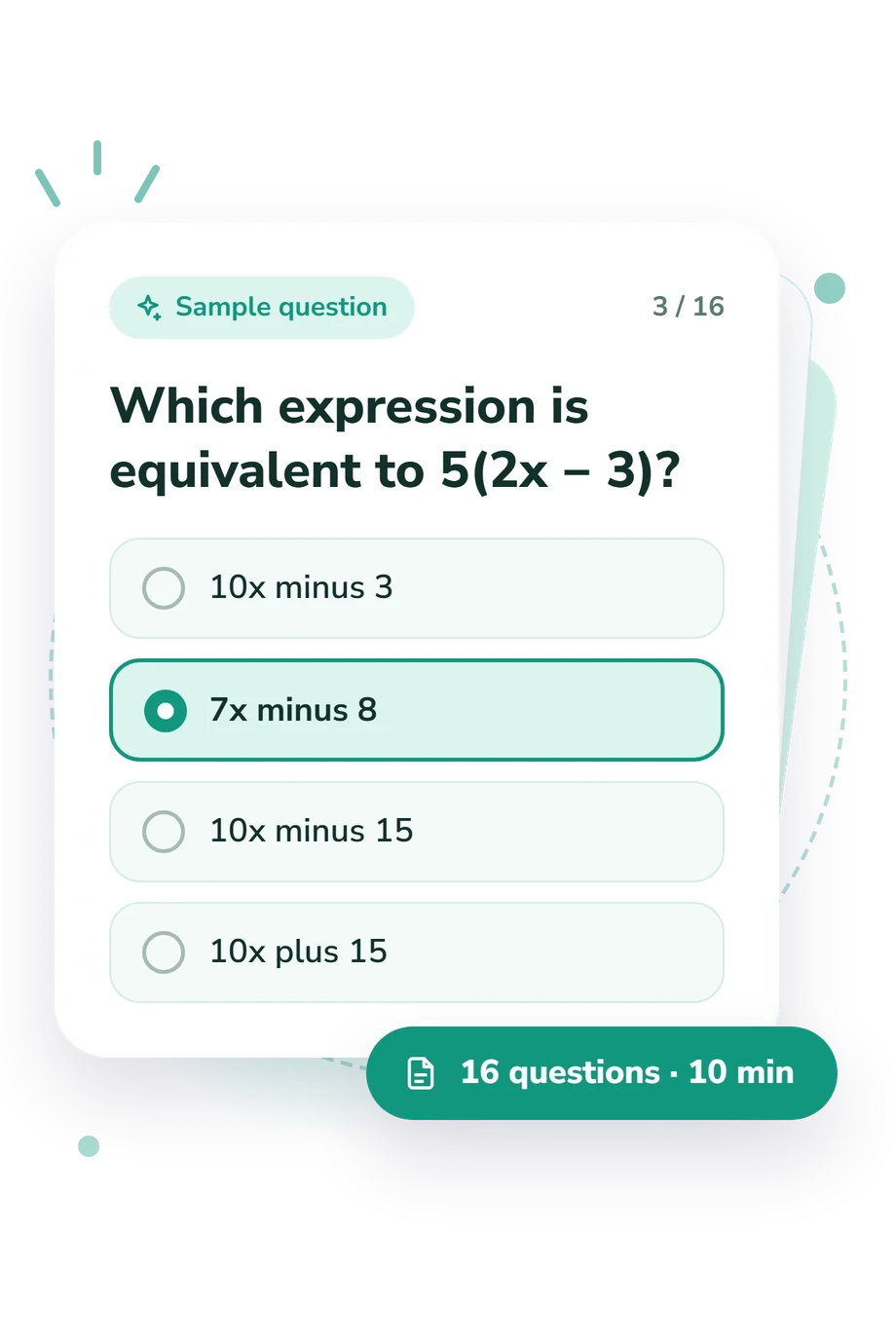
- 10x minus 3
- 7x minus 8
- 10x minus 15
- 10x plus 15
6th Grade Math Quiz - Description and methodology of the test
Students, families, and teachers can use the 6th grade math quiz to sample practical skills and identify topics that deserve review. It works as a math quiz grade 6 learners can use before targeted practice. The result offers a focused snapshot of strengths and possible gaps, helping readers plan revision without treating one short sitting as a complete picture of mathematical ability.
What This Assessment Explores
Across the items, learners apply sixth-grade ideas in practical and symbolic settings. Problems involve money, averages, equivalent expressions, coordinates, decimals, fraction operations, volume, order of operations, probability, common factors, signed numbers, area, rates, equations, comparing fractions, and percentages. This range suits a math quiz for 6th graders because it samples both computation and application rather than a single chapter.
The single displayed scale is 6th Grade Math Knowledge (0-16), and its result bands are:
- Foundations to Review (0-6) indicates that revisiting core operations, fractions, ratios, and basic algebra may be useful.
- Developing Knowledge (7-12) shows understanding of many sampled sixth-grade concepts, while targeted review may improve consistency.
- Strong Knowledge (13-16) reflects strong command of the skills sampled in this quiz, not complete mastery.
For a maths quiz for class 6, this profile supports focused practice by topic instead of a broad, unguided review.
Methodology and Scientific Basis
Each item presents a problem with four answer choices, and the respondent selects the option that best solves it. The content moves among arithmetic, fractions, ratios, algebra, geometry, statistics, and probability. The displayed score counts correct answers across the 16 items; it does not show solution steps or measure speed.
That fixed-choice format makes an online 6th-grade math quiz easy to complete consistently, but guessing, reading errors, or unfamiliarity with one topic can affect the total. A selected answer shows the outcome, not the reasoning behind it.
Content is conceptually aligned with the Common Core mathematics framework (2010), including ratios, rational numbers, expressions, equations, geometry, and data. Fraction coverage is consistent with priorities described by Siegler and colleagues (2010). The National Research Council (2001) presents mathematical proficiency as broader than isolated correct answers, so this result is best read as a snapshot of sampled knowledge and application.
Because the quiz is informal and non-standardized, its bands guide review rather than grade placement or a full curriculum assessment. Comparing results over time is most useful when practice conditions are similar.
- National Governors Association Center for Best Practices, & Council of Chief State School Officers. (2010). Common Core State Standards for Mathematics. Washington, DC: Authors.
- Siegler, Robert, Thomas Carpenter, Francis Fennell, David Geary, James Lewis, Yukari Okamoto, Laurie Thompson, & Jonathan Wray. (2010). Developing Effective Fractions Instruction for Kindergarten Through 8th Grade: A Practice Guide (NCEE 2010-4039). Washington, DC: National Center for Education Evaluation and Regional Assistance, Institute of Education Sciences, U.S. Department of Education.
- National Research Council. (2001). Adding It Up: Helping Children Learn Mathematics. Edited by Jeremy Kilpatrick, Jane Swafford, & Bradford Findell. Washington, DC: National Academies Press. 10.17226/9822
Updated: